


Two pro-democracy Chinese dissidents who smuggled themselves into Taiwan early last year still look to the future with hope, even though they've been waiting for over a year so far to be granted asylum from one of several democratic countries they've applied to, including the US, the UK and Taiwan.
Their stories challenge the rhetoric of democratic countries that they will assist China in building a democracy. They also shine a harsh light on Taiwan's failure to show itself to be a nation built on the principle of human rights, experts said.
Chen Rongli (
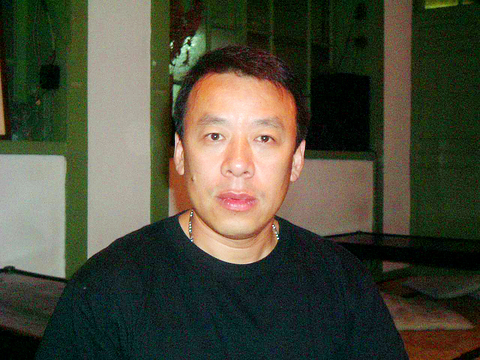
PHOTO: SHIH HSIU-CHUAN, TAIPEI TIMES
Forty-two-year-old Yan Peng (
Despite investigations into their backgrounds that confirmed the two men were political activists in China, the government has only granted them temporary visas.
The nation's top official responsible for relations with China, Joseph Wu (

PHOTO: SHIH HSIU-CHUAN, TAIPEI TIMES
Following the precedent of the case of Tang Yuanjun (唐元雋), a Chinese democracy activist who was sent to the US two months after swimming from a fishing boat to Taiwanese shores to claim asylum in 2002, the government's solution to Chen and Yan's appeals for political asylum has been to search for third countries to accept them.
Over the past year, third countries contacted include the US, the UK, Canada, Australia and France. None has given a positive response to date.
In view of this, some religious workers recently registered the two men as international refugees at the UN, in a bid to speed up the review of their asylum applications through this channel.
Speaking of the experience of waiting for a response to his asylum application, Yan told the Taipei Times that he often feels like a beggar.
"I really appreciate my many Taiwanese friends. Some religious workers are providing me with board and lodging, and the MAC gives me NT$5,000 per month [which was raised to NT$10,000 per month starting this month], but the feeling of uncertainty toward my future has been torture. I don't know how to face the spiritual pressure," Yan said.
Unable to get a job with his temporary visa, which has to be renewed every three months, Yan said that the only thing he can do every day is to walk the streets.
Yan said that the international community's view of China has changed in recent years, with concern over the country's political reform taking a back seat to economic interests.
"There seem to be signs of fear of the CCP [Chinese Communist Party], which makes democratic countries tend to ignore the situation of Chinese pro-democracy dissidents," he said.
Despite this, Yan still believes that external forces can help remove the obstacles blocking China's democratization. He hopes that a third country will accept him and his family members, who are facing police harassment in China.
Chen's experience proves Yan's point about the fear of the CCP.
"As I was in jail for eight years, I would like to begin some short-term studies in Taiwan. With the help of a professor, I applied to a Catholic university, but I was rejected. The professor told me that they [the Catholic Church] want to preach in China and thus turned me down out of fear of provoking the Chinese authorities," Chen told the Taipei Times.
Chen, who just applied for membership at a library close to where he is staying in Taipei, said that he goes there almost every day.
"The subject I am into is philosophy. But later this month I will be moved to another place, and the government told me that there might not be a library nearby," he said.
Unlike Yan, Chen applied for a long-stay visa early this year, but his application was declined, with the government saying that he was ineligible because he had entered the country illegally.
Chen and Yan are now preparing to submit their applications to the government.
"I might choose to go back to China if I fail again. If this democratic world won't open its door for me, I can't keep standing outside," Chen said.
Reviewing the government's attitude in handling Chen's earlier application, Wu Chia-pei (吳佳佩), the director of the Taiwan Association for Human Rights, said the government was shirking its responsibility to provide political asylum.
"It is reasonable that many political refugees have to leave their countries illegally because of government oppression, and thus they can only enter other countries illegally," Wu said.
"People seek asylum either for political reasons or others. Seeking asylum is a human right and every government has the duty to provide asylum," Chiu Huang-chuan (
Provision of asylum is a human-rights concern and involves the exertion of a country's sovereignty, Chiu said.
"If Taiwan fails to provide asylum, it might get a bad record on human rights. The country's sovereign power might also abate as a result," Chiu said.

Considering that most countries issue more than five denominations of banknotes, the central bank has decided to redesign all five denominations, the bank said as it prepares for the first major overhaul of the banknotes in more than 24 years. Central bank Governor Yang Chin-lung (楊金龍) is expected to report to the Legislative Yuan today on the bank’s operations and the redesign’s progress. The bank in a report sent to the legislature ahead of today’s meeting said it had commissioned a survey on the public’s preferences. Survey results showed that NT$100 and NT$1,000 banknotes are the most commonly used, while NT$200 and NT$2,000

The Centers for Disease Control (CDC) yesterday reported the first case of a new COVID-19 subvariant — BA.3.2 — in a 10-year-old Singaporean girl who had a fever upon arrival in Taiwan and tested positive for the disease. The girl left Taiwan on March 20 and the case did not have a direct impact on the local community, it said. The WHO added the BA.3.2 strain to its list of Variants Under Monitoring in December last year, but this was the first imported case of the COVID-19 variant in Taiwan, CDC Deputy Director-General Lin Ming-cheng (林明誠) said. The girl arrived in Taiwan on

South Korea is planning to revise its controversial electronic arrival card, a step Taiwanese officials said prompted them to hold off on planned retaliatory measures, a South Korean media report said yesterday. A Yonhap News Agency report said that the South Korean Ministry of Foreign Affairs is planning to remove the “previous departure place” and “next destination” fields from its e-arrival card system. The plan, reached after interagency consultations, is under review and aims to simplify entry procedures and align the electronic form with the paper version, a South Korean ministry official said. The fields — which appeared only on the electronic form

The Ministry of Foreign Affairs (MOFA) is suspending retaliation measures against South Korea that were set to take effect tomorrow, after Seoul said it is updating its e-arrival system, MOFA said today. The measures were to be a new round of retaliation after Taiwan on March 1 changed South Korea's designation on government-issued alien resident certificates held by South Korean nationals to "South Korea” from the "Republic of Korea," the country’s official name. The move came after months of protests to Seoul over its listing of Taiwan as "China (Taiwan)" in dropdown menus on its new online immigration entry system. MOFA last week


 RSS
RSS