


After the National Assembly ratified the constitutional amendments passed by the legislature last August, a new round of political disputes has begun, especially in the redistricting of constituencies, political observers said yesterday.
"Because of the reduction of the total number of legislative seats, lawmakers from both the bigger and smaller parties are afraid that they might be the next one who will be out of their job," said Swei Duh-ching (
As the constitutional amendments adopt a "single-member district, two-vote" system for legislative elections, the number of constituencies will be increased from the current 29 to 73. The number of legislators will also be halved from 225 to 113, starting in 2008.
As the boundaries of the new constituencies are required by law to be made available to the public one year before the election, political disputes are expected before the dust settles in 2007.
Current procedure
Under the current legislative electoral system -- or parallel system -- voters elect representatives through two different systems: a list proportional representation (PR) system and a plurality/majority system.
Under the list PR system, each party or grouping presents a list of candidates for a multi-member electoral district. Voters select their preferred party, and the parties then receive seats in proportion to their overall share of the vote. The winning candidates are taken from the lists in the order of their position on the lists.
The new "single-member district, two-vote" electoral system, allows the electorate to cast one vote for a candidate and another for a party.
Since the redrawing of constituencies will have a direct and dramatic impact on the next legislative election, political parties have been bickering over who is better suited for the job.
Right for the job?
The Central Election Commission (CEC), the body currently in charge of drawing constituencies, is planning to revamp the Election and Recall Law of Civil Servants (
The law stipulates that the CEC is responsible for delineating constituencies for elections for the National Assembly, the Legislative Yuan, the Taiwan Provincial Consultative Council and municipal councilors.
The biggest party in the legislature, the Democratic Progressive Party (DPP), contends that redistricting for the new legislative electoral system should be conducted by an independent, fair organization, and that the Legislative Yuan should not be involved to ensure impartiality. The party has said the independent body can be the CEC or a newly established entity.
Legislature
Arguing that there is a danger of gerrymandering if the CEC takes on the redrawing of constituencies, the Taiwan Solidarity Union (TSU) said that objectivity and impartiality can only be guaranteed if redistricting is handled by the legislature. The party contends that a redistricting plan that meets the public interest could be mapped out via cross-party negotiations.
The Chinese Nationalist Party (KMT) is trying to take advantage of the pan-blue alliance's numerical edge in the legislature to push for passage of the organic law of the CEC, in which a redistricting committee would be established under the organization to guarantee "objectivity, fairness and impartiality."
The KMT, however, remained evasive about which body should be entrusted with the mission to redraw the new constituencies, or whether the redistricting should be approved by the lawmaking body, saying that everything is negotiable.
The KMT's ally, the People First Party (PFP), said that the matter should be tackled by the legislature and a redistricting committee should be established.
Despite the various arguments put forward by each party, Swei said that he cannot think of any institution in the country that would be suited for the task because different people doing the job will produce a different result.
"When the rules of the game are not accepted by the players, it is very hard to continue the game," he said. "There is no such thing as a perfect electoral system in this world, but there is always an electoral system that is better than the others."
Analyzing the new electoral system, Swei said that he sees it as disadvantageous to smaller parties, independents and Aboriginal lawmakers.
Candidates will be forced to step on their colleagues to be nominated by their own party, and those standing a better chance of winning a party's nomination are likely to have stronger political ideology and radical opinions.
"The electorate, therefore, is left with not much choice but to chose between rascal A of the A party and rascal B of the B party," he said. "The same rule may well be applied to the candidates for at-large lawmakers."
Small parties
Liao Fu-te (廖福特), an assistant research fellow at the Institute of Law Preparatory Office at Academia Sinica, agreed with Swei that the redrawing of constituencies will be one of the hottest debates this year.
He, however, is more optimistic about the future of smaller parties.
"When the size of the constituencies becomes smaller, potential candidates must focus more on regional issues and court regional voters," he said. "Although it is not a bad thing, it is bound to make candidates lose their international perspective."

UPGRADE: The Kang Ding-class frigate is replacing its Chaparall missiles with Tien Chien II and Hua Yang VLS, which would provide it with long-range, 360° air defense Taiwan plans to produce 1,200 to 1,376 Hai Chien II missiles (海劍二, Sea Sword II) — also known as TC-2N — to serve as the standard air defense system of the navy’s surface combatant fleet, a source said yesterday. Last week, the Hai Chien II, the naval version of the Tien Kung II missile (天劍二, Sky Sword II), completed a live-fire test in waters off the National Chungshan Institute of Science and Technology’s Jiupeng facility (九鵬) in Pingtung County’s Manjhou Township (滿州). The MIM72 Chaparral and other dated air defense missiles that currently arm Taiwanese ships have inadequate range to combat Chinese

REASONS FOR TRAVEL: An assistant professor said that proposed amendments to penalize drivers if they used drugs overseas would not deter people from traveling People who operate a motor vehicle under the influence of marijuana would have their driver’s license revoked, even if they used the substance while overseas, the Ministry of Transportation and Communications said yesterday, citing proposed amendments to the Road Traffic Management and Penalty Act (道路交通管理處罰條例). The amendments would also authorize the government to revoke the licenses of people determined to have used Category 1 or Category 2 narcotics, even if they were not operating a vehicle while under the influence of drugs, as well as ban them from taking the license test for three years, the ministry said. People aged 18 or

HEAVY WEATHER: Typhoon Jangmi is due to crash straight into the Ryukyus as airlines look to shift flights to larger aircraft or cancel flights to Okinawa entirely Taiwan’s international air carriers announced flight adjustments over the weekend as Typhoon Jangmi is forecast to hit the Ryukyu Islands today and tomorrow. The Central Weather Administration (CWA) upgraded Jangmi from a tropical storm to a typhoon at 8am yesterday, with the eye located 580km south of Naha city. It was moving north at 19kph. Today, China Airlines’ CI-120, CI-121, CI-122 and CI-123 flights between Taoyuan and Naha, Okinawa, have been canceled as well as CI-132 and CI-133 between Kaohsiung and Naha. EVA Air’s BR-112, BR-113, BR-186 and BR-185 flights between Taoyuan and Naha are also canceled. Low-cost carrier Tigerair Taiwan canceled IT-230,
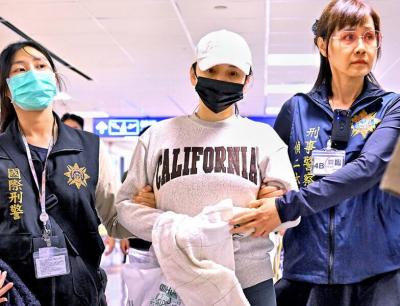
Johanne Liou (劉喬安), a Taiwanese woman who shot to unwanted fame during the Sunflower movement protests in 2014, returned to Taiwan last night after being deported from the US. She is to stand trial in Taiwan for charges involving embezzlement, fraud and drug crimes. The Criminal Investigation Bureau (CIB) said it took her into custody at Taiwan Taoyuan International Airport and would first question her before transferring her to the New Taipei District Prosecutors’ Office. She was arrested upon disembarking a flight from San Francisco that landed shortly before 7pm. Liou absconded to the US in 2019 after jumping bail


 RSS
RSS