

The Taiwan High Court yesterday ruled that Taipei City Government must pay NT$330 million to the former residents of the Tunghsing Building (
Yesterday's verdict said: "City officials were negligent in supervising the building's construction and quality control, so they should be responsible for the catastrophe."
The Tunghsing Building was leveled in the magnitude 7.3 earthquake six years ago, killing 87 people.
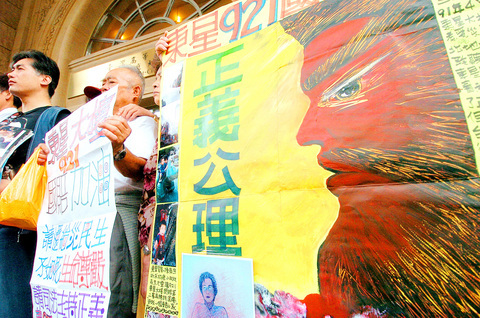
PHOTO: CHIEN JUNG-FENG, TAIPEI TIMES
The ruling
The verdict said 152 victims will be able to receive compensation in the range of NT$1.8 million to NT$ 2.5 million, according to the damages they suffered.
The court's decision said although the National Compensation Law (國賠法) did not apply to this case -- since the company contracted to build the 12-story complex were granted a construction license on February 23, 1981, before the law was implemented on July 1 of that year -- the city government should still pay for damages to the property and well-being of those victims, according to Taiwan's Civil Code.
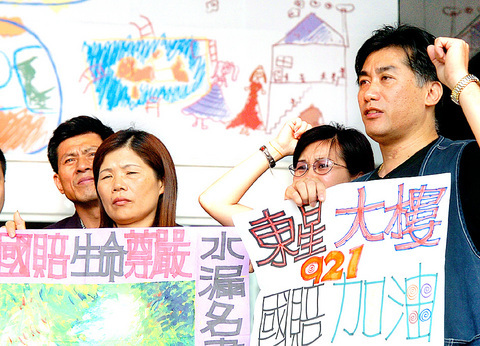
PHOTO: CHIEN JUNG-FENG, TAIPEI TIMESN
City to Appeal?
Taipei Mayor Ma Ying-jeou (
The commissioner of the city government's Bureau of Public Works, William Chen (
"It is unreasonable to lay all the blame on the city government," he said.
Chen said that construction companies and architects, not the city government, should take responsibility for quality control.
The original lawsuit filed by surviving residents demanded NT$1.5 billion in compensation from the city government. In May 2002 the Taipei City District Court ruled the city government must pay NT$480 million in compensation.
More than 20 members of the Tunghsing Building Self-help Association (
Long process
Tsai said the residents requested that the city government not appeal the verdict to the Supreme Court.
"The lawsuit has taken too long," he said. "The residents are so tired, and this should end now."
Time to wrap it up
He said the city government should spend more time tightening security measures for future construction projects and designing regulations to protect human life, rather than fighting the victims in court.
It was a sad story, he said, noting that in some cases all of the members of a family had been killed in the complex during the earthquake.
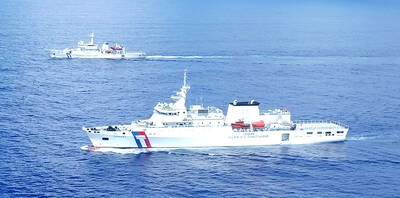
‘FRIENDSHIP FLEET’: A CGA official is scheduled to meet with the president of the Pacific nation, while one of the ships is to host a banquet and National Day event Two Coast Guard Administration (CGA) patrol vessels have docked at Malakal Harbor in Palau as part of an expedition exercise and diplomatic visit, during which a senior official is expected to meet with Palauan President Surangel Whipps Jr, the agency said yesterday. The two vessels, the 4,000-tonne-class Chiayi and the 1,000-tonne-class Penghu, set sail for Palau from Taiwan last week and arrived on Tuesday at Malakal Harbor, the CGA’s Fleet Branch said in a statement. The journey marks the second time the CGA has dispatched a “friendship fleet” to another country, after it sent its first-ever goodwill fleet, comprising the Hualien and
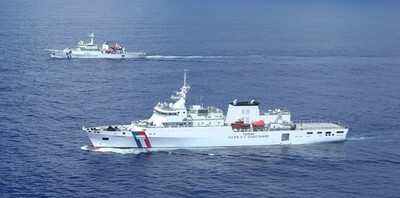
The Coast Guard Administration (CGA) today said that two of its patrol vessels have docked at Palau's Malakal Harbor as part of an expedition exercise and diplomatic visit, during which a senior official is expected to meet with the Palauan president. The two vessels, the 4,000-tonne-class Chiayi (嘉義) and the 1,000-tonne-class Penghu (澎湖), set sail for Palau from Taiwan last week and arrived at Malakal Harbor yesterday, the CGA's Fleet Branch said in a statement. The journey marked the second time the CGA has dispatched a "Friendship Fleet" to another country, after it sent its first-ever goodwill fleet, comprising the Hualien (花蓮)
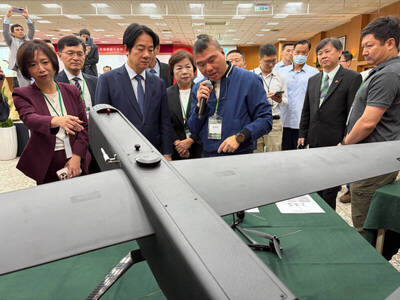
Two executives of drone supplier Jiin Ming Industry Co (錦明實業) have been detained and held incommunicado over the company's alleged use of prohibited China-made chips and camera lenses in drones supplied under recent military contracts, the Taoyuan District Prosecutors' Office said today. In a statement, prosecutors said they raided the offices of Jiin Ming — headquartered in Taoyuan — as well as those of its subsidiaries and its suppliers on Thursday last week. The raids followed a report that the company had breached its procurement contracts by putting the prohibited components into drones delivered to the military. During the raids, prosecutors summoned
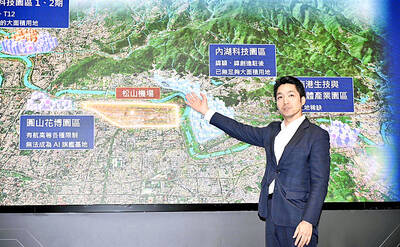
DETAILED PLAN NEEDED: Relocating the airport would affect not just travelers, but also undermine national defense and emergency medical services, a legislator said Taipei Mayor Chiang Wan-an (蔣萬安) yesterday proposed relocating Taipei International Airport (Songshan airport) and turning the site into an artificial intelligence (AI) park, drawing opposition from politicians across party lines. Chiang’s plan would turn the 300 hectares into an AI park featuring tech clusters, residential communities and green space. The industrial cluster would host 200 domestic enterprises, generate NT$12 trillion (US$376.47 billion) in output, and accommodate 65,000 jobs and 35,000 residents, he said. Cabinet spokeswoman Michelle Lee (李慧芝) said the Executive Yuan was surprised by the announcement, as the Taipei City Government did not discuss the proposal with the central government before making


 RSS
RSS