


When Peng Ming-min (彭明敏) co-authored a 1964 manifesto advocating establishment of a new government and a free and democratic nation for the Taiwanese, the concept was not accepted by the then Chinese Nationalist Party (KMT) regime.
Peng has proved to be a visionary, however. Many of the ideas he wrote about 41 years ago in the manifesto, entitled, A Declaration of Formosan Self-Salvation have now either been achieved or have become the mainstream opinion of the majority of the Taiwanese people.
Peng, who currently serves as a senior advisor to the president, has played a pivotal role in the nation's democracy movement and has been regarded as the "godfather of Taiwan's independence movement."
The declaration, considered by many as one most important documents in Taiwan's history, has been lauded by President Chen Shui-bian (陳水扁) as the "beacon leading Taiwan in its path toward democracy."
As a director of the political science department at National Taiwan University during the martial law days, Peng drafted the declaration with two of his students -- Hsieh Tsung-min (謝聰敏) and Wei Ting-chao (魏廷朝) -- and prepared to distribute ten thousands copies.
But the document never got the chance to see the light of day. As soon as printing was completed, Peng and his students were arrested on sedition charges.
"The fact that Peng and his students drafted a discourse on the idea of Taiwan's independence, a risky move at the time, has guaranteed them a place in history," said Chen I-shen (
It wasn't until years later that people had a chance to read the declaration when it was included in Peng's memoir, A Taste of Freedom, published in English in 1972.
The manifesto outlined an analysis of Taiwan's political situation, its prospects for the future and its status in the international community.
It highlighted eight main issues, including: the fact that China and Taiwan are separate must be legally recognized; it is impossible to retake the mainland; attempts to retake the mainland only serve as an excuse to perpetuate the KMT regime; and the KMT represents neither China nor Taiwan.
The declaration also fleshed out three basic objectives: to establish a new state with a new government, create a new constitution, and join the UN as a new member state.
"Upon the writing of the final draft after so many months of discussion and indirect debate, we were exhilarated and filled with a sense of success. But we were conscious that we were walking a dangerous path. Life seemed to have taken on a new meaning," Peng recalled in his memoirs.
"The obstacles in our path were dwarfed by the magnitude of the effect we hoped this manifesto might have upon the lives of ten million Formosans and upon the refugees from the mainland living among us," said Peng in the memoir. "If our manifesto generated debate in every community, it would prepare the way for popular support for an overt attempt to break up the party dictatorship and destroy the stranglehold of the secret police system."
Born into a doctor's family during the Japanese colonial era, Peng was entranced by French literature in his youth.
He spent the years of World War II studying in Japan and was seriously wounded during a US bombing raid just one day before he could reach the relative safety of his brother's home near Nagasaki.
Peng returned to Taiwan and completed his education at National Taiwan University. He turned from the pleasures of French culture to a legal aspects of air navigation.
According to George H. Kerr, who wrote the foreword for Peng's memoir, "[Peng] soon made himself a local authority [in air navigation], attracting the attention of his faculty and winning the patronage of the distinguished scholar Dr. Hu Shih (
"[Peng] was sent abroad to study, first to Montreal and then to Paris. Here he distinguished himself as a pioneer in the new field of law, and his technical publications attracted considerable international attention," Kerr wrote.
Before drafting the declaration, Peng had been appointed as legal adviser to the KMT at the UN. Political realities at the UN strengthened Peng in his conviction that there is one China and one Taiwan.
In November 1965, Peng was convicted of sedition and sentenced to eight years in prison, but his sentence was later commuted to house arrest, where he was placed under 24-hour surveillance. In 1970, he escaped from Taipei and took political asylum in Sweden.
Out of consideration for the safety of those who helped him escape, Peng has never openly discussed the episode.
Peng later moved his place of exile to the US until 1992, when he returned to Taiwan following the lifting of martial law.
Paired with Frank Hsieh (謝長廷) as his running mate, Peng ran for president under the Democratic Progressive Party (DPP) banner in 1996 during the nation's first direct presidential election. The Peng-Hsieh ticket then garnered about 21.1 percent of the vote.
In the decades after the drafting of his declaration, Peng remains devoted to his beliefs and continues to speak out for the right to self-determination of the Taiwanese people.
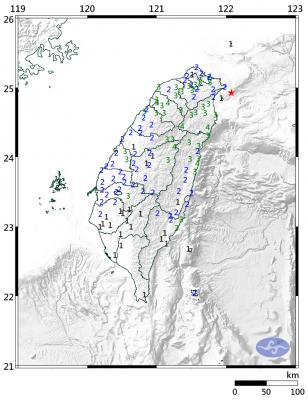
A magnitude 6.1 earthquake struck off the coast of Yilan County at 8:39pm tonight, the Central Weather Administration (CWA) said, with no immediate reports of damage or injuries. The epicenter was 38.7km east-northeast of Yilan County Hall at a focal depth of 98.3km, the CWA’s Seismological Center said. The quake’s maximum intensity, which gauges the actual physical effect of a seismic event, was a level 4 on Taiwan’s 7-tier intensity scale, the center said. That intensity level was recorded in Yilan County’s Nanao Township (南澳), Hsinchu County’s Guansi Township (關西), Nantou County’s Hehuanshan (合歡山) and Hualien County’s Yanliao (鹽寮). An intensity of 3 was
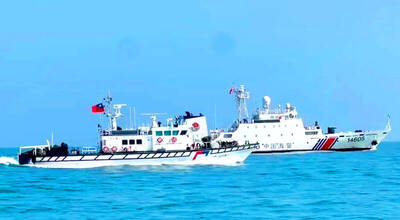
Instead of focusing solely on the threat of a full-scale military invasion, the US and its allies must prepare for a potential Chinese “quarantine” of Taiwan enforced through customs inspections, Stanford University Hoover fellow Eyck Freymann said in a Foreign Affairs article published on Wednesday. China could use various “gray zone” tactics in “reconfiguring the regional and ultimately the global economic order without a war,” said Freymann, who is also a nonresident research fellow at the US Naval War College. China might seize control of Taiwan’s links to the outside world by requiring all flights and ships entering or leaving Taiwan
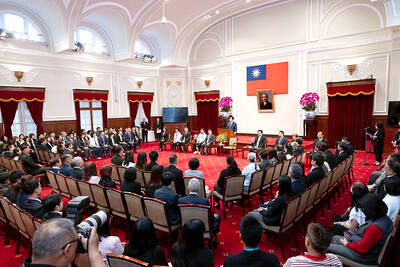
The next minimum wage hike is expected to exceed NT$30,000, President William Lai (賴清德) said yesterday during an award ceremony honoring “model workers,” including migrant workers, at the Presidential Office ahead of Workers’ Day today. Lai said he wished to thank the awardees on behalf of the nation and extend his most sincere respect for their hard work, on which Taiwan’s prosperity has been built. Lai specifically thanked 10 migrant workers selected for the award, saying that although they left their home countries to further their own goals, their efforts have benefited Taiwan as well. The nation’s industrial sector and small businesses lay
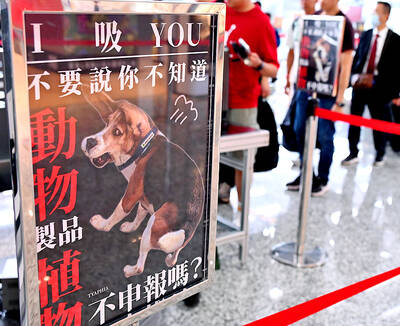
Quarantine awareness posters at Taiwan Taoyuan International Airport have gone viral for their use of wordplay. Issued by the airport branch of the Animal and Plant Health Inspection Agency, the posters feature sniffer dogs making a range of facial expressions, paired with advisory messages built around homophones. “We update the messages for holidays and campaign needs, periodically refreshing materials to attract people’s attention,” quarantine officials said. “The aim is to use the dogs’ appeal to draw focus to quarantine regulations.” A Japanese traveler visiting Taiwan has posted a photo on X of a poster showing a quarantine dog with a


 RSS
RSS