


US congressmen have launched a signature drive urging US President George W. Bush to review the longstanding "one China" policy, a Democratic Progressive Party (DPP) lawmaker said yesterday.
"While China has become the US government's biggest enemy after the end of the Cold War and the fall of the Soviet Union, many US congressmen have been wondering whether the `one China' policy makes sense any more and whether it is necessary to re-examine, or even better yet, revise it to a `one China, one Taiwan' policy," DPP Legislator Chiang Chao-yi (
He was quoting US congressmen, who are members of the pro-Taiwan sub-group in the US Congress -- the Taiwan Caucus.
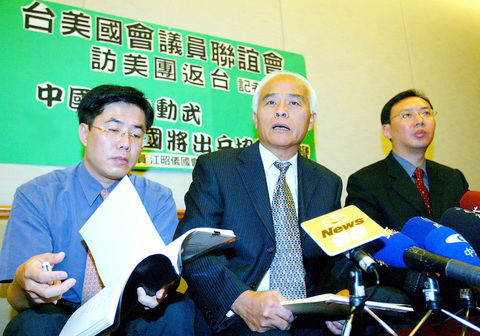
PHOTO: WANG YI-SOONG
Chiang made the remark yesterday morning in the legislature after returning from his six-day trip to the US, where he met with think tank experts, congressmen and officials from the National Security Council, Department of Defense and State Department, including Deputy Assistant Secretary of State Randall Shriver.
According to Chiang, Shriver told the 10-person visiting group during a breakfast meeting last Monday that the US will deal with contingencies in the Taiwan Strait in compliance with the Taiwan Relations Act.
Shriver also told the group that China is not as strong as it seems but rather weak, because Beijing had sent officials to Washington twice before the "Anti-Secession" Law was adopted on March 14 in an attempt to convince the US of its validity.
In addition to warning Beijing about the consequences of enacting the law, Chiang said that the US government has made it very clear that such legislation would be unhelpful and a step in the wrong direction.
Delegation members were also present at a hearing in the House International Relations Committee last Wednesday, when Shriver addressed the passage of the "Anti-Secession" Law and its impact on cross-strait and US-China relations.
During the hearing, Chiang said, Shriver outlined the US government's efforts to let Beijing know their views of the legislation.
The efforts included the meeting between former deputy secretary Richard Armitage and director of China's Taiwan Affairs Office Chen Yunlin (
In a February visit to Beijing, National Security Council Senior Director for Asian Affairs Michael Green told Chinese leaders that passage of the legislation would undermine cross-strait stability.
The US ambassador to Beijing also urged China not to pass the legislation on the eve of the ratification vote by the National People's Congress, Chiang quoted Shriver as saying.
After talking with members of the US National Security Council, members of congress and think tank experts, Chiang said that most of them agreed that Beijing eventually opted to ignore the US warnings and forge ahead with the enactment of the controversial law because it was under a tremendous amount of pressure at home.
"In the face of rampant corruption, the huge gap between the rich and the poor as well as Chinese people's increasing distrust of the Chinese Communist Party, Chinese President Hu Jintao (
When asked to comment on Chinese National Party (KMT) Vice Chairman Chiang Pin-kun's (
"They think that the KMT puts its own future at stake and runs counter to the will of the Taiwanese people, because more than 90 percent of the people of Taiwan are opposed to the Anti-Secession Law," heg said.
"They also think that what the KMT is doing is unbelievable, because it used to educate the public about the evils of communism during its 50-year reign, but now they, as an opposition party, are sucking up to the CCP," he said.
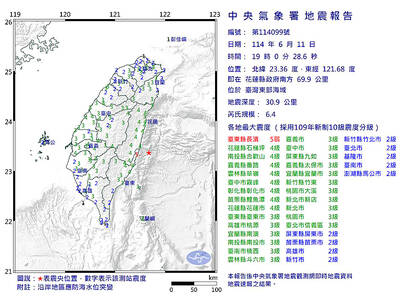
A magnitude 6.4 earthquake struck off the coast of Hualien County in eastern Taiwan at 7pm yesterday, the Central Weather Administration (CWA) said. The epicenter of the temblor was at sea, about 69.9km south of Hualien County Hall, at a depth of 30.9km, it said. There were no immediate reports of damage resulting from the quake. The earthquake’s intensity, which gauges the actual effect of a temblor, was highest in Taitung County’s Changbin Township (長濱), where it measured 5 on Taiwan’s seven-tier intensity scale. The quake also measured an intensity of 4 in Hualien, Nantou, Chiayi, Yunlin, Changhua and Miaoli counties, as well as

Credit departments of farmers’ and fishers’ associations blocked a total of more than NT$180 million (US$6.01 million) from being lost to scams last year, National Police Agency (NPA) data showed. The Agricultural Finance Agency (AFA) said last week that staff of farmers’ and fishers’ associations’ credit departments are required to implement fraud prevention measures when they serve clients at the counter. They would ask clients about personal financial management activities whenever they suspect there might be a fraud situation, and would immediately report the incident to local authorities, which would send police officers to the site to help, it said. NPA data showed

ENERGY RESILIENCE: Although Alaska is open for investments, Taiwan is sourcing its gas from the Middle East, and the sea routes carry risks, Ho Cheng-hui said US government officials’ high-profile reception of a Taiwanese representative at the Alaska Sustainable Energy Conference indicated the emergence of an Indo-Pacific energy resilience alliance, an academic said. Presidential Office Secretary-General Pan Men-an (潘孟安) attended the conference in Alaska on Thursday last week at the invitation of the US government. Pan visited oil and gas facilities with senior US officials, including US Secretary of the Interior Doug Burgum, US Secretary of Energy Chris Wright, Alaska Governor Mike Dunleavy and US Senator Daniel Sullivan. Pan attending the conference on behalf of President William Lai (賴清德) shows a significant elevation in diplomatic representation,
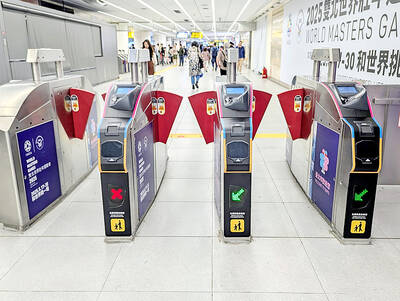
The Taipei MRT is to begin accepting mobile payment services in the fall, Taipei Rapid Transit Corp said on Saturday. When the company finishes the installation of new payment units at ticketing gates in October, MRT passengers can use credit cards, Apple Pay, Google Pay and Samsung Pay, the operator said. In addition, the MRT would also provide QR payment codes — which would be compatible with Line Pay, Jkopay, iPass Money, PXPay Plus, EasyWallet, iCash Pay, Taiwan Pay and Taishin Pay — to access the railway system. Currently, passengers can access the Taipei MRT by buying a single-journey token or using EasyCard,


 RSS
RSS