


The Democratic Progressive Party (DPP) yesterday said that the Chinese Nationalist Party's (KMT) delegation to China has downgraded Taiwan's sovereignty and betrayed mainstream public opinion.
KMT Vice Chairman Chiang Pin-kun (江丙坤) yesterday led a group of KMT officials and lawmakers to pay their respects at the 72 Martyrs Mausoleum, commemorating those who died in an unsuccessful revolt against the Qing Dynasty in Guangzhou in 1911.
DPP Secretary-General Lee Yi-yang (李逸洋) said yesterday it was an inappropriate and unwise analogy for the KMT to say that the trip was a "third round" of cooperation between the KMT and Beijing, which has degraded Taiwan's sovereignty and deviated from mainstream public opinion.
"I felt sorry for Chiang because he should not bring the national flag of the Republic of China or KMT's party flag to China," Lee said. "Is it acceptable for the KMT to sacrifice its dignity just because it wants to get into the good graces of the Chinese Communist Party?"
"How could the people of Taiwan believe that the KMT would defend Taiwan after seeing how readily it surrenders its dignity?" Lee said.
"We urge the KMT to be cautious about their words and deeds in China," he said.
Lee also said that the DPP welcomes any kind of cross-strait dialogue, but it against the KMT making agreements with China on behalf of the Taiwanese people without the government's authorization.
Chiang yesterday greeted hundreds of people visiting the memorial for the 72 activists killed in the 1911 uprising months before revolutionaries overthrew China's last imperial dynasty.
Reporters swarmed Chiang and his 30-member delegation as they placed wreaths at the shrine and bowed.
"Although the two sides are currently in a political standoff, we love freedom and peace. We appreciate economic development," Chiang said.
"We can enjoy this situation because the sacrifices of these martyrs eventually led to a good result," Chiang said as he wept while commending the martyrs.
Chiang later arrived in the former ROC capital of Nanjing. He was greeted at the Nanjing airport by Chinese officials and Taiwanese businesspeople.
He planned to visit the tomb of Nationalist founder Sun Yat-sen (孫中山), honored by both Taiwan and Beijing for leading the movement that ended imperial rule.
Chinese state media yesterday hailed the KMT's visit, one day before Chiang is scheduled to meet Communist Party officials in Beijing.
The China Daily, the government's official English-language daily, said Chiang was making the first formal visit by KMT leaders since 1949, when the party left China after losing a civil war to the communists.


An essay competition jointly organized by a local writing society and a publisher affiliated with the Chinese Communist Party (CCP) might have contravened the Act Governing Relations Between the People of the Taiwan Area and the Mainland Area (臺灣地區與大陸地區人民關係條例), the Mainland Affairs Council (MAC) said on Thursday. “In this case, the partner organization is clearly an agency under the CCP’s Fujian Provincial Committee,” MAC Deputy Minister and spokesperson Liang Wen-chieh (梁文傑) said at a news briefing in Taipei. “It also involves bringing Taiwanese students to China with all-expenses-paid arrangements to attend award ceremonies and camps,” Liang said. Those two “characteristics” are typically sufficient
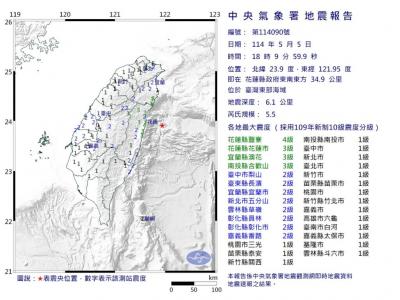
A magnitude 5.9 earthquake that struck about 33km off the coast of Hualien City was the "main shock" in a series of quakes in the area, with aftershocks expected over the next three days, the Central Weather Administration (CWA) said yesterday. Prior to the magnitude 5.9 quake shaking most of Taiwan at 6:53pm yesterday, six other earthquakes stronger than a magnitude of 4, starting with a magnitude 5.5 quake at 6:09pm, occurred in the area. CWA Seismological Center Director Wu Chien-fu (吳健富) confirmed that the quakes were all part of the same series and that the magnitude 5.5 temblor was

The brilliant blue waters, thick foliage and bucolic atmosphere on this seemingly idyllic archipelago deep in the Pacific Ocean belie the key role it now plays in a titanic geopolitical struggle. Palau is again on the front line as China, and the US and its allies prepare their forces in an intensifying contest for control over the Asia-Pacific region. The democratic nation of just 17,000 people hosts US-controlled airstrips and soon-to-be-completed radar installations that the US military describes as “critical” to monitoring vast swathes of water and airspace. It is also a key piece of the second island chain, a string of
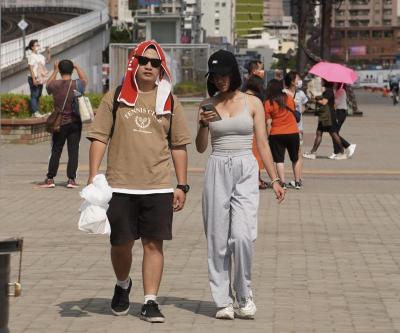
The Central Weather Administration has issued a heat alert for southeastern Taiwan, warning of temperatures as high as 36°C today, while alerting some coastal areas of strong winds later in the day. Kaohsiung’s Neimen District (內門) and Pingtung County’s Neipu Township (內埔) are under an orange heat alert, which warns of temperatures as high as 36°C for three consecutive days, the CWA said, citing southwest winds. The heat would also extend to Tainan’s Nansi (楠西) and Yujing (玉井) districts, as well as Pingtung’s Gaoshu (高樹), Yanpu (鹽埔) and Majia (瑪家) townships, it said, forecasting highs of up to 36°C in those areas


 RSS
RSS