


The government's commitment to collaborative research projects in information and communication technologies (ICT) makes Taiwan an ideal partner for the EU, European representatives said yesterday in Taipei.
They told a press conference that a 2005 Euro-Taiwan ICT Cooperation Event would be held from April 27 to April 30 in Taipei and Hsinchu.
The event is a result of Taiwan's first official scientific collaboration agreement signed by the National Science Council in 2003 with the Directorate-General Information Society of the European Commission.
The commission encourages Taiwanese researchers to participate in collaborative projects involving EU's Sixth Framework Program, which sets out the priorities, including the Information Society Technologies (IST) priority, for the period from 2002 to 2006.
Since late last year, the EU has worked closely with the council in a bid to strengthen the participation of Taiwanese universities, institutes and organizations in its future research projects through a well-designed mechanism known as the GAPFILL project.
The project aims to develop scientific and technological cooperation between Europe and Asia in the ICT field. It is currently financed by the European Commission's IST Program.
Roger Torrenti, GAPFILL project advisor and chief executive officer of Sigma Consultants, said at the press conference yesterday that well-functioning national institutions promoting scientific research in four Asian countries, including Taiwan, make the EU believe that strengthening relations with scientists in these countries might result in productive outcomes from collaborative research projects.
"The GAPFILL project is not designed for Taiwanese organizations to propose financial support only. We do need specific skills Taiwanese research organizations have in ICT fields," Torrenti said.
Generally, the EU aims to promote ICT in diverse fields, such as health, optoelectronics, info-telecommunications, micro and nano-based subsystems, advanced grid technologies and environment risk management, he said.
"Many EU members have worked on tsunami-related issues. If Taiwan has special skills pertaining to natural disaster prevention, that would be perfect," Torrenti said.
The EU is Taiwan's fourth-largest trading partner, accounting for 12 percent of Taiwan's external trade.
Brian McDonald, head of the European Economic and Trade Office, said that collaborative scientific projects should be further strengthened as relations between the two sides have deepened because of the growing amount of investment.
Deputy Minister of the National Science Council Shieh Ching-jyh (
"Being selected by the EU as one of its major collaborative targets this year demonstrates that Taiwan's high-tech achievement in the past has drawn the world's attention," Shieh said.
"The GAPFILL projects will also improve Taiwan's relationships in the international community," he said.
Since last December, 110 research proposals involving ICT in the fields of health, biotechnology and cyber technologies have been filed with the council for GAPFILL consideration.
Research centers and private companies in the EU have proposed about 50 possible projects linked to Taiwan.

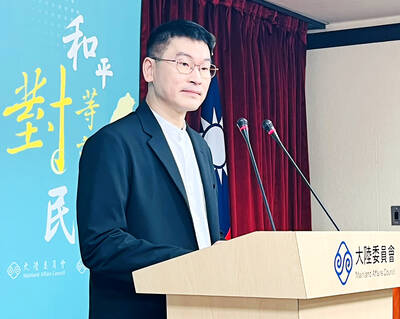
An essay competition jointly organized by a local writing society and a publisher affiliated with the Chinese Communist Party (CCP) might have contravened the Act Governing Relations Between the People of the Taiwan Area and the Mainland Area (臺灣地區與大陸地區人民關係條例), the Mainland Affairs Council (MAC) said on Thursday. “In this case, the partner organization is clearly an agency under the CCP’s Fujian Provincial Committee,” MAC Deputy Minister and spokesperson Liang Wen-chieh (梁文傑) said at a news briefing in Taipei. “It also involves bringing Taiwanese students to China with all-expenses-paid arrangements to attend award ceremonies and camps,” Liang said. Those two “characteristics” are typically sufficient
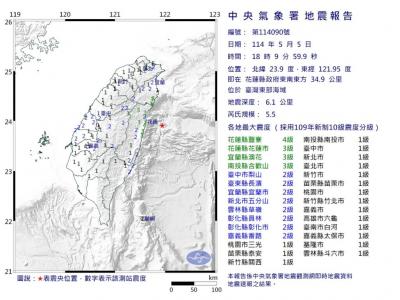
A magnitude 5.9 earthquake that struck about 33km off the coast of Hualien City was the "main shock" in a series of quakes in the area, with aftershocks expected over the next three days, the Central Weather Administration (CWA) said yesterday. Prior to the magnitude 5.9 quake shaking most of Taiwan at 6:53pm yesterday, six other earthquakes stronger than a magnitude of 4, starting with a magnitude 5.5 quake at 6:09pm, occurred in the area. CWA Seismological Center Director Wu Chien-fu (吳健富) confirmed that the quakes were all part of the same series and that the magnitude 5.5 temblor was
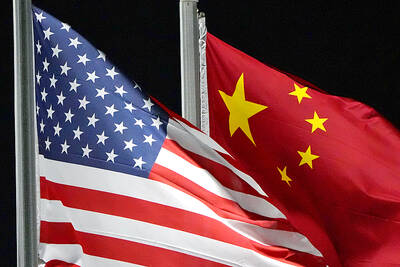
The brilliant blue waters, thick foliage and bucolic atmosphere on this seemingly idyllic archipelago deep in the Pacific Ocean belie the key role it now plays in a titanic geopolitical struggle. Palau is again on the front line as China, and the US and its allies prepare their forces in an intensifying contest for control over the Asia-Pacific region. The democratic nation of just 17,000 people hosts US-controlled airstrips and soon-to-be-completed radar installations that the US military describes as “critical” to monitoring vast swathes of water and airspace. It is also a key piece of the second island chain, a string of
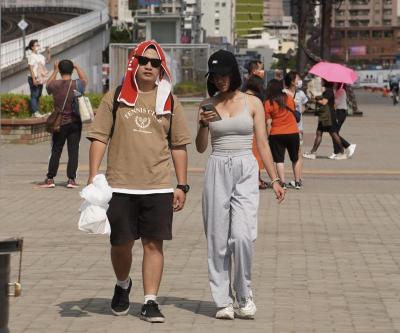
The Central Weather Administration has issued a heat alert for southeastern Taiwan, warning of temperatures as high as 36°C today, while alerting some coastal areas of strong winds later in the day. Kaohsiung’s Neimen District (內門) and Pingtung County’s Neipu Township (內埔) are under an orange heat alert, which warns of temperatures as high as 36°C for three consecutive days, the CWA said, citing southwest winds. The heat would also extend to Tainan’s Nansi (楠西) and Yujing (玉井) districts, as well as Pingtung’s Gaoshu (高樹), Yanpu (鹽埔) and Majia (瑪家) townships, it said, forecasting highs of up to 36°C in those areas


 RSS
RSS