


What would prompt a famous doctor to put aside his stellar career, step out of the hospital, and embark on the difficult road of bettering the country's health policy? That was the question on everyone's mind when the renowned orthopedist Hou Sheng-mou (
The question is even more perplexing, given the fact that Hou took the post at a time of crisis. Before Hou became the DOH's deputy director-general last December, the health authority was already reeling under the financial woes of the National Health Insurance (NHI) system. The NT$4.3 billion safety reserve for the universal insurance program was expected to be used up by next month. The NT$12.8 billion annual deficit was expected to edge higher. And the citizen panel the DOH recruited to discuss possible solutions last month spurned the official proposal to raise insurance premiums.
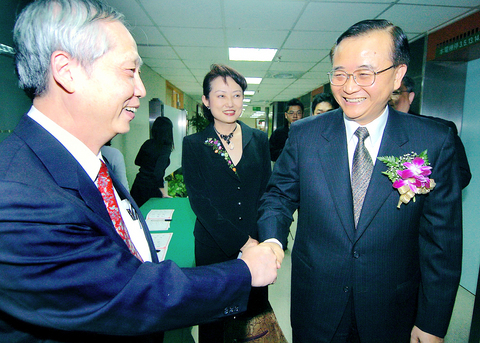
TAIPEI TIMES FILE PHOTO
The situation was made pricklier when the new Premier Frank Hsieh (
Hou knows well that fixing the troubled health system will be the most arduous task he's ever attempted.
"It is like a seriously ill ten-year-old boy," he said. "We need to examine him first and prescribe drugs. And if that doesn't work, we need further treatments or even major operation."
One of the fastest-rising stars in the nation's medical profession, Hou excels not only as an orthopedic surgeon but also in hospital management. At the age of 42, Hou became Taiwan's youngest hospital superintendent and brought record-breaking profits to the DOH-funded Taipei Hospital in Singhuang, Taipei County. Later, Hou honed his administrative skills during his term as deputy superintendent at the prestigious National Taiwan University Hospital and director of educational affairs at the university.
His academic achievements also earned him the position of dean of NTU's school of medicine and the Delta Omega Honor Society Award from Johns Hopkins University. A member of the American Osteopathic Association, Hou is one of the few Taiwanese medical academics who has publish papers in the association's journal.
In his tenure at NTU Hospital, Hou also cultivated strong political ties. When heavyweight doctors vied to become the hospital's superintendent in July, Hou was deemed the candidate with the best shot at the job. Hou grabbed more media attention when he became an instructor to President Chen Shui-bian's (
With his abundance of administrative and medical talent, and political connections, it's hard to find someone who can rival Hou. And yet all of that skill and talent may not be enough to fix the tottering NHI. Hou himself admitted that he has little experience with managing the system.
"NHI is really a hot potato. I'm a new student who has just started to learn this ultra-complicated system," he said. "I've spent every minute I can spare on pondering how to keep the NHI program afloat."
Can the doctor-turned-official cure the nation's ailing health system? It's a question that Hou will spend his term answering.


UPGRADE: The Kang Ding-class frigate is replacing its Chaparall missiles with Tien Chien II and Hua Yang VLS, which would provide it with long-range, 360° air defense Taiwan plans to produce 1,200 to 1,376 Hai Chien II missiles (海劍二, Sea Sword II) — also known as TC-2N — to serve as the standard air defense system of the navy’s surface combatant fleet, a source said yesterday. Last week, the Hai Chien II, the naval version of the Tien Kung II missile (天劍二, Sky Sword II), completed a live-fire test in waters off the National Chungshan Institute of Science and Technology’s Jiupeng facility (九鵬) in Pingtung County’s Manjhou Township (滿州). The MIM72 Chaparral and other dated air defense missiles that currently arm Taiwanese ships have inadequate range to combat Chinese

REASONS FOR TRAVEL: An assistant professor said that proposed amendments to penalize drivers if they used drugs overseas would not deter people from traveling People who operate a motor vehicle under the influence of marijuana would have their driver’s license revoked, even if they used the substance while overseas, the Ministry of Transportation and Communications said yesterday, citing proposed amendments to the Road Traffic Management and Penalty Act (道路交通管理處罰條例). The amendments would also authorize the government to revoke the licenses of people determined to have used Category 1 or Category 2 narcotics, even if they were not operating a vehicle while under the influence of drugs, as well as ban them from taking the license test for three years, the ministry said. People aged 18 or
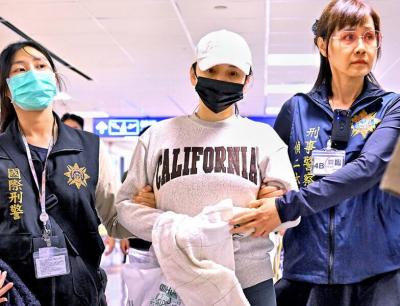
Johanne Liou (劉喬安), a Taiwanese woman who shot to unwanted fame during the Sunflower movement protests in 2014, returned to Taiwan last night after being deported from the US. She is to stand trial in Taiwan for charges involving embezzlement, fraud and drug crimes. The Criminal Investigation Bureau (CIB) said it took her into custody at Taiwan Taoyuan International Airport and would first question her before transferring her to the New Taipei District Prosecutors’ Office. She was arrested upon disembarking a flight from San Francisco that landed shortly before 7pm. Liou absconded to the US in 2019 after jumping bail
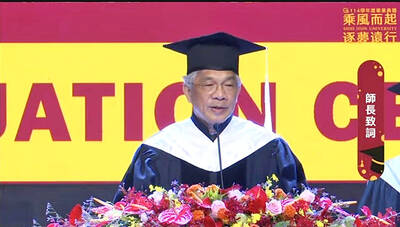
Shih Hsin University President Chen Ching-he (陳清河) yesterday issued a public apology for comments made in his commencement speech last week, stating that he has asked the school to suspend his duties and halt his wages for two months as a show of contrition. At the commencement ceremony on May 30, Chen said, “If you don’t manage your time well, or your own emotions, or your health, then I am telling every one of you — put a quick end to ‘you,’ because the world has no need for ‘you.’” The comments have sparked significant controversy online, and Chen through an open


 RSS
RSS