


For people in Taiwan, Lunar New Year involves a set of familiar routines: families have a big feast together on New Year's eve, and people go visit and offer goodwill to their relatives during this time.
But for those who spend New Year abroad, these familiar routines may not be possible and when some lawmakers reminisced about holidays spent abroad, many mixed feelings came up.
Newly elected Chinese Nationalist Party (KMT) Legislator Kung Wen-chi (
Kung is an Aborigine and received his doctoral degree from Loughborough University in the UK in 1997, on an aboriginal scholarship from the government.
During his second year in the UK, he rented a house from a Pakistani man and shared the place with some Chinese students. They also lived with the landlord.
cultural conflicts
Kung said there was one New Year when he and his Chinese housemates invited friends over and dined together. Since Chinese people always prepare pork for the Lunar New Year feast, they got into argument with their Muslim landlord.
"The landlord was unhappy about us cooking pork and he said the smell might cause some conflicts between him and his friends who visit. But at the same time we Chinese are used to eating pork, so it was a dilemma caused by cultural differences," Kung said.
agreement
"Later on, we came to an agreement with the landlord that every time we bought pork, we would cook it right away so that no pork would be stored in the common fridge. We would also try to keep the pork smell to a minimum. The arrangement worked fine and we got on with the landlord from that point," he said.
Kung said that when he brought his family back to the UK last year to travel around, they also returned to the house to visit the Pakistani landlord and his wife.
For others, although the New Year is a time for celebration, there are also sad memories involved.
Newly elected Democratic Progressive Party (DPP) Legislator Sue Huang (黃淑英), who lived in the US from 1979 to 1992, recalled a time when Lunar New Year gatherings held by overseas Taiwanese were good opportunities for the old KMT administration to monitor "dissidents'" whereabouts.
Martial law era
"Back in the martial law period, the Lunar New Year for many blacklisted Taiwanese was really a time of sadness: they had been abroad for a long time, and the Taiwanese traditional holidays would make them miss and think of Taiwan," Huang said.
Huang said that during the early 1990s, blacklisted "dissidents" started to slip back to Taiwan. There was one year when Stella Chen (
"So in the New Year gathering that year, disguised KMT agents circulated around the gathering and asked people about Chen's whereabouts, and even I got questioned," Huang said.
"But I wasn't aware that the agents were fishing for specific information, and I only realized what really had happened afterwards. It was a sad incident," she said.
The most interesting and bizarre incidents lawmakers can recall about their overseas experiences, though, mostly happened in their day-to-day lives.
New Taiwan Solidarity Union (TSU) caucus whip Lo Chih-ming (
Taiwan advantage
"Luckily it was a time when Taiwan excelled in the manufacturing of computer peripherals. To get a spot in the computer room, I would make a bet with a local student who was using a computer that he would give his spot to me if all the keyboards in the room were made in Taiwan," Lo said.
"Every time I placed such a wager, even in different places, I always got a spot in the computer room," he said, chuckling.
New DPP caucus whip Lai Ching-te (賴清德), who spent four consecutive summers -- ?from 1999 to 2002 -- at Harvard University in the US to get his master's degree in public health, told what was probably the most bizarre story caused by cultural differences.
He said that there was one time he went to Arizona to visit an Indian tribe, and he saw a pig with a wooden leg. He became curious and asked the man who owned the pig what had happened.
Pig tales
Lai said that the owner told him that the pig came and pushed at his front gate one night when a fire had broken out, and the family managed to escape the fire due to the pig's warning.
Lai then asked whether the pig had lost the leg during the incident, but the man said no.
Lai again asked what had happened to the pig, but the man became a bit angry and told him of another incident instead.
"The man said there was another time when his daughter was playing in the middle of the road, and a car appeared, going quite quickly toward his daughter. But the pig appeared and shoved the little girl to the side of the road and she avoided being hit by the car," Lai said.
"So I asked the man whether the pig lost his leg in the incident, but the man again said no and got really angry. He yelled, `Hey! How could you say anything like that! For such a good pig as this, of course when we want to eat it, we can only eat a leg at one time!" Lai said.
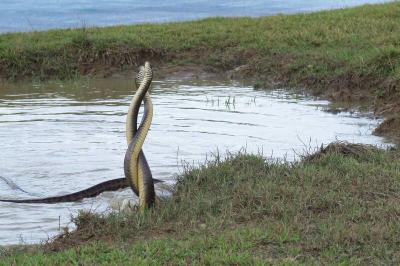
Kenting National Park service technician Yang Jien-fon (楊政峰) won a silver award in World Grand Prix Photography Awards Spring Season for his photograph of two male rat snakes intertwined in combat. Yang’s colleagues at Kenting National Park said he is a master of nature photography who has been held back by his job in civil service. The awards accept entries in all four seasons across six categories: architectural and urban photography, black-and-white and fine art photography, commercial and fashion photography, documentary and people photography, nature and experimental photography, and mobile photography. Awards are ranked according to scores and divided into platinum, gold and

The Chinese Nationalist Party (KMT) caucus yesterday said it opposes the introduction of migrant workers from India until a mechanism is in place to prevent workers from absconding. Minister of Labor Hung Sun-han (洪申翰) on Thursday told the Legislative Yuan that the first group of migrant workers from India could be introduced as early as this year, as part of a government program. The caucus’ opposition to the policy is based on the assessment that “the risk is too high,” KMT caucus secretary-general Lin Pei-hsiang (林沛祥) said. Taiwan has a serious and long-standing problem of migrant workers absconding from their contracts, indicating that

SPACE VETERAN: Kjell N. Lindgren, who helps lead NASA’s human spaceflight missions, has been on two expeditions on the ISS and has spent 311 days in space Taiwan-born US astronaut Kjell N. Lindgren is to visit Taiwan to promote technological partnerships through one of the programs organized by the US for its 250th national anniversary. Lindgren would be in Taiwan from Tuesday to Saturday next week as part of the US Bureau of Educational and Cultural Affairs’ US Speaker Program, organized to celebrate the 250th anniversary of the signing of the Declaration of Independence, the American Institute in Taiwan (AIT) said in a statement yesterday. Lindgren plans to engage with key leaders across the nation “to advance cutting-edge technological partnerships and inspire the next generation of scientists and engineers,”

TRADE-OFF: Beijing seeks to trade a bowl of tempura for a Chinese delicacy, an official said, while another said its promises were attempts to interfere in the polls The government must carefully consider the national security implications of building a bridge connecting Kinmen County and Xiamen, China, the Public Construction Commission (PCC) said yesterday. PCC Commissioner Derek Chen (陳金德), who is also a minister without portfolio, made the remarks in a meeting of the legislature’s Transportation Committee, after Democratic Progressive Party Legislator Hsu Fu-kuei (徐富癸) asked about China’s proposal of new infrastructure projects to further connect Kinmen and Lienchiang (Matsu) counties with Xiamen. China unveiled the bridge plan, along with nine other policies for Taiwan, on Sunday, the last day of Chinese Nationalist Party (KMT) Chairwoman Cheng Li-wun’s (鄭麗文) visit


 RSS
RSS