


Coming from a blue-collar family in Taipei City's "blacksmith street," premier-designate Frank Hsieh (謝長廷) has proven to be tremendously flexible and resolute, which should make valuable assets in his new negotiation and stability Cabinet.
Progressing from a gymnast to a lawyer, one of Hsieh's most well-known mottos is "baby fat is not actually fat." In other words, Hsieh believes that a person does not necessarily win the game if he starts early. The theory proves true for in his own career.
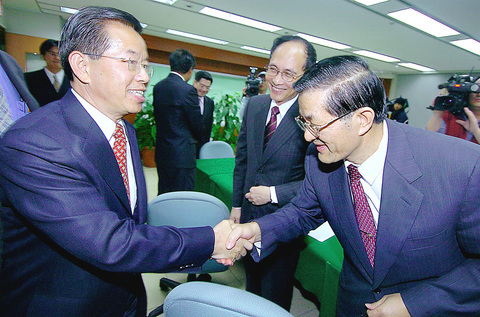
PHOTO: LIAO CHEN-HUI, TAIPEI TIMES
Holding a bachelor's degree in law from National Taiwan University (NTU) and a master's of philosophy from Kyoto University in Japan, Hsieh has constantly been compared with his long-time friend and political competitor, President Chen Shui-bian (陳水扁).
The 59-year-old Hsieh is five years older than the president and entered politics earlier than him. They both began their involvement in politics in the early 1980s before serving as defense lawyers for political prisoners in the wake of the Kaohsiung Incident. Both were elected as Taipei City councilors in 1981.
Hsieh and Chen, as well as former Hsinchu Deputy Mayor Lin Cheng-chieh (林正杰), were collectively dubbed the "three musketeers" of the tangwai movement (referring to the group of political outsiders who were not part of the Chinese Nationalist Party (KMT) during their dictatorship).
Hsieh served as Taipei City councilor between 1981 and 1989 and as a Democratic Progressive Party (DPP) lawmaker from 1989 to 1996. He also helped to form a party faction called the Welfare State Alliance in 1992.
In 1994, Hsieh decided to withdraw from the second stage of the party's primary in the run-up to the Taipei mayoral election after narrowly losing to Chen in the first round.
He was then recruited by Chen to serve as his campaign director and helped him win the Taipei mayor's office in 1994.
Seeking to boost his popularity, Hsieh ran for vice president in the 1996 presidential election on the DPP ticket with presidential candidate Peng Ming-min (彭明敏) but the duo lost. In 1998, Hsieh was elected Kaohsiung mayor, outshining Chen, who was defeated in his bid for re-election in as Taipei mayor. Chen then went on to win the presidential election in March 2000.
Two months later, Hsieh once again demonstrated his own political strength in the party by winning the DPP chairmanship. After winning his re-election bid in December 2002, Hsieh had little time to celebrate his success before facing a barrage of attacks implicating him in a vote-buying scam in a city council speakership election. Hsu jen-tu (許仁圖), director of the Kaohsiung City Government's civil affairs bureau and former DPP deputy secretary-general, said that when Hsieh was DPP chairman, there was no "sour rivalry" between Hsieh and Chen.
"While the public seems to see their political competition as negative, one thing I can assure you is that their relationship is solid and strong," Hsu said.
Hsu, who has been working with Hsieh for the past eight years, described Hsieh as a man of "wisdom" and "clemency."
"[Hsieh's] wisdom has helped him manage the city and handle crisis well," Hsu said. "I'm certain he'll do a good job in his new position."
Some might question Hsieh's wisdom, however, especially in light of the "Sung Chi-li (宋七力)" incident.
When he was seeking re-election in 2002, Hsieh once sparked controversy by seeking the advice of convicted fraudster Sung Chi-li -- a notorious cult leader who claims to have supernatural powers. A few days after winning the mayoral election, Hsieh raised eyebrows by reiterating earlier remarks that he believed in Sung, despite his conviction on fraud charges.
Analyzing Hsieh's personality, a senior journalist and a long-time friend of Hsieh, who asked not to be named, described him as "flexible" and "quick-witted."
"Unlike President Chen, who always wants to be in the No. 1 position in every situation, Hsieh is more interested in interacting with people, although he also works very hard at his career," he said.
During an exclusive interview with the Taipei Times last month, Hsieh himself attributed his high approval rating and Kaohsiung's success to "trust."
"Society needs trust, yet it seems that we are losing it," he said.
For a kid coming from "blacksmith street" collecting scrap metal to support his family, Hsieh has learned from personal experience how to survive in dire situations and turn things around. The valuable life experiences are certain to serve him well in his new job.
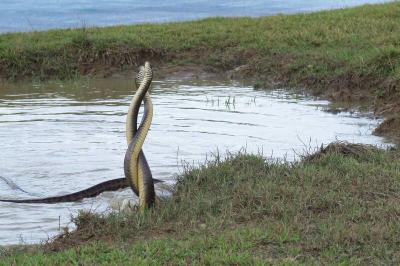
Kenting National Park service technician Yang Jien-fon (楊政峰) won a silver award in World Grand Prix Photography Awards Spring Season for his photograph of two male rat snakes intertwined in combat. Yang’s colleagues at Kenting National Park said he is a master of nature photography who has been held back by his job in civil service. The awards accept entries in all four seasons across six categories: architectural and urban photography, black-and-white and fine art photography, commercial and fashion photography, documentary and people photography, nature and experimental photography, and mobile photography. Awards are ranked according to scores and divided into platinum, gold and

More than half of the bamboo vipers captured in Tainan in the past few years were found in the city’s Sinhua District (新化), while other districts had smaller catches or none at all. Every year, Tainan captures about 6,000 snakes which have made their way into people’s homes. Of the six major venomous snakes in Taiwan, the cobra, the many-banded krait, the brown-spotted pit viper and the bamboo viper are the most frequently captured. The high concentration of bamboo vipers captured in Sinhua District is puzzling. Tainan Agriculture Bureau Forestry and Nature Conservation Division head Chu Chien-ming (朱健明) earlier this week said that the

The Chinese Nationalist Party (KMT) caucus yesterday said it opposes the introduction of migrant workers from India until a mechanism is in place to prevent workers from absconding. Minister of Labor Hung Sun-han (洪申翰) on Thursday told the Legislative Yuan that the first group of migrant workers from India could be introduced as early as this year, as part of a government program. The caucus’ opposition to the policy is based on the assessment that “the risk is too high,” KMT caucus secretary-general Lin Pei-hsiang (林沛祥) said. Taiwan has a serious and long-standing problem of migrant workers absconding from their contracts, indicating that

SPACE VETERAN: Kjell N. Lindgren, who helps lead NASA’s human spaceflight missions, has been on two expeditions on the ISS and has spent 311 days in space Taiwan-born US astronaut Kjell N. Lindgren is to visit Taiwan to promote technological partnerships through one of the programs organized by the US for its 250th national anniversary. Lindgren would be in Taiwan from Tuesday to Saturday next week as part of the US Bureau of Educational and Cultural Affairs’ US Speaker Program, organized to celebrate the 250th anniversary of the signing of the Declaration of Independence, the American Institute in Taiwan (AIT) said in a statement yesterday. Lindgren plans to engage with key leaders across the nation “to advance cutting-edge technological partnerships and inspire the next generation of scientists and engineers,”


 RSS
RSS