


The political geography was little changed yesterday as the Democratic Progressive Party (DPP) and its ally, the Taiwan Solidarity Union (TSU), failed to boost their local standings.
Taipei City residents did not enthusiastically take part in the election. Statistics showed only 61 per-cent of voters cast ballots.
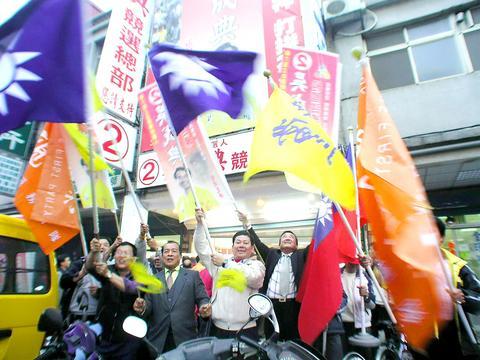
PHOTO: WU CHENG-TING, TAIPEI TIMES
In northern Taipei City, or district one, the pan-green camp and the pan-blue camp split the 10 seats down the middle. But the district was the only place the DPP's ballot-allocation strategy worked.
In district two, the pan-blue camp of the Chinese Nationalist Party (KMT), the People First Party (PFP) and New Party, retained their strong influence.
The KMT and the DPP each won three seats, the PFP took two and the TSU won one. Independent Li Ao (
The KMT's Lai Shyh-bao (
In Taipei County, the DPP held onto its 11 seats but its ally didn't fare as well. The TSU lost one of the two seats it had gained in 2001 election. The pan-blue camp added three more seats to the 13 it won in 2001 for a total of 16. KMT candidate Wu Yu-sheng (
Although President Chen Shui-bian (
In Taichung City, the pan-green and the pan-blues evenly split the eight seats being contested.
In Yunlin County, the pan-greens gained some ground, although the election was affected by the arrest of former county commissioner Chang Jung-wei (
The pan-greens added one seat to the two they won in the country in 2001 with the victory of TSU councilwoman Yin Lin-in (
In Chiayi County, the DPP safeguarded its three seats by taking 63 percent of the vote, while a KMT candidate won the other seat.
In Tainan County, home not only to President Chen but fanatic pan-green supporters, the DPP held onto its five seats by taking al-most half the votes. The KMT won two seats and an independent candidate took the remaining seat.
In Tainan City, the pan-green camp lost one of the four seats won in 2001 as the TSU's candidate lost. The KMT won two seats and a PFP candidate won one.
In the two electoral districts of Kaohsiung City, the pan-greens gained about 53 percent of the vote, a significantly improvement over the 48 percent won in 2001.
The DPP's Lee Kun-tse (
But the pan-green's vote-allocation strategy didn't work in the southern dis-trict, where they lost one seat. The greens won seven seats, the KMT took two and the PFP won two.
In Pingtung County, the DPP lost one of its four seats. The KMT won two seats and and an independent candidate took one.
In eastern Taiwan, the pan-blues continued their tradition of strong showings. In Taitung County, KMT Legislator Huang Chien-ting (
In Hualien County, DPP Legislator Lu Po-chi (
In offshore counties, independents and other candidates did well. Penghu County's sole seat was won by Lin Ping-kun (
Four Aboriginal candidates were elected in plains townships. The DPP's Chen Ying (

NATIONAL SECURITY: Authorities are working to confirm the identities of the military personnel involved and investigating possible illegal conduct and regulatory violations Authorities are probing possible national security implications after Kinmen police and immigration officers on Sunday found a Chinese woman allegedly posing as a tourist while engaging in prostitution involving more than 10 military personnel. The woman, surnamed Chen (陳), has since been deported, authorities said, adding that investigators are still working to confirm the identities of those implicated, as the records only listed code names and aliases. The case stemmed from a report received by the Kinmen District Prosecutors’ Office on Friday last week from the Jinhu Precinct of the Kinmen County Police Bureau. On Sunday, police, along with the National Immigration

GLOBALGIVING: ‘ Caving to external pressure is not acceptable for an organization that has cultivated justice reform and human rights for 30 years,’ one NGO said A slew of non-government organizations (NGOs) have withdrawn from the GlobalGiving fundraising platform after it announced it would use “Chinese Taipei” instead of “Taiwan” from next month. The Taiwan Good Rice Association wrote on Facebook on Friday that it was informed on April 28 via a teleconference call of the change, which was made because the platform wanted to operate in China. Taiwan Good Rice is to terminate all cooperative relationships with GlobalGiving in response to the platform’s “unilateral and non-negotiable” decision to remove references to Taiwan, the NGO said. “Taiwan is in the official name of Taiwan Good Rice Association and the

HEAVY WEATHER: Typhoon Jangmi is due to crash straight into the Ryukyus as airlines look to shift flights to larger aircraft or cancel flights to Okinawa entirely Taiwan’s international air carriers announced flight adjustments over the weekend as Typhoon Jangmi is forecast to hit the Ryukyu Islands today and tomorrow. The Central Weather Administration (CWA) upgraded Jangmi from a tropical storm to a typhoon at 8am yesterday, with the eye located 580km south of Naha city. It was moving north at 19kph. Today, China Airlines’ CI-120, CI-121, CI-122 and CI-123 flights between Taoyuan and Naha, Okinawa, have been canceled as well as CI-132 and CI-133 between Kaohsiung and Naha. EVA Air’s BR-112, BR-113, BR-186 and BR-185 flights between Taoyuan and Naha are also canceled. Low-cost carrier Tigerair Taiwan canceled IT-230,
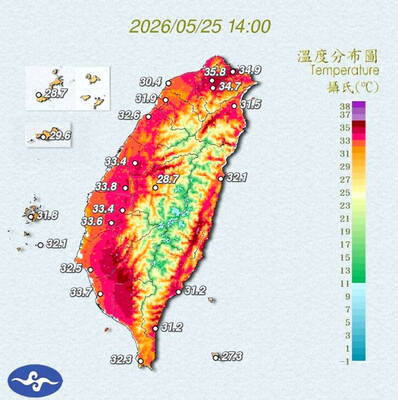
STAY COOL: The HPA recommended that people stay hydrated, use air-conditioning or fans while indoors, wear loose-fitting clothes and walk in the shade while outdoors Employers must implement measures such as installing cooling equipment, and providing drinking water and rest breaks for outdoor workers starting from Monday next week, the Taipei Department of Labor said on Sunday. Employers who fail to comply could face fines of NT$30,000 to NT$300,000 under the Occupational Safety and Health Act (職業安全衛生法), the department said. Businesses in Taipei employing fewer than 100 workers, as well as registered self-employed workers with labor insurance coverage, could receive on-site assessments and guidance from occupational safety consultants to help them apply for central government subsidies to implement or improve heat-protection measures, it said. Under the Ministry of


 RSS
RSS