


Health ministers from Taiwan's diplomatic allies Kiribati, the Marshall Islands, Palau, Solomon Islands and Tuvalu inked the Taipei Health Communique and Agreement on Cooperation at the International Conference for Austronesian Health yesterday.
Chaired by Chen Chien-jen (
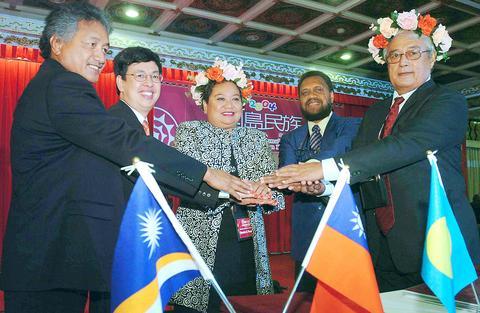
PHOTO: CHIANG YING-YING, TAIPEI TIMES
Sandra Sumang Pierantozzi, vice president and minister of health for Palau, said the country's medial staff treat the majority of illness and diseases. The more acute illnesses which require more than tertiary care are referred off-island to the Philippines or Hawaii for treatment, she said.
"This practice is fine as Palau is not able to afford, nor is it practical, to establish such medical facilities in Palau. However, the cost of medical referral is increasing every year, and we are struggling with spiraling costs within a limited economy," Pierantozzi said.
Noting Palau has a rather high rate of schizophrenia, she said that since the early 1950s, some research has been conducted into the health of Palauans with the mental disorder, and some families have been identified as carrying a gene that perpetuates the illness.
"More genetic research is required to shed light on all this," she said.
Another major challenge for Palau, she said, is the development of adequate human resources in medicine, nursing and allied health.
"At present, there appears to be a sufficient number of physicians working within our health community; however, a good number of them are expatriates who will one day have to return to their respective countries," Pierantozzi said.
Judson Leafasia, permanent secretary of the Solomon Islands' Ministry of Health and Medical Services, reported that several provincial hospitals had not been fully operational during the years of ethnic conflict in the country.
"However, by the end of 2003, all hospitals became fully operational, but most are still in dire need of repairs, refurbishing as well as supplies of certain equipment and drugs," a paper provided by Solomon Islands' Ministry of Health said.
Citing staff shortages as a major problem, the paper said human resource development in health is one of the country's priorities.
"To this end, a number of doctors are currently undertaking postgraduate training in pathology, psychiatry and internal medicine and obstetrics/gynecology," the paper said.
Alesana Kleis Seluka, Tuvalu's minister of health, said a lack of technical staff and laboratory equipment are the main obstacles to the delivery of health care to HIV patients in the country.
"We cannot offer effective and efficient treatment and care to HIV/AIDS sufferers as we do not have the capacity to provide the necessary blood tests to monitor the effectiveness of anti-retroviral drugs. Meanwhile, no health staff have been trained to provide appropriate care for HIV/AIDS clients," Seluka said.
"We need assistance from developed countries to fill the gaps in the process of preventing HIV/AIDS and also the care of HIV/AIDS sufferers," Seluka said.
In introducing programs for Austronesian health cooperation, Lin Ching-fong (林慶豐), chief secretary of the DOH's Bureau of Health Promotion, suggested Taiwan and its Pacific allies hold regular forums on health and medical care, and set up a technical advisory group on medical care technology in the Austronesian region.
The official promised Taiwan's medical centers will make available programs to train health and medical personnel at its allies. Senior medical personnel in Taiwan will visit the Austronesian countries to organize such programs, he said.
Lin also said Taiwan will help strengthen the health facilities of its allies.
Additionally, the Center of Austronesian Health Research and Development has been established in Taipei to improve health services for Taiwan's allies in the region.

Considering that most countries issue more than five denominations of banknotes, the central bank has decided to redesign all five denominations, the bank said as it prepares for the first major overhaul of the banknotes in more than 24 years. Central bank Governor Yang Chin-lung (楊金龍) is expected to report to the Legislative Yuan today on the bank’s operations and the redesign’s progress. The bank in a report sent to the legislature ahead of today’s meeting said it had commissioned a survey on the public’s preferences. Survey results showed that NT$100 and NT$1,000 banknotes are the most commonly used, while NT$200 and NT$2,000

The Centers for Disease Control (CDC) yesterday reported the first case of a new COVID-19 subvariant — BA.3.2 — in a 10-year-old Singaporean girl who had a fever upon arrival in Taiwan and tested positive for the disease. The girl left Taiwan on March 20 and the case did not have a direct impact on the local community, it said. The WHO added the BA.3.2 strain to its list of Variants Under Monitoring in December last year, but this was the first imported case of the COVID-19 variant in Taiwan, CDC Deputy Director-General Lin Ming-cheng (林明誠) said. The girl arrived in Taiwan on

South Korea is planning to revise its controversial electronic arrival card, a step Taiwanese officials said prompted them to hold off on planned retaliatory measures, a South Korean media report said yesterday. A Yonhap News Agency report said that the South Korean Ministry of Foreign Affairs is planning to remove the “previous departure place” and “next destination” fields from its e-arrival card system. The plan, reached after interagency consultations, is under review and aims to simplify entry procedures and align the electronic form with the paper version, a South Korean ministry official said. The fields — which appeared only on the electronic form

The Ministry of Foreign Affairs (MOFA) is suspending retaliation measures against South Korea that were set to take effect tomorrow, after Seoul said it is updating its e-arrival system, MOFA said today. The measures were to be a new round of retaliation after Taiwan on March 1 changed South Korea's designation on government-issued alien resident certificates held by South Korean nationals to "South Korea” from the "Republic of Korea," the country’s official name. The move came after months of protests to Seoul over its listing of Taiwan as "China (Taiwan)" in dropdown menus on its new online immigration entry system. MOFA last week


 RSS
RSS