


With tensions running high in the legislative campaign and many Democratic Progressive Party (DPP) candidates finding their chances of election in jeopardy, the vote allocation strategy is coming to be regarded as a panacea. However, one candidate's medicine can be another's poison, especially for the candidates who are leading in the polls.
Some DPP candidates' unwillingness to share votes is increasingly obvious as the legislative elections enter the homestretch. DPP Legislator Hsiao Bi-khim (
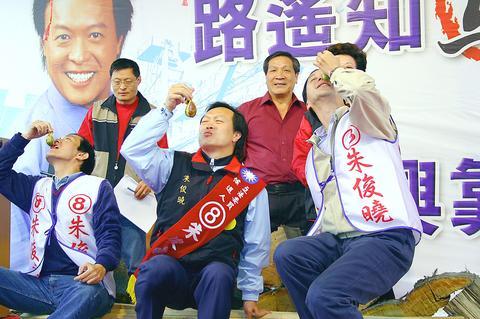
PHOTO: YIN CHEN-WEI, TAIPEI TIMES
"It is unfair to me that everyone asks me to share votes with them just because I'm in the lead," Hsiao said. "I'm so worried that people may think my election is a certainty and give their votes to other candidates, which might cause me to lose instead."
Hsiao also said that she hopes candidates who need more votes won't spread gossip about her and instead work harder on electioneering. She denied that her complaints were directed at fellow DPP candidate Cheng Yun-peng (鄭運鵬), who is lagging in the polls.
infighting
Such infighting among DPP candidates derives from the reality that the DPP will not gain as many votes as they need, yet it nominated a plethora of candidates in some constituencies.
Asked about the details of the vote allocation strategy, DPP higher-ups have responded that the aim is to "make a bigger cake so that everyone can have a whack," meaning that the pan-green camp has to extend its political turf as widely as possible. However, when the cake is not big enough for all the candidates who are eager for a bite, disputes are unavoidable.
DPP caucus whip Tsai Huang-liang (
"All candidates should accept the final election outcome since they've agreed to a united campaign strategy," Tsai said.
Huang Ching-lin (黃慶林), director of the DPP's Taipei City chapter, also said that campaign gossip might ruin the outcome of vote allocation. The DPP has banned its candidates from publishing campaign ads that ask voters for emergency help once the vote allocation is launched.
"Otherwise, we will take disciplinary action against these candidates," Huang said.
Nevertheless, Tsai said that he was still confident that the DPP's vote allocation would be more effective than the pan-blue camp's since the DPP's supporters are familiar with this sort of campaign.
In the legislative elections three years ago, the DPP won about 39 percent of the seats in the legislature, accounting for 33.4 percent of total ballots, demonstrating the effectiveness of vote allocation.
"Successful vote allocation depends on how clear the message sent to voters is prior to election day, and the political party that wants to engage in this strategy had better have experience in it," DPP survey center chief Pan I-hsuan (
Currently, the DPP has finished vote allocation operations in 13 constituencies, including Taipei City, Kaohsiung City, Kaohsiung County, Tainan City, Tainan County, Taichung City, the three constituencies in Taipei County, Pingtung County.
Pan said many candidates who had been in danger of losing have been returned to the safe list after the DPP launched the allocation. Taipei County candidate Shen Fa-hui (
Pan said the DPP still estimates it will win around 94 to 95 seats, according its latest poll, below the goal of 101 seats set by President Chen Shui-bian (陳水扁). But Pan believes that as long as the DPP allots its ballots evenly, it still has a good chance of achieving the aim.
According to DPP Information and Culture Department Director Cheng Wen-tsan (
Usually, about one week before election day, the DPP will tell its partisans to portion out ballots to specific candidates in their constituencies according to the last number on their ID card, or according to their birth month.
In a constituency where the DPP has nominated four or six candidates, it would instruct its supporters to allot votes to each candidate according to their birth month. Each candidate could have an allotment of two or three months. This allocation pattern is dubbed "Four Seasons Red (四季紅)," which is also the name of a Taiwanese folk song.
If there are five candidates in one constituency, then each candidate would be allocated votes based on the last two digits of the voter's ID card, Cheng said.
Ten DPP candidates in the north and south districts in Taipei City have adopted this pattern.
"Vote allocation is a campaign tradition, or a consensus among DPP members, and this kind of peer pressure also pushes candidates to accept the strategy," Cheng said.
"Many people criticize vote allocation as being undemocratic and depriving people of individual choice," Cheng said. "But interestingly enough, the vote allocation was a campaign tactic invented by our supporters spontaneously a decade ago because they really wanted to help the DPP grow."
"It is a tactic derived from the bottom-up," Cheng said.
separation from TSU
Chen Shui-bian's announcement that the DPP targets winning at least 101 seats on its own, meanwhile, in some ways shows that the DPP wants to win the election without the Taiwan Solidarity Union's (TSU) help.
As the TSU's campaign has not gained momentum as quickly as the DPP had expected, the DPP's lukewarm response to the TSU's call for cooperation in vote allocation has become increasingly clear.
At present, the DPP is only working with the TSU to share votes in Tainan City, Taichung City, Pingtung County and in Kaohsiung City, although many TSU candidates have demanded the DPP include them because the TSU contributed significantly to Chen's re-election bid.
Lin Chih-Lung (
In the pan-blue strongholds of Keelung City, Hsihchu City, Chiayi City, Taichung County, Maoli County and Taiyuan County, competition among the pan-green camp will be even keener,
"We hope the DPP will realize that winning a majority in the legislature is a common goal for the pan-green camp. It should not exclude the TSU from vote allocation, which might marginalize the TSU," said David Huang (


UPGRADE: The Kang Ding-class frigate is replacing its Chaparall missiles with Tien Chien II and Hua Yang VLS, which would provide it with long-range, 360° air defense Taiwan plans to produce 1,200 to 1,376 Hai Chien II missiles (海劍二, Sea Sword II) — also known as TC-2N — to serve as the standard air defense system of the navy’s surface combatant fleet, a source said yesterday. Last week, the Hai Chien II, the naval version of the Tien Kung II missile (天劍二, Sky Sword II), completed a live-fire test in waters off the National Chungshan Institute of Science and Technology’s Jiupeng facility (九鵬) in Pingtung County’s Manjhou Township (滿州). The MIM72 Chaparral and other dated air defense missiles that currently arm Taiwanese ships have inadequate range to combat Chinese

REASONS FOR TRAVEL: An assistant professor said that proposed amendments to penalize drivers if they used drugs overseas would not deter people from traveling People who operate a motor vehicle under the influence of marijuana would have their driver’s license revoked, even if they used the substance while overseas, the Ministry of Transportation and Communications said yesterday, citing proposed amendments to the Road Traffic Management and Penalty Act (道路交通管理處罰條例). The amendments would also authorize the government to revoke the licenses of people determined to have used Category 1 or Category 2 narcotics, even if they were not operating a vehicle while under the influence of drugs, as well as ban them from taking the license test for three years, the ministry said. People aged 18 or
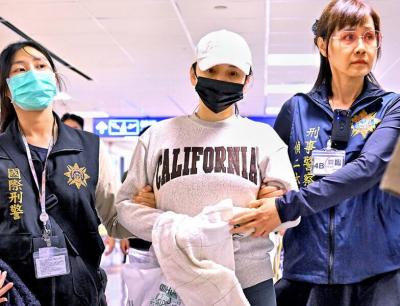
Johanne Liou (劉喬安), a Taiwanese woman who shot to unwanted fame during the Sunflower movement protests in 2014, returned to Taiwan last night after being deported from the US. She is to stand trial in Taiwan for charges involving embezzlement, fraud and drug crimes. The Criminal Investigation Bureau (CIB) said it took her into custody at Taiwan Taoyuan International Airport and would first question her before transferring her to the New Taipei District Prosecutors’ Office. She was arrested upon disembarking a flight from San Francisco that landed shortly before 7pm. Liou absconded to the US in 2019 after jumping bail
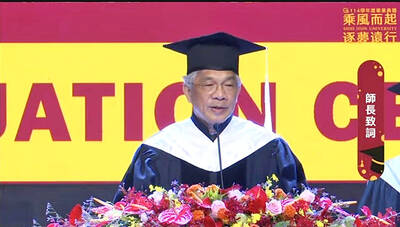
Shih Hsin University President Chen Ching-he (陳清河) yesterday issued a public apology for comments made in his commencement speech last week, stating that he has asked the school to suspend his duties and halt his wages for two months as a show of contrition. At the commencement ceremony on May 30, Chen said, “If you don’t manage your time well, or your own emotions, or your health, then I am telling every one of you — put a quick end to ‘you,’ because the world has no need for ‘you.’” The comments have sparked significant controversy online, and Chen through an open


 RSS
RSS