


Natural disasters forced Taiwan Power Company official Chen Chia-nan (
The Wanjung Hydroelectric Project's director in Kukuan, Tai-chung County, is shepherding a NT$8.4 billion project to revamp the plant in light of the 921 Earthquake and subsequent flooding and landslides.
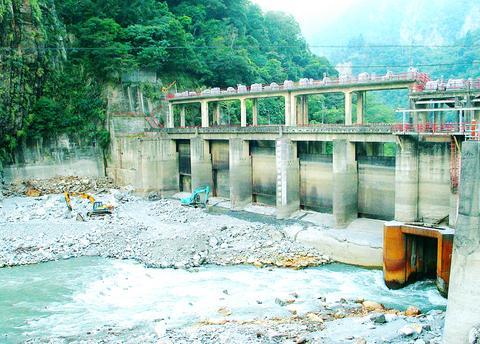
PHOTO: CHIU YU-TZU, TAIPEI TIMES
"We are building new facilities in much higher places where they cannot be inundated when flooding occurs," Chen said.
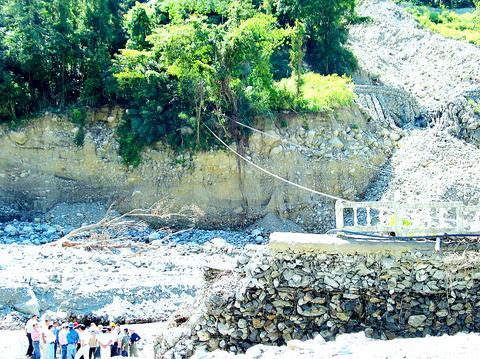
PHOTO: CHIU YU-TZU, TAIPEI TIMES
The 124km-long Tachia River originates on the 3,742m-high Nanhu Mountain, the highest peak in the northern Central Mountain Range. Its rapid 1,200m drop over a 70km section between Tehchi and Shihkang makes the river a perfect site for generating hydroelectricity. As early as 1922, the Japanese built a first plant there.
The current Kukuan plant began operating in 1961, and convenient roads brought several hot spring hotels to the area. But the 921 Earthquake and heavy rains between March and June 2000 deposited sand, stones, driftwood and other debris on the riverbed, raising it by 10m. And on July 30, 2001, heavy rains brought by Typhoon Toraji raised the riverbed by another 9m, inundating the plant's underground control room.
"The river's surface reached the exit of the plant's water tunnel, eventually causing it to malfunction," Chen said.
The troubles continued this year as six state-run power plants along Tachia River were inundated and damaged by floodwaters from Tropical Storm Mindulle in early July.
"At our site, there was once a suspension bridge, which was 22m higher than the surface of the river. When Mindulle came, the river's surface was 4m higher than the bridge, which was eventually washed away," said Tsai Chin-fa (
He said the new water tunnel cannot be inundated because its exit is at a reservoir operated by Taipower.
In the meantime, Taipower must spend NT$1 billion annually to boost power generation at other plants to make up for the Tachia plant.
The plant's planned reopening in the summer of 2007 will not only aid Taipower but should also help revive the area around Kukuan. Since the 921 Earthquake, the area has suffered from frequent road blockages after heavy rain.
"It's not necessary to be pessimistic about the future of Tachia River because people can always find a way out," Taipower vice president Tsai Ying-chau (
He said that several small generators along the river had been buried by mud-slides decades ago, but that engineers will build new plants in more appropriate places.
"To make peace with nature, we also adopted ecological engineering methods to fortify the unstable slopes nearby. Recent heavy rains did not trigger mudflows or landslides" in those areas, Tsai said.
Kukuan residents hope the government will restore not only power plants but also collapsed roads between Kukuan and Techi, which have been closed since the 921 Earthquake.
"We've lived on tourism for years. The tourism industry will never be revived without solving traffic problems and reopening the Central Cross-Island Highway," said Henry Chang (
Roads to a popular national forest recreation area at Pahsien Mountain, where the Shihwen and Chiapao rivers meet, have been closed since July.
However, the highway's possible reopening has been a controversial issue for years. Environmentalists have called on the government to leave the damaged mountain areas alone, while the government spent billions to repair roads and restore damaged sites. This summer's floods undid much of the road repair work.
Chung Ting-maw (鐘丁茂), an ecologist at Providence University in Taichung, and his research team examined several reconstructed sites on slopes and mountaintops in disaster areas and found that some could not withstand this summer's abnormally heavy rains.
"If the government doesn't give up highway reconstruction work, it should inform residents of the risks they face living in fragile, water-logged mountainous areas," Chung said.
Jack Cheng (
"Silt and stones piled up in these Tachia River tributaries must be removed to make the riverbed deeper and the watercourse wider," said Cheng, who has researched the area's mountains for years.
Public Construction Commission vice chairman Kuo Ching-chiang (郭清江) made similar suggestions.
"The mountains' geological structure became quite unstable and there's not enough room for the riverwater to flow. If we don't do anything to remove the factors causing the danger, mudflows and landslides will continue to cause tragedies," Kuo said.

NATIONAL SECURITY: Authorities are working to confirm the identities of the military personnel involved and investigating possible illegal conduct and regulatory violations Authorities are probing possible national security implications after Kinmen police and immigration officers on Sunday found a Chinese woman allegedly posing as a tourist while engaging in prostitution involving more than 10 military personnel. The woman, surnamed Chen (陳), has since been deported, authorities said, adding that investigators are still working to confirm the identities of those implicated, as the records only listed code names and aliases. The case stemmed from a report received by the Kinmen District Prosecutors’ Office on Friday last week from the Jinhu Precinct of the Kinmen County Police Bureau. On Sunday, police, along with the National Immigration

REASONS FOR TRAVEL: An assistant professor said that proposed amendments to penalize drivers if they used drugs overseas would not deter people from traveling People who operate a motor vehicle under the influence of marijuana would have their driver’s license revoked, even if they used the substance while overseas, the Ministry of Transportation and Communications said yesterday, citing proposed amendments to the Road Traffic Management and Penalty Act (道路交通管理處罰條例). The amendments would also authorize the government to revoke the licenses of people determined to have used Category 1 or Category 2 narcotics, even if they were not operating a vehicle while under the influence of drugs, as well as ban them from taking the license test for three years, the ministry said. People aged 18 or

GLOBALGIVING: ‘ Caving to external pressure is not acceptable for an organization that has cultivated justice reform and human rights for 30 years,’ one NGO said A slew of non-government organizations (NGOs) have withdrawn from the GlobalGiving fundraising platform after it announced it would use “Chinese Taipei” instead of “Taiwan” from next month. The Taiwan Good Rice Association wrote on Facebook on Friday that it was informed on April 28 via a teleconference call of the change, which was made because the platform wanted to operate in China. Taiwan Good Rice is to terminate all cooperative relationships with GlobalGiving in response to the platform’s “unilateral and non-negotiable” decision to remove references to Taiwan, the NGO said. “Taiwan is in the official name of Taiwan Good Rice Association and the

HEAVY WEATHER: Typhoon Jangmi is due to crash straight into the Ryukyus as airlines look to shift flights to larger aircraft or cancel flights to Okinawa entirely Taiwan’s international air carriers announced flight adjustments over the weekend as Typhoon Jangmi is forecast to hit the Ryukyu Islands today and tomorrow. The Central Weather Administration (CWA) upgraded Jangmi from a tropical storm to a typhoon at 8am yesterday, with the eye located 580km south of Naha city. It was moving north at 19kph. Today, China Airlines’ CI-120, CI-121, CI-122 and CI-123 flights between Taoyuan and Naha, Okinawa, have been canceled as well as CI-132 and CI-133 between Kaohsiung and Naha. EVA Air’s BR-112, BR-113, BR-186 and BR-185 flights between Taoyuan and Naha are also canceled. Low-cost carrier Tigerair Taiwan canceled IT-230,


 RSS
RSS