


As Kaohsiung, the nation's second largest city, upgrades with new construction and links to international activities, a long-term offshore reclamation project is offering greater benefit to the city than was originally expected.
Known as the South Star Plan (
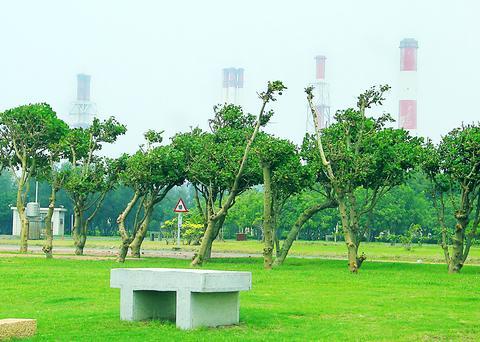
PHOTO: CHIU YU-TZU, TAIPEI TIMES
The project's first phase accommodated 4.5 million cubic meters of waste soil, transforming about 50 hectares of land reclaimed from the sea into a verdant park for residents of Hsiaokang District, an otherwise industrial zone of thermal power plants, ironworks and other manufacturers.
Visitors now can walk on the new land and see recycled tires placed along the coast to prevent wave erosion.
In the mid-1990s, the city government revised the project's mission to include non-hazardous industrial waste as well as construction fill.
According to Chang Feng-teng (
"Comprehensive environmental facilities are absolutely needed as Kaohsiung upgrades itself to an international city," Chang said.
Since Kaohsiung is to host the 2009 World Games, more construction waste will be produced by sports-related facilities and infrastructure, he said.
Chang said the project had improved the quality of life for Hsiaokang residents.
"They have been protected from coastal erosion and the city government will have more space for urban planning," he said.
The city government plans to use future reclaimed land for warehouses to develop Hsiaokang-based Kaohsiung International Airport.
The project's second phase will accommodate about 16 million cubic meters of waste soil, non-hazardous industrial waste and residues collected from waste incinerators. Furnace slag produced by China Steel in Hsiaokang is being used to replace earth in embankments stretching 4.4 km, resolving another industrial waste headache. Offshore areas from Talinpu to Fengpitou (鳳鼻頭) will eventually be 170 hectares of reclaimed land, and in 2006, a 30-hectare forest park will be completed at the site.
"Natural resources such as soil are quite precious for Taiwan, an island nation. New concepts pertaining to sustainable development encourage maximum reuse of materials," deputy Environmental Protection administrator Tsay Ting-kuei (蔡丁貴) said.
China Steel produces millions of tonnes of furnace slag, which the Environmental Protection Administration has for years encouraged it to recycle. In addition to coastal embankments, furnace slag from China Steel has been used as material for waterproof plates, slag ceramic tiles and even teapots.
Environmental officials said the South Star Plan was once opposed by local residents, who refused to accept that their neighborhood would be turned into a dump.
However, the project's environmental impact has been monitored for years to protect the coastal environment.
"We have a task force to monitor coastal terrain, air quality, noise, groundwater, tidal range, sinkage rate and other aspects," said Wang Chien-chih (
In the past, about NT$100 million was given to local communities as compensation.
Fengming borough chief Huang Juin-fu (黃俊富), who has lived in Fengpitou for decades, told the Taipei Times that the government's use of new land reclaimed from the sea for building warehouses fails to benefit local residents.
"It's easy to foresee that the roads will be occupied by trucks getting in and out, and we might have a worse quality of life," Huang said.
Huang said that fishermen had already sacrificed coastline originally used to anchor fishing boats for the South Star Plan.
"The government should be smart enough to transform the land reclaimed from the sea into a well-designed scenic spot to attract people who are interested not only in a beautiful beach scene but also in environmental protection," Huang said.
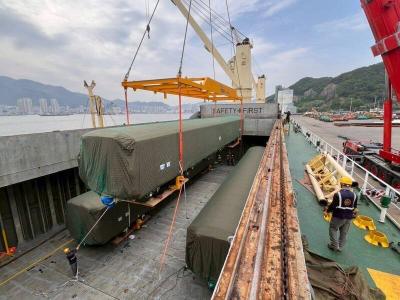
The first of 10 new high-capacity trains purchased from South Korea’s Hyundai Rotem arrived at the Port of Taipei yesterday to meet the demands of an expanding metro network, Taipei Rapid Transit Corp (TRTC) said yesterday. The train completed a three-day, 1,200km voyage from the Port of Masan in South Korea, the company said. Costing NT$590 million (US$18.79 million) each, the new six-carriage trains feature a redesigned interior based on "human-centric" transportation concepts, TRTC said. The design utilizes continuous longitudinal seating to widen the aisles and optimize passenger flow, while also upgrading passenger information displays and driving control systems for a more comfortable
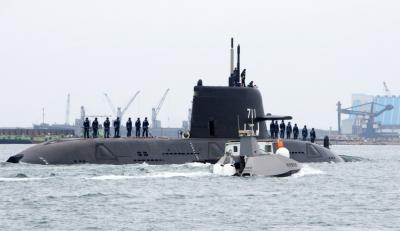
Taiwan's first indigenous defense submarine, the SS-711 Hai Kun (海鯤, or Narwhal), departed for its 13th sea trial at 7am today, marking its seventh submerged test, with delivery to the navy scheduled for July. The outing also marked its first sea deployment since President William Lai (賴清德) boarded the submarine for an inspection on March 19, drawing a crowd of military enthusiasts who gathered to show support. The submarine this morning departed port accompanied by CSBC Corp’s Endeavor Manta (奮進魔鬼魚號) uncrewed surface vessel and a navy M109 assault boat. Amid public interest in key milestones such as torpedo-launching operations and overnight submerged trials,
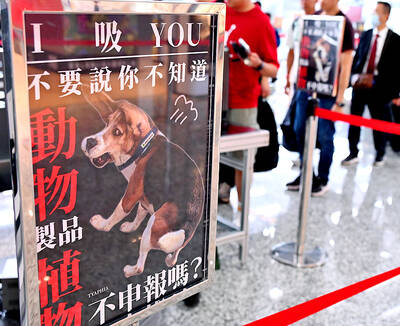
Quarantine awareness posters at Taiwan Taoyuan International Airport have gone viral for their use of wordplay. Issued by the airport branch of the Animal and Plant Health Inspection Agency, the posters feature sniffer dogs making a range of facial expressions, paired with advisory messages built around homophones. “We update the messages for holidays and campaign needs, periodically refreshing materials to attract people’s attention,” quarantine officials said. “The aim is to use the dogs’ appeal to draw focus to quarantine regulations.” A Japanese traveler visiting Taiwan has posted a photo on X of a poster showing a quarantine dog with a
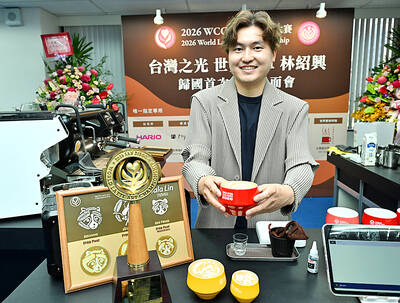
Taiwan’s coffee community has launched a “one-person-one-e-mail” campaign, calling for people to send a protest-e-mail to the World Coffee Championships (WCC) urging it to redesignate Taiwanese competitors as from “Taiwan,” rather than “Chinese Taipei.” The call followed sudden action last week after the WCC changed all references to Taiwanese competitors from “Taiwan” to “Chinese Taipei,” including recent World Latte Art champion Bala (林紹興), who won the World Latte Art Championship in San Diego earlier this month. When Bala received the trophy, he was referred to as representing Taiwan, as well as in the announcement on the WCC’s Web site, until it


 RSS
RSS