


Representatives of Orchid Island, Taitung County and environmentalists yesterday asked the Control Yuan to investigate an illegal dumping case involving hundreds of mock barrels of radioactive waste used previously at an interim repository for low-level radioactive waste.
Showing pictures of numerous 55-gallon barrels laying haphazardly on a slope 10km from the repository and only 100m from the coastline, Shyman Faien (
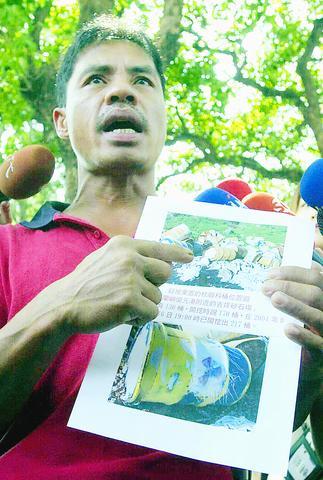
PHOTO: CHIANG YING-YING, TAIPEI TIMES
According to Shyman Faien, a resident found some uncovered barrels with solid cement inside when shepherding on the slope on August 10. Residents further explored the site and became terrified after discovering more barrels underground. Some of the barrels were painted with the radiation warning sign.
Officials from the state-owned Taiwan Power Company (Taipower), which manages the repository, explained to residents that about 130 non-hazardous mock barrels, used for workers to practice with, had been placed there temporarily.
Meanwhile, officials of the Atomic Energy Council (AEC) said they did not discover any abnormal radiation levels at the slope after conducting tests.
Shyman Faien said the two official agencies were not trustworthy, because 217 unidentified barrels had been removed by residents as of Monday.
"How can we Orchid Island residents possibly believe what they said? We strongly urge the Control Yuan to investigate if the two official agencies have neglected their duties," Shyman Faien said.
Shyman Faien said that waste barrels had been dumped at the site for two years, and none of residents had been informed.
"The leaves of yams planted nearby have served as food for a long time. We don't even know if the yam fields were contaminated by radiation," Shyman Faien said.
Chen said that the appearance of barrels at inappropriate places implied that Taipower might have neglected their duties and the AEC might have failed to supervise Taipower on radiation safety issues.
"We will have a taskforce established within a week and some field investigations will be necessary," Chen said.
Taipower on Aug. 10 issued a press release stressing that the slope belonged to a cement plant, whose owner agreed to let Taipower's subcontractors store used barrels there temporarily. To distinguish mock barrels of radioactive waste from real barrels of radioactive waste, Taipower had them painted grey or blue, rather than yellow. Barrels containing low-level radioactive waste are yellow and labeled with a radiation warning sign.
Lee Ching-hor (
"Those barrels in grey and blue were used last year by Taipower's subcontractors to practice repacking and other functions at a newly built treatment center," Lee said.
Lee said the new center, currently under trial, will be reviewed by the AEC to ensure its proper functioning.
There are about 98,000 barrels of low-level radioactive waste stored at the repository on Orchid Island. Lee said removing rust stains on barrels and repacking waste are important tasks for Taipower in managing the facility.

Considering that most countries issue more than five denominations of banknotes, the central bank has decided to redesign all five denominations, the bank said as it prepares for the first major overhaul of the banknotes in more than 24 years. Central bank Governor Yang Chin-lung (楊金龍) is expected to report to the Legislative Yuan today on the bank’s operations and the redesign’s progress. The bank in a report sent to the legislature ahead of today’s meeting said it had commissioned a survey on the public’s preferences. Survey results showed that NT$100 and NT$1,000 banknotes are the most commonly used, while NT$200 and NT$2,000

The Centers for Disease Control (CDC) yesterday reported the first case of a new COVID-19 subvariant — BA.3.2 — in a 10-year-old Singaporean girl who had a fever upon arrival in Taiwan and tested positive for the disease. The girl left Taiwan on March 20 and the case did not have a direct impact on the local community, it said. The WHO added the BA.3.2 strain to its list of Variants Under Monitoring in December last year, but this was the first imported case of the COVID-19 variant in Taiwan, CDC Deputy Director-General Lin Ming-cheng (林明誠) said. The girl arrived in Taiwan on

South Korea is planning to revise its controversial electronic arrival card, a step Taiwanese officials said prompted them to hold off on planned retaliatory measures, a South Korean media report said yesterday. A Yonhap News Agency report said that the South Korean Ministry of Foreign Affairs is planning to remove the “previous departure place” and “next destination” fields from its e-arrival card system. The plan, reached after interagency consultations, is under review and aims to simplify entry procedures and align the electronic form with the paper version, a South Korean ministry official said. The fields — which appeared only on the electronic form

The Ministry of Foreign Affairs (MOFA) is suspending retaliation measures against South Korea that were set to take effect tomorrow, after Seoul said it is updating its e-arrival system, MOFA said today. The measures were to be a new round of retaliation after Taiwan on March 1 changed South Korea's designation on government-issued alien resident certificates held by South Korean nationals to "South Korea” from the "Republic of Korea," the country’s official name. The move came after months of protests to Seoul over its listing of Taiwan as "China (Taiwan)" in dropdown menus on its new online immigration entry system. MOFA last week


 RSS
RSS