


Control Yuan President Fredrick Chien (
Chien -- along with Chinese Nationalist Party (KMT) Chairman Lien Chan (
With Chen Lu-an and Shen having disappeared from the political scene in recent years, and Lien struggling to save his political career, Chien is alone among the "princes" in continuing to exercise a positive political influence and in enjoying respect from various camps.
When the public thinks of Chien, they usually think of him as a heavyweight diplomat because of his experience as representative to the US and minister of foreign affairs. But Chien has also served in other positions, including head of the Government Information Office, chairman of the Council for Economic Planning and Development, speaker of the National Assembly and now president of the Control Yuan.
In a rare interview given last year, Chien said that in 1990 former president Lee Teng-hui (
`stubborn person'
"I said I did not have the capability to become premier because many legislators were interpellating the premier in [Hoklo, more commonly known as Taiwanese], and I could not understand Taiwanese 100 percent. If I needed someone to translate for me, it would have been a joke. So I turned the offer down," said Chien, a Mainlander.
Chien said that he and Lee argued for over two hours, which made Lee quite unhappy. But Chien did not give ground.
"I am quite a stubborn person," Chien said.
"Before I accept a position, I ask myself two questions: one, whether my taking the position would be helpful to the country; two, whether I would be capable of working in that position," Chien said.
Chien might have been too humble when he said he was incapable -- he has become a very seasoned politician over his long career in diplomacy.
When the US severed official diplomatic ties with Taiwan in 1978, Chien was vice minister of foreign affairs, and when China carried out missile tests in the Taiwan Strait in 1996 just as Taiwan was about to hold its first-ever direct presidential election, Chien was the minister of foreign affairs.
The administration of Chen Shui-bian has relied on Chien's diplomatic skills heavily: Chien has acted as Chen Shui-bian's special envoy to foreign countries several times, most notably to deliver condolences to the US over the Sept. 11 terrorist attacks and to attend the funeral of former US president Ronald Reagan.
`strict'
Veteran KMT Legislator Hung Chao-nan (洪昭男), who served in the Ministry of Foreign Affairs under Chien, recalls Chien as a short-tempered but talented person.
Hung said Chien was strict with himself and with others, and that he was the kind who would scold subordinates in front of others.
"There was one time when he was visiting Europe and most of the Taiwanese officials had to take tranquilizers before they met Chien," Hung said.
"But he is a person with a sense of mission. He wants to contribute to the country. When he told us that he was appointed to become the National Assembly speaker, he displayed a sense of loss," Hung said.
Many considered it a waste to put Chien in the National Assembly. But Chien still worked hard as speaker to smooth out disputes between camps.
"I remember that when he, as speaker, first came to see me, he was able to review my career and praise my achievements all in Taiwanese," said Lee Chin-yi (李金億), director of the Democratic Progressive Party's legislative caucus office, but a National Assembly member at the time.
Lee Chin-yi said that the incident showed that Chien was able to get along with members of the Assembly, contradicting an impression that he was aloof and snobbish.
"Although he has been a loyal KMT member, when he dealt with National Assembly affairs, he was able to handle disputes impartially most of the time," Lee Chin-yi said.
"He is a person with a sense of mission. It is not surprising that he has decided to take the chairmanship of the investigation committee because he may be able to use the opportunity to stabilize a split society," Lee Chin-yi said.
Chien has a reputation for disliking reporters. He seldom holds press conferences and he gives few interviews. When he held a press conference to explain why he had decided to become the committee chairman, he was sharp and harsh with the reporters.
But during that press conference, Chien's sense of mission seemed genuine. He seemed like a veteran general giving a pep talk for his last major battle.
"This position will be my last chance to serve the country before I retire from public life. I will not continue to serve as a civil servant after my term as the Control Yuan President expires on Jan. 31 next year," Chien said, responding to suggestions that he was aiming at higher political positions.
"During my term of five years and seven months as president of the Control Yuan, I have demanded of myself that I avoid political thinking because this position needs impartial thinking," Chien said. He also said he had not participated in KMT party affairs for a long time.
Chien said that he had initially declined several offers from the president to accept the chairmanship, recommending other candidates instead. Chien finally accepted the offer because other candidates were not interested.

FUKUOKA SITUATION: Japanese media reported that the pathogen is expected to be identified by the summer, while the CDC downplayed the idea that it was hMPV A “mysterious cold-like illness” reported in Japan’s Fukuoka Prefecture does not seem to be a new disease, but Japanese authorities have been asked about the situation, the Centers for Disease Control (CDC) said yesterday. The Fukuoka Prefectural Medical Association on Wednesday told a news conference that a “mystery cold” that has become a hot topic on social media is “highly likely to be caused by some kind of viral infection,” Japan’s KBC News reported. “Many people are experiencing symptoms starting with a sore throat, followed by a runny nose, phlegm and a severe cough,” KBC News reported, citing association officials. Health authorities are

Nvidia Corp CEO Jensen Huang (黃仁勳) arrived in Taiwan yesterday ahead of upcoming AI and technology events, saying he plans to meet with clients and Taiwan Semiconductor Manufacturing Co Chairman C.C. Wei (魏哲家) during his visit. After landing at Taipei Songshan Airport, Huang posed for photos with fans and handed out Yakult drinks to reporters and supporters waiting at the scene, saying he has “a lot to do” during the trip. Asked about reports that Nvidia’s planned headquarters site in Taipei’s Beitou Shilin Technology Park could break ground on May 27, Huang said that if the company holds an event, he would

The Ministry of Finance this afternoon announced the winning numbers for the March-April uniform invoice lottery. The winning number for the NT$10 million (US$318,060) special prize is 19531471, and the winning number for the NT$2 million grand prize is 85941329. Three numbers were drawn for the NT$200,000 first prize: 07225810, 20231230 and 83518781. Those with receipts matching the last seven digits of any of the first-prize numbers will win the NT$40,000 second prize, while those matching the last six digits will win the NT$10,000 third prize. Those whose receipts match the last five digits of the first-prize numbers can claim the NT$4,000 fourth prize,
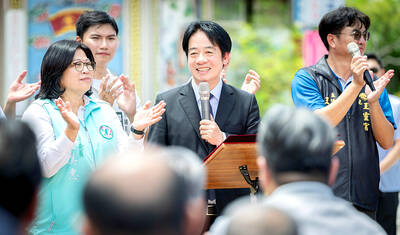
SIX SUBSIDIES: The monthly allowance for older farmers is to increase to NT$10,000, and NT$5,000 is to be given to homemakers under the national pension system, Lai said The government is to implement major welfare policies for disadvantaged groups, including raising the monthly allowance for older farmers to NT$10,000 and providing homemakers with NT$5,000 per month, President William Lai (賴清德) said yesterday. Lai made the remarks during a visit to Wangling Temple in Chiayi County, saying that the planned increases were being introduced amid economic growth and an increase in tax revenue. Touting a policy, in which the government plans to provide a monthly allowance of NT$5,000 for every child under the age of 18 in a bid to address Taiwan’s low birthrate, Lai said that if received for the


 RSS
RSS