


What kind of sounds do women make during sex? Do they differ from country to country, from man to woman, from heterosexual to homosexual? Sister Radio (FM105.7) is being fined by the Government Information Office (GIO) for exploring this question.
The GIO has fined the station for violating programming content decency regulations during its February fourteenth airing of the radio program Lez Radio (拉子三缺一).
Sister Radio, the only radio station in Taiwan focusing on women's issues, held a press conference yesterday to protest the fine.
"This warning is a blow against progressive thinking in Taiwan," said Wang Li-ping (
The program in question talked about the use of condoms in lesbian sex, with a two-minute section in which that night's host, "Wei Wei," imitated sexual noises made by actresses in foreign and local movies.
That section of the show, said Wei Wei, was meant to help debunk the myth that lesbian sex must be silent. Because homosexual sex is still a taboo subject in society, many misconceptions exist about homosexual lovemaking, even among homosexuals, she explained.
Growing up as a lesbian in Taiwan, she said, she learned about homosexuality by trial and error, without knowing how sex between same-sex partners worked, let alone what safe sex was all about.
"Our show is the only one out there that talks about lesbian issues, from how lesbians are perceived to how we love each other, including expressions of that love, even in sex," she said.
Originally, the station was issued a warning on March 8 for violating government restrictions and guidelines on television and radio programming content. The warning stated that the content of the Valentine's Day program was under review for being too explicit in its description of how to use regular condoms during lesbian sex. After the station protested, it received an official document of administrative punishment on April 14th, in which the station was accused of having "adversely affected good social customs" with its imitation of sexual noises.
The fact that the GIO dropped its focus on the program's general content means they support frank sexual education, said Denise Liang (梁瓊丹), the manager of the station's programming division.
However, the GIO fine for the two-minute segment on sexual noises was unfair, station representatives said.
They said the GIO was applying double standards, as sexual acts and noises are common in public television shows and in movies.
The station plans to appeal against the punishment tomorrow.
Wang vowed to fight to the end and she promised that the warning would not affect future programming content, despite the fact that 12 such warnings will prevent the station from being able to renew its operating license when it expires in two years.
Sister Radio broadcasts to audiences in Yunlin, Chiayi and Tainan counties.
Lez Radio is broadcast on Saturday nights from 11-12pm.

UPGRADE: The Kang Ding-class frigate is replacing its Chaparall missiles with Tien Chien II and Hua Yang VLS, which would provide it with long-range, 360° air defense Taiwan plans to produce 1,200 to 1,376 Hai Chien II missiles (海劍二, Sea Sword II) — also known as TC-2N — to serve as the standard air defense system of the navy’s surface combatant fleet, a source said yesterday. Last week, the Hai Chien II, the naval version of the Tien Kung II missile (天劍二, Sky Sword II), completed a live-fire test in waters off the National Chungshan Institute of Science and Technology’s Jiupeng facility (九鵬) in Pingtung County’s Manjhou Township (滿州). The MIM72 Chaparral and other dated air defense missiles that currently arm Taiwanese ships have inadequate range to combat Chinese

REASONS FOR TRAVEL: An assistant professor said that proposed amendments to penalize drivers if they used drugs overseas would not deter people from traveling People who operate a motor vehicle under the influence of marijuana would have their driver’s license revoked, even if they used the substance while overseas, the Ministry of Transportation and Communications said yesterday, citing proposed amendments to the Road Traffic Management and Penalty Act (道路交通管理處罰條例). The amendments would also authorize the government to revoke the licenses of people determined to have used Category 1 or Category 2 narcotics, even if they were not operating a vehicle while under the influence of drugs, as well as ban them from taking the license test for three years, the ministry said. People aged 18 or

HEAVY WEATHER: Typhoon Jangmi is due to crash straight into the Ryukyus as airlines look to shift flights to larger aircraft or cancel flights to Okinawa entirely Taiwan’s international air carriers announced flight adjustments over the weekend as Typhoon Jangmi is forecast to hit the Ryukyu Islands today and tomorrow. The Central Weather Administration (CWA) upgraded Jangmi from a tropical storm to a typhoon at 8am yesterday, with the eye located 580km south of Naha city. It was moving north at 19kph. Today, China Airlines’ CI-120, CI-121, CI-122 and CI-123 flights between Taoyuan and Naha, Okinawa, have been canceled as well as CI-132 and CI-133 between Kaohsiung and Naha. EVA Air’s BR-112, BR-113, BR-186 and BR-185 flights between Taoyuan and Naha are also canceled. Low-cost carrier Tigerair Taiwan canceled IT-230,
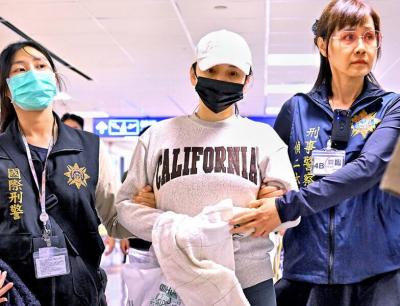
Johanne Liou (劉喬安), a Taiwanese woman who shot to unwanted fame during the Sunflower movement protests in 2014, returned to Taiwan last night after being deported from the US. She is to stand trial in Taiwan for charges involving embezzlement, fraud and drug crimes. The Criminal Investigation Bureau (CIB) said it took her into custody at Taiwan Taoyuan International Airport and would first question her before transferring her to the New Taipei District Prosecutors’ Office. She was arrested upon disembarking a flight from San Francisco that landed shortly before 7pm. Liou absconded to the US in 2019 after jumping bail


 RSS
RSS