


The Taiwan Association for Victims of Occupational Injuries (TAVOI) yesterday urged the Council of Labor Affairs to lower the bar for defining "death from overwork" and to allow workers unions to participate in examinations of potential cases.
"Clock-in work hours are usually the basis used by the council to determine if someone has been overworked to death. It is the last 24 hours before a worker's death that the council would examine to see if there were any abnormal work-load," said TAVOI general secretary Huang Hsiao-ling (黃小陵).
Huang said that clock-in hours are not an accurate way of determining whether a person has died from overwork, as there are many other physical and mental disorders that could be seen as indicators of such a death.
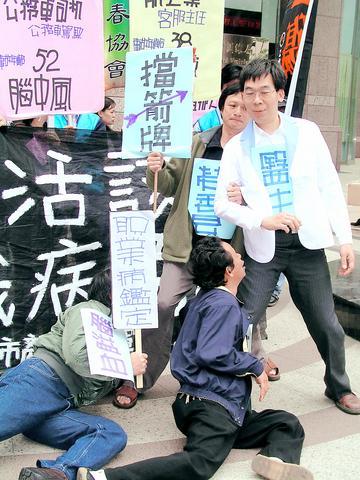
PHOTO: TING TING-YUN, TAIPEI TIMES
"The council hires occupational-injury doctors to examine each reported case," Huang said.
"However, we feel that the doctors might not be able to understand the nature of each job in each industry and therefore, we urge the council to allow workers' unions to have a say in determining the cause of death in these cases," Huang said.
Donald Du (杜宗禮), an attending physician at National Taiwan University Hospital's Center for Man-agement of Occupational Injuries and Diseases, who has more than 10 years of experience in the field, said that there is still no clear-cut medical definition as to what constitutes "death from overwork."
"The term originated from the Japanese word karoshi, but the more official term that we use is "work-related circulatory diseases," Du said.
"At present, if we are approached with an occupational-disease diagnosis, we will usually study the conditions of his [the person's] cardiac condition and cranial blood vessels to determine if the sudden deterioration of his health was a long-term disease built up or due to other reasons," Du said.
The doctor explained that the difficulty in making a definite diagnosis for this disease lies in information gathering.
"It is just too difficult to know if the person's death is directly linked to his work, or linked to personal reasons. Therefore, doctors who handle these cases have a hard time drawing a conclusive diagnosis," Du said.
According to Du, the only established work-related circulatory disease he knew of was the case of an underground parking-lot worker who died about two years ago of carbon-monoxide poisoning.
In response to TAVOI's request, the head of the council's Department of Occupational Safety and Health, Lin Chin-chi (
"The council has not compiled any official statistics as to how many individuals have died of work-related circulatory diseases. At present, the council lets doctors, occupational-health experts and legal experts gather such information," Lin said.
Lin said whether or not the onset of a particular disease was due to a sudden increase in workload was the key factor in determining each case.
As to allowing workers' unions to take part in the deliberations, Lin said that their participation might make matters much more complex.
"Right now, there are already a number of experts working on each case. Letting workers' unions join in might open the floodgates to everyone related to the deceased person taking part in each case," Lin said.

Considering that most countries issue more than five denominations of banknotes, the central bank has decided to redesign all five denominations, the bank said as it prepares for the first major overhaul of the banknotes in more than 24 years. Central bank Governor Yang Chin-lung (楊金龍) is expected to report to the Legislative Yuan today on the bank’s operations and the redesign’s progress. The bank in a report sent to the legislature ahead of today’s meeting said it had commissioned a survey on the public’s preferences. Survey results showed that NT$100 and NT$1,000 banknotes are the most commonly used, while NT$200 and NT$2,000

The Centers for Disease Control (CDC) yesterday reported the first case of a new COVID-19 subvariant — BA.3.2 — in a 10-year-old Singaporean girl who had a fever upon arrival in Taiwan and tested positive for the disease. The girl left Taiwan on March 20 and the case did not have a direct impact on the local community, it said. The WHO added the BA.3.2 strain to its list of Variants Under Monitoring in December last year, but this was the first imported case of the COVID-19 variant in Taiwan, CDC Deputy Director-General Lin Ming-cheng (林明誠) said. The girl arrived in Taiwan on

South Korea is planning to revise its controversial electronic arrival card, a step Taiwanese officials said prompted them to hold off on planned retaliatory measures, a South Korean media report said yesterday. A Yonhap News Agency report said that the South Korean Ministry of Foreign Affairs is planning to remove the “previous departure place” and “next destination” fields from its e-arrival card system. The plan, reached after interagency consultations, is under review and aims to simplify entry procedures and align the electronic form with the paper version, a South Korean ministry official said. The fields — which appeared only on the electronic form

The Ministry of Foreign Affairs (MOFA) is suspending retaliation measures against South Korea that were set to take effect tomorrow, after Seoul said it is updating its e-arrival system, MOFA said today. The measures were to be a new round of retaliation after Taiwan on March 1 changed South Korea's designation on government-issued alien resident certificates held by South Korean nationals to "South Korea” from the "Republic of Korea," the country’s official name. The move came after months of protests to Seoul over its listing of Taiwan as "China (Taiwan)" in dropdown menus on its new online immigration entry system. MOFA last week


 RSS
RSS