


Taipei Times: Have the three American forensic experts you sent to Taiwan [coroner Cyril Wecht, ballistics expert Michael Haag and crime scene analyst Tom Palmbach] updated you on the latest results of the investigation?
Henry Lee (
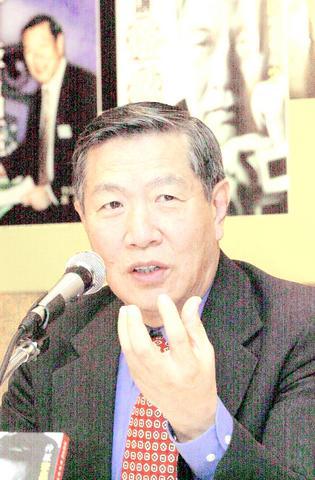
PHOTO: TAIPEI TIMES
TT: The three experts said that President Chen Shui-bian (
Lee: Even though I have not examined the wound, if they found that it was a gunshot wound and it was fresh, I will verify that. Judging from the photos, it looks just like a gunshot wound.
As for how fresh it was, I cannot make a conclusion.
TT: Wecht indicated that his team could not judge when Chen was shot. In your experience, can a judgement be made on how fresh a wound is after it has healed?
Lee: Hard to say. Everyone's body, immune system and health are different. Only a doctor who examines the wound would know. Making a judgement also depends on other material evidence, such as clothing. How much blood was there and was it new blood? If these can be verified, there might be a conclusion.
But there might not necessarily be one because in forensic science there are sometimes gray areas. Expectations that forensic scientists can tell exactly what happened at a particular point in time cannot possibly be met.
TT: So what's the first thing you'll do when you arrive in Taiwan later this month?
Lee: The first thing is of course to collect evidence. I will review all the photos and records they have. I will first review the material evidence, shell casings, bullets and clothing. The second thing is to read the findings from the National Police Administration's Criminal Investigation Bureau (CIB) and look at their analysis and see whether their interpretation of the evidence is correct.
The next thing is to examine the bullet hole in the jeep's windshield, the rest of the jeep and the wounds, followed by a reconstruction of the bullets' trajectory.
TT: You were quoted in the media recently as saying you don't think the shooting was staged, nor was it an assassination attempt. Can you explain the reasons you think this?
Lee: A shooting incident can be divided into three parts. The first part is to determine the trajectory of the bullet, the kind of weapon, the ammunition and the shooter's position.
The second part is to determine the motive. Why did someone fire the shot?
The last part is to find out who is responsible. A foundation needs to be established first -- then comes the determination of the motive.
One type of speculation is that the Chinese Nationalist Party (KMT) and the People First Party were behind the shooting, while another is that Chen's camp staged the shooting in order to win the presidential election. There are other possibilities in between.
In my experience, if it was a political assassination, a high-powered rifle would have been used. Even if the assassin opted for a handgun, it would be a high-powered one.
If the aim was to kill, why not take it to the extreme? If it was arranged, why didn't they make a better show so that there wouldn't be all these questions today? So if neither of these theories stands up to examination, then what is the truth?
If the shooter could be found, all these questions would be answered.
TT: The CIB has not found gunpowder residue on Chen's clothes. Judging from this, can you tell if the shot was fired from a long distance? How is that determined?
Lee: They said they didn't find powder residue on Chen's clothes, but does that mean there was no gunpowder residue in the first place or that the residue was lost when the clothes were collected by the hospital? Those are two different things.
When you pull the trigger of a gun and the bullet comes out, some powder is burned and some isn't. The unburned powder falls to the ground as very fine particles. If the target is very close to the gun, you will find powder on the target. If it is far away, you won't find it because the excess powder fell to the ground.
Usually, for a small and fully-loaded handgun, we can find powder up to 1m away from the gun. But there is another problem: the bullets were homemade. So questions
like this can only be answered after I examine all the evidence in Taiwan.
TT: In your experience, can a wound such as Chen's be produced with precision?
Lee: This question is beyond the scope of forensic science. I base my conclusions on the results of my analysis. When I finish my analysis in this case, there might be a conclusion or there might not be.
TT: Some people from the Democratic Progressive Party recently took issue with your political affiliations. Do you feel any pressure to confront politics when you're in Taiwan?
Lee: I have never been involved in politics in my life. I am respected by both the Republican and the Democratic parties in the US. If my role as a forensic scientist has to be associated with politics, then we may as well forget about this entirely.
TT: Do you think your findings will be accepted by the various parties?
Lee: Recognition and acceptance should come from the public. It has nothing to do with politicians. Politicians have their own agenda -- they can find fault in a saint. Recognition from the public is more important than the response of politicians.
Also See Story:
Editorial: Overlooking the obvious

Considering that most countries issue more than five denominations of banknotes, the central bank has decided to redesign all five denominations, the bank said as it prepares for the first major overhaul of the banknotes in more than 24 years. Central bank Governor Yang Chin-lung (楊金龍) is expected to report to the Legislative Yuan today on the bank’s operations and the redesign’s progress. The bank in a report sent to the legislature ahead of today’s meeting said it had commissioned a survey on the public’s preferences. Survey results showed that NT$100 and NT$1,000 banknotes are the most commonly used, while NT$200 and NT$2,000

The Centers for Disease Control (CDC) yesterday reported the first case of a new COVID-19 subvariant — BA.3.2 — in a 10-year-old Singaporean girl who had a fever upon arrival in Taiwan and tested positive for the disease. The girl left Taiwan on March 20 and the case did not have a direct impact on the local community, it said. The WHO added the BA.3.2 strain to its list of Variants Under Monitoring in December last year, but this was the first imported case of the COVID-19 variant in Taiwan, CDC Deputy Director-General Lin Ming-cheng (林明誠) said. The girl arrived in Taiwan on

ANNUAL EVENT: Two massive Pokemon balloons are to be set up in Daan Park, with an event zone operating from 10am to 6pm This year’s Taipei Floral Picnic is to be held at Daan Park today and tomorrow, featuring an exclusive Pokemon Go event, a themed food market, a coffee rave picnic area and stage performances, the Taipei Department of Information and Tourism said yesterday. Two massive Pokemon balloons are to be set up in the park as attractions, with an exclusive event zone operating from 10am to 6pm, it said. Participants who complete designated tasks on-site would have a chance to receive limited-edition souvenirs, it added. People could also try the newly launched game Pokemon Pokopia in the trial area, the department said. Three PokeStops are

South Korea is planning to revise its controversial electronic arrival card, a step Taiwanese officials said prompted them to hold off on planned retaliatory measures, a South Korean media report said yesterday. A Yonhap News Agency report said that the South Korean Ministry of Foreign Affairs is planning to remove the “previous departure place” and “next destination” fields from its e-arrival card system. The plan, reached after interagency consultations, is under review and aims to simplify entry procedures and align the electronic form with the paper version, a South Korean ministry official said. The fields — which appeared only on the electronic form


 RSS
RSS