


■ Society
Weather blamed for crime
Social order was generally good during the Lunar New Year holiday, statistics released yesterday by the Criminal Investigation Bureau (CIB) showed. Bureau officials said that during the six-day period, there were 81 major criminal cases reported, down 22 from 103 cases the previous year. There were 51 rob-beries and 16 burglary cases. There were also 11 man-slaughter cases, up nine cases from last year's holi-day, police said. They attributed the rise to the coldest holiday period in 11 years, so that when friends and relatives gathered they often lost control of them-selves under the influence of alcohol. The number of cases of rape and major burglaries were both fewer than 10, police reported.
■ Society
Whale's penis arouses envy
Scores of men have visited Tainan's Sutsao Wild Life Reservation Area where professors, students and volunteers were working on the corpse of a male whale, because they were curious about the whale's genitalia. The whale's penis measures 1.6m in length and it looks like a thick water pipe. More than 100 Tainan City resi-dents, mostly men, have reportedly gone to see the corpse to "experience" the size of its penis. The 60-tonne whale was found dead on the seashore of Yunlin County on Sunday. The county government sent the corpse to the National Cheng Kung University, whose biology professors wanted to preserve it as a specimen.
■ Health
NTUH prohibits bribes
National Taiwan University Hospital has set issued a code of conduct to regulate the widespread practice of giving red envelopes to doctors to ensure optimal health care. According to the new code, the first of its kind in the nation, hospital staff and workers are prohibited from accepting any red envelopes containing cash, gift certificates, or securities. However, gifts valued under NT$2,000 can be accepted. Doctors are also barred from encouraging patients to donate red envelopes to specific foundations. Hos-pital workers in charge of purchasing medical supplies are also prohibited from accepting bribes from medi-cal and pharmaceutical companies. Taiwan Health Care Reform Foundation chairwoman Chang Li-yun (張苙雲) yesterday said that while she supported the hospital's efforts, patients would have to stop giving red envelopes for the policy to be successful. The money in red envelopes given to doctors can reportedly amount to as much as NT$60,000 to NT$80,000 for organ-transplant operations.
■ Politics
Yu pledges clean vote
Premier Yu Shyi-kun said yesterday that his admin-istration will brook no violence or corruption in the March 20 presidential election. During the weekly Cabinet meeting, Yu said the fierce competition has given rise to allegations of vote-buying. In order to prevent the country from plunging again into the grip of "black gold" politics, Yu urged law-enforcement agencies to go all-out to maintain a clean, fair and just election. He said anyone found buying votes will be prosecuted regard-less of rank, status or political affiliation. Yu said the Ministry of Justice has opened a hotline (0800-024099) for tips on election irregularities. Police officers have also been asked to give special attention to prevent election-fixing, Yu said. The police department estimated that police officers will have to go on 100,000 election-related missions before March 20.
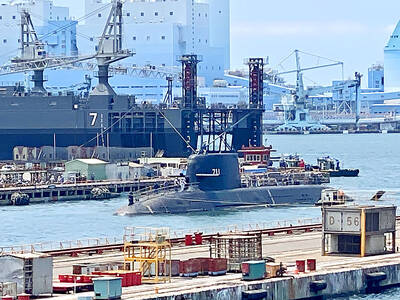
AGING: While Japan has 22 submarines, Taiwan only operates four, two of which were commissioned by the US in 1945 and 1946, and transferred to Taiwan in 1973 Taiwan would need at least 12 submarines to reach modern fleet capabilities, CSBC Corp, Taiwan chairman Chen Cheng-hung (陳政宏) said in an interview broadcast on Friday, citing a US assessment. CSBC is testing the nation’s first indigenous defense submarine, the Hai Kun (海鯤, Narwhal), which is scheduled to be delivered to the navy next month or in July. The Hai Kun has completed torpedo-firing tests and is scheduled to undergo overnight sea trials, Chen said on an SET TV military affairs program. Taiwan would require at least 12 submarines to establish a modern submarine force after assessing the nation’s operational environment and defense
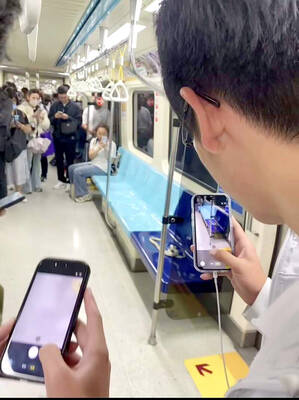
A white king snake that frightened passengers and caused a stir on a Taipei MRT train on Friday evening has been claimed by its owner, who would be fined, Taipei Rapid Transit Corp (TRTC) said yesterday. A person on Threads posted that he thought he was lucky to find an empty row of seats on Friday after boarding a train on the Bannan (Blue) Line, only to spot a white snake with black stripes after sitting down. Startled, he jumped up, he wrote, describing the encounter as “terrifying.” “Taipei’s rat control plan: Release snakes on the metro,” one person wrote in reply, referring
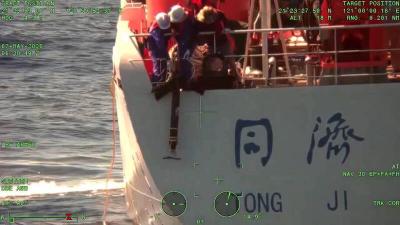
The coast guard today said that it had disrupted "illegal" operations by a Chinese research ship in waters close to the nation and driven it away, part of what Taipei sees a provocative pattern of China's stepped up maritime activities. The coast guard said that it on Thursday last week detected the Chinese ship Tongji (同濟號), which was commissioned only last year, 29 nautical miles (54km) southeast of the southern tip of Taiwan, although just outside restricted waters. The ship was observed lowering ropes into the water, suspected to be the deployment of scientific instruments for "illegal" survey operations, and the coast
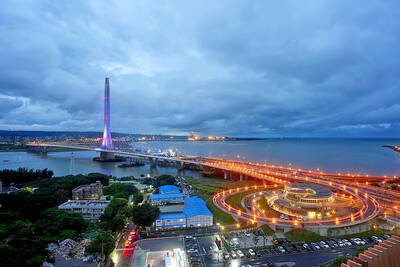
An inauguration ceremony was held yesterday for the Danjiang Bridge, the world’s longest single-mast asymmetric cable-stayed bridge, ahead of its official opening to traffic on Tuesday, marking a major milestone after nearly three decades of planning and construction. At the ceremony in New Taipei City attended by President William Lai (賴清德), Premier Cho Jung-tai (卓榮泰), Minister of Transportation and Communications Chen Shih-kai (陳世凱) and New Taipei City Mayor Hou Yu-ih (侯友宜), the bridge was hailed as both an engineering landmark and a long-awaited regional transport link connecting Tamsui (淡水) and Bali (八里)


 RSS
RSS