


For Ku Yao-ming (
Ku's house in Tungshih was designated half-collapsed after the devastating earthquake that measured 7.3 on the Richter scale. The quake also led to a shutdown of Ku's restaurant business and caused Ku to join many others in the ranks of the unemployed after the disaster.
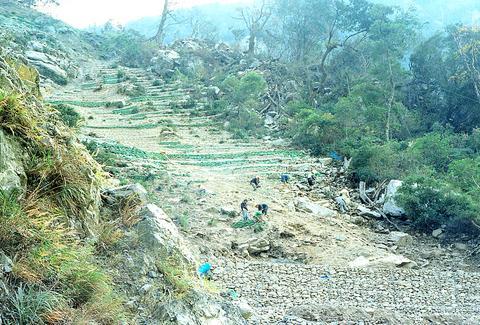
PHOTO: CHIU YU-TZU, TAIPEI TIMES
"Construction done with ecological engineering methods to treat collapsed land in mountainous areas dragged me out of a 20-month period during which I had no income," Ku told the Taipei Times.
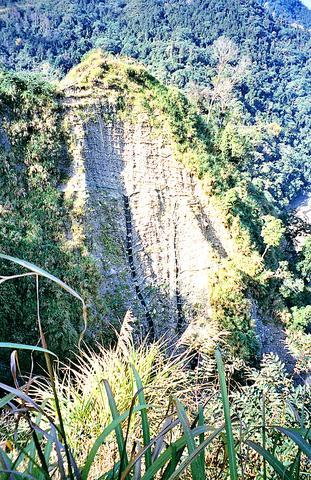
PHOTO: CHIU YU-TZU, TAIPEI TIMES
In June, 2001, Ku became one of the squad chiefs supervising tasks done by diligent workers, who were mostly mechanics, technicians and farmers before the 921 earthquake.
Job opportunities
To restore several collapsed areas along the highway passing through the Central Mountain range, the township offices of Tungshih and Hoping were entrusted by the central government to hire local victims of the earthquake to do the work. As of the end of last year, 26 construction projects offering 56,000 job opportunities with NT$1,800 daily pay, were completed.
According to Liu Ching-te (劉慶得), the secretary of the Tungshih township office, these construction projects are welcomed by local residents.
"Most unemployed people would rather do hard physical work than to sit at home and face an uncertain future," Liu said.
At many construction sites along the highway, Ku and thousands of workers used cobbles, which are densely packed in gabions, to build firm and solid embankments. On steep slopes where mechanical cranes cannot reach, workers passed stones from hand to hand building facilities to channel rain water effectively.
Working at remote construction sites at altitudes of more than 1,400m, workers have to make fires to keep themselves warm during lunch breaks. On each working day, they drink spring water from the top of the mountain and use it to wash dust from their faces before returning home after eight hours of hard physical work.
Their performance was tested by sudden torrential rains during the summer last year. Despite the 260mm rainfall in Kukuan in one day at the end of June last year, newly completed facilities and recently planted vegetation jointly preserve the once-fragile slopes. The result inspired hundreds of workers.
Ku and his partners are now working on the restoration work using ecological engineering methods on a 500m-long slope, which sits in a section of the highway between Kukuan and Techi.
Covered with giant rocks and dried trunks, the slope was once, in fact, the road, until it was devastated by mudflows and landslides triggered by heavy rains brought by Typhoon Toraji(桃芝) in the summer of 2001. Before the earthquake, the place was an important research site for scientists at Agricultural Research Institute to study trout living in Maling River.
Search
Ku and his teammates spent 25 days some months ago searching for deep slits in the topsoil at the top of the slope where rainwater might accumulate and eventually trigger more landslides. During their search they joyfully discovered an unexposed rare giant Taiwan incense cedar, which needed four people to circle it.
The slits they found, with a total length of about 300m, are fixed by being filled with soil and gravel, collected by workers on the slope.
To further preserve the slope, workers also spread seeds of species such as the Taiwan incense cedar and Zelkova Formosan trees, hoping the trees' root systems will eventually bind the fragile slope soil together.
"Without spending time working here, many of us would never have a chance to experience the fragility of the environment," Ku said, pointing at several flourishing seedlings.
Public Construction Commission Vice Chairman Kuo Ching-chiang (
"Unquestionably, constructions adopting ecological engineering methods have successfully turned some indifferent residents into into real appreciators of their local environment," Kuo said.
construction
At another construction site in Hoping township, through which runs the Wushihkeng river, a tributary of the Taan River, Kuo examined the newly grown vegetation on the top of a steep 350m-long slope composed of loose gravel layers, which collapsed during the 921 earthquake.
Fifty-seven-year-old worker Teng Chiu-chien (鄧秋乾) told Kuo that the completion of placing posts and establishing railings, work that he said needed the skills of Spiderman to do, was one of the greatest experiences of his life as he witnessed the way nature made a gradual recovery from the ruin of a natural disaster.
"I also saw the challenging task as a way of curing myself," Teng said.
Teng's house in Tungshih became one of 5,000 half-collapsed buildings left by the quake. More than 16,000 houses in Tungshih were left either fully collapsed or half-collapsed after the 1999 temblor.
Teng's co-worker, Chang Wen-hsi (張文禧), lost his house in Tungshih during the earthquake. After losing money in his orchard business for three years Chang became one of the spidermen mending slits at the top of the slope and building water channels.
Chang and Teng are just two of thousands of Hakka people working in the tough conditions in the mountain areas alongside Aboriginal workers, from whom they learned rock-climbing skills. Through their work, they stepped out of the shadow of the 921 earthquake together.
Nowadays, Teng, Chang and others come back to the mountain range often to check the results of their work.
Kuo said he was glad to see the harmonious interaction between people from different places and with diverse ethnic backgrounds.
Between June of 2001 and June of last year, construction focusing on the treatment of a 115-hectare area of collapsed land in the catchment area of Wushihkeng River offered 10,288 job opportunities to local people suffering from the 921 earthquake.

NATIONAL SECURITY: Authorities are working to confirm the identities of the military personnel involved and investigating possible illegal conduct and regulatory violations Authorities are probing possible national security implications after Kinmen police and immigration officers on Sunday found a Chinese woman allegedly posing as a tourist while engaging in prostitution involving more than 10 military personnel. The woman, surnamed Chen (陳), has since been deported, authorities said, adding that investigators are still working to confirm the identities of those implicated, as the records only listed code names and aliases. The case stemmed from a report received by the Kinmen District Prosecutors’ Office on Friday last week from the Jinhu Precinct of the Kinmen County Police Bureau. On Sunday, police, along with the National Immigration

GLOBALGIVING: ‘ Caving to external pressure is not acceptable for an organization that has cultivated justice reform and human rights for 30 years,’ one NGO said A slew of non-government organizations (NGOs) have withdrawn from the GlobalGiving fundraising platform after it announced it would use “Chinese Taipei” instead of “Taiwan” from next month. The Taiwan Good Rice Association wrote on Facebook on Friday that it was informed on April 28 via a teleconference call of the change, which was made because the platform wanted to operate in China. Taiwan Good Rice is to terminate all cooperative relationships with GlobalGiving in response to the platform’s “unilateral and non-negotiable” decision to remove references to Taiwan, the NGO said. “Taiwan is in the official name of Taiwan Good Rice Association and the

HEAVY WEATHER: Typhoon Jangmi is due to crash straight into the Ryukyus as airlines look to shift flights to larger aircraft or cancel flights to Okinawa entirely Taiwan’s international air carriers announced flight adjustments over the weekend as Typhoon Jangmi is forecast to hit the Ryukyu Islands today and tomorrow. The Central Weather Administration (CWA) upgraded Jangmi from a tropical storm to a typhoon at 8am yesterday, with the eye located 580km south of Naha city. It was moving north at 19kph. Today, China Airlines’ CI-120, CI-121, CI-122 and CI-123 flights between Taoyuan and Naha, Okinawa, have been canceled as well as CI-132 and CI-133 between Kaohsiung and Naha. EVA Air’s BR-112, BR-113, BR-186 and BR-185 flights between Taoyuan and Naha are also canceled. Low-cost carrier Tigerair Taiwan canceled IT-230,

MULTIPRONGED APPROACH: China has sought to pressure Palau across a number of fronts, but the island nation has staunchly resisted overtures to ditch Taiwan Palau has been firm in backing Taiwan despite Chinese pressure that uses tourism economics, cyberattacks and criminal infiltration as tools to threaten the Pacific ally into renouncing its recognition of Taiwan as a sovereign state. The Presidential Office yesterday announced that Vice President Hsiao Bi-khim (蕭美琴) would visit Palau from Saturday to Wednesday next week at the invitation of Palauan President Surangel Whipps Jr. Whipps in April said in an interview that China had outspokenly asked Palau to “denounce Taiwan.” “And we have said: ‘We have no enemies, but nobody tells us who our friends are,’” he said. Whipps has told reporters multiple times


 RSS
RSS