


The sole remaining ministerial-level official from the pan-blue camp in the Cabinet, Environmental Protection Administration (EPA) chief Hau Lung-bin (郝龍斌), will today officially transfer his leadership to Deputy Administrator Chang Juu-en (張祖恩), who will fill the post until Premier Yu Shyi-kun announces Hau's successor.
Since Hau, a doctor of food science, took over as administrator in March 2001, observers have wondered how long he would survive in a Cabinet dominated by the Democratic Progressive Party (DPP). He eventually spent two and half years in the position, gaining experience as a Cabinet member as well as public exposure, which will serve him well in his future political career.
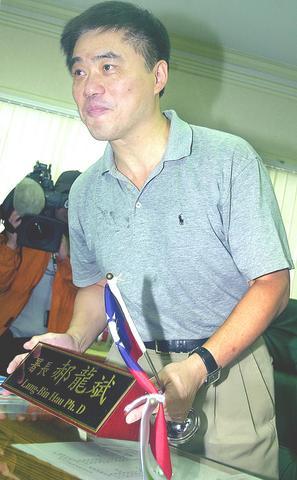
PHOTO: CHEN TZE-MING, TAIPEI TIMES
Hau's predecessor, Lin Jun-yi (林俊義), who has a doctorate in biology, stepped down amid controversy surrounding an oil spill caused by a Greek cargo ship, the MV Amorgos, near Kenting National Park in January 2001.
"Reviewing Hau's performance over the last two and half years, we environmentalists conclude that he is one of the best media manipulators around. He did not heartily take the helm of the EPA," George Cheng (鄭益明), secretary-general of the Taiwan Watch Institution, told the Taipei Times.
According to Cheng, Hau used his commitement to environmental protection as an excuse for his resignation, but he had misled the public about the implications of the Environmental Impact Assessment Act (環境影響評估法) concerning public opinion.
Following an advisory referendum by residents of Pinglin township, Taipei County, on Sept. 13, Hau said that "public opinion should not be more important than professional ones" and "the result of an advisory referendum should not overthrow that of an environmental impact assessment."
The referendum showed that 98 percent of Pinglin residents who voted wanted exit and entrance ramps at Pinglin for the Taipei-Ilan Freeway, which is currently under construction. Hau expressed the EPA's disagreement with the results of the referendum, saying the water supply to the Feitsui Reservoir in Taipei County would be contaminated by the construction.
Hau stressed that the freeway project should not be changed, because its environmental impact assessment had already been approved.
He further suggested that a public development project should not be liable to change by a referendum if its environmental impact assessment had already been approved.
This suggestion was turned down by Yu, who said professionalism should not be placed above democracy. This led to Hau's resignation last Wednesday.
"The environmental impact system, which is fair, objective and trustworthy, should respect professionalism more than public opinions," Hau stressed at a press conference announcing his resignation last week.
Hau said he could foresee a series of environmental catastrophes once the referendum law, which is still being drafted, has been passed.
Cheng said it was regrettable that Hau avoided mentioning one of the important parts missing from the existing environmental impact assessment system.
"The lack of public participation has been totally ignored by Hau," Cheng said.
Environmental opposition has become commonplace in Taiwan since the Environmental Impact Assessment Act came into effect at the end of 1994. According to the law, public hearings have to be held only after the approval of the first phase of the assessment, which gives developers the green light to begin work.
Environmentalists said the referendum would be the last defense mechanism against inappropriate development projects.
Despite the controversy surrounding Hau's resignation, residents of Chichi township, Nantou County, and elsewhere are calling for referendums to halt the building of incinerators near their communities.
On Saturday, the referendum in Chichi showed 98 percent of those who voted oppose the construction of an incinerator worth NT$4 billion. The result, like in Pinglin's case, will not reverse the government's decision. EPA officials said they would respect the conclusions of the local government's Environmental Impact Assessment Committee, which approved the assessment last month.
Lai Wei-chieh (賴偉傑), secretary-general of the Green Citizens' Action Alliance, said it was time for the EPA to review questionable environmental impact reports that have been passed arbitrarily in the past.
Taking an incinerator in Linnei Township, Yunlin County, as an example, Lai said the EPA financially supports the project, although it knows the need for a new water treatment plant was missing from the environmental impact report.
Lai said that Hau has been selectively defending an unsound Environmental Impact Assessment Act, targeting smaller plastic manufacturers and seizing illegal plants causing environmental pollution to create a positive image in front of the media.
Lai said that Hau avoided handling thorny problems such as industrial waste management, because it would have been hard for him to get into the spotlight with this line of action.
Lai said Hau seemed to be the only Cabinet member who could dodge severe supervision by a Legislative Yuan dominated by the pan-blue camp.
According to Lai, the UN's World Summit on Sustainable Development in Johannesburg in August last year called for openness, public participation and social justice in environmental protection.
"Obviously Hau, who led Taiwan's delegation to the summit, learned little of global trends in sustainable development at the event," Lai said.

UPGRADE: The Kang Ding-class frigate is replacing its Chaparall missiles with Tien Chien II and Hua Yang VLS, which would provide it with long-range, 360° air defense Taiwan plans to produce 1,200 to 1,376 Hai Chien II missiles (海劍二, Sea Sword II) — also known as TC-2N — to serve as the standard air defense system of the navy’s surface combatant fleet, a source said yesterday. Last week, the Hai Chien II, the naval version of the Tien Kung II missile (天劍二, Sky Sword II), completed a live-fire test in waters off the National Chungshan Institute of Science and Technology’s Jiupeng facility (九鵬) in Pingtung County’s Manjhou Township (滿州). The MIM72 Chaparral and other dated air defense missiles that currently arm Taiwanese ships have inadequate range to combat Chinese

REASONS FOR TRAVEL: An assistant professor said that proposed amendments to penalize drivers if they used drugs overseas would not deter people from traveling People who operate a motor vehicle under the influence of marijuana would have their driver’s license revoked, even if they used the substance while overseas, the Ministry of Transportation and Communications said yesterday, citing proposed amendments to the Road Traffic Management and Penalty Act (道路交通管理處罰條例). The amendments would also authorize the government to revoke the licenses of people determined to have used Category 1 or Category 2 narcotics, even if they were not operating a vehicle while under the influence of drugs, as well as ban them from taking the license test for three years, the ministry said. People aged 18 or

GLOBALGIVING: ‘ Caving to external pressure is not acceptable for an organization that has cultivated justice reform and human rights for 30 years,’ one NGO said A slew of non-government organizations (NGOs) have withdrawn from the GlobalGiving fundraising platform after it announced it would use “Chinese Taipei” instead of “Taiwan” from next month. The Taiwan Good Rice Association wrote on Facebook on Friday that it was informed on April 28 via a teleconference call of the change, which was made because the platform wanted to operate in China. Taiwan Good Rice is to terminate all cooperative relationships with GlobalGiving in response to the platform’s “unilateral and non-negotiable” decision to remove references to Taiwan, the NGO said. “Taiwan is in the official name of Taiwan Good Rice Association and the

HEAVY WEATHER: Typhoon Jangmi is due to crash straight into the Ryukyus as airlines look to shift flights to larger aircraft or cancel flights to Okinawa entirely Taiwan’s international air carriers announced flight adjustments over the weekend as Typhoon Jangmi is forecast to hit the Ryukyu Islands today and tomorrow. The Central Weather Administration (CWA) upgraded Jangmi from a tropical storm to a typhoon at 8am yesterday, with the eye located 580km south of Naha city. It was moving north at 19kph. Today, China Airlines’ CI-120, CI-121, CI-122 and CI-123 flights between Taoyuan and Naha, Okinawa, have been canceled as well as CI-132 and CI-133 between Kaohsiung and Naha. EVA Air’s BR-112, BR-113, BR-186 and BR-185 flights between Taoyuan and Naha are also canceled. Low-cost carrier Tigerair Taiwan canceled IT-230,


 RSS
RSS