


After working 16 hours a day, for 20 successive days in the sweltering July heat, Lin Chi-yang (林淇瀁), widely known by his pen name Xiang Yang (向陽), finished the taxing work of writing 430 entries totalling 60,000 characters of his new work Lei Chen's Black Paper Memoirs on the Creation of A New Party soon after earning his PhD in journalism at National Chengchi University this May.
While fully occupied with projects as a poet, a political critic and a college lecturer, Lin finished his dissertation on Taiwan's political evolution and media history of the 1950s at the age of 48 after nine years of research, using Free China biweekly founded by Lei Chen in 1949 as his primary source.
"I think everyone who wants to understand the ethos and truth of this period ruled by the Chinese Nationalist Party (KMT) should read Free China and Lei's memoir -- especially journalists and politicians," he said.
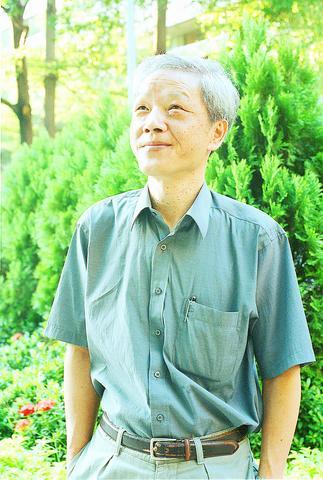
PHOTO: GEORGE TSORNG, TAIPEI TIMES
"In fact, Lei inspired a lot of figures in the Democratic Progressive Party (DPP) burgeoning in the 1950s," Lin added.
Praising Lei as an uebermensch, in the tradition of German philosopher Fredrich Nietzsche, Lin said that his admiration for Lei has come from a belief in democracy and human rights, and it has nothing to do with national identity.
"As a Taiwan native who grew up in rural Nantou, I felt sad for Lei when reading his manuscripts. Lei dared to challenge Chiang Kai-shek's authoritarianism and made a case for the freedom of speech and democracy even though he was an elite mainlander," Lin said. "I view Lei as a warrior."
In 1960, Lei was put in jail for treason by the Chiang administration with a 10-year sentence because of the articles criticizing Chiang printed in Free China and Lei's intention to launch the China Democratic Party (中國民主黨) to confront the KMT's oligarchy. Lei's persecution is known as the "Lei Chen Incident."
Wang Jung-wen (王榮文), who is president of Yuanliou Publishing Company which published Lei Chen's "black paper" memoir last Wednesday said that Lin is the optimal person to fulfill such a special task. "Black paper" means unofficial, in contrast to the better-known term "White Paper," which has come to mean an official document.
"Lin studied Lei's life and Free China with a poet's sensibility and a seasoned journalist's sense while he also obeyed the serious rules of the academic research," said Wang, who also dubbed Lin as a `poet scholar.' "Mr. Lin's annotations provided good details for readers who do not familiar with the Lei's incident," Lin said.
Determined to be a poet at the age of 13 and considering it as a lifetime commitment, Lin led the Chinese free-verse movement of the 1970s and devoted himself to the political reform movement of the 1980s. Lin has published more than 15 anthologies with the motifs of Taiwan local culture and local ties to the land.
Some of his poems were written in Hokkien. Standpoint, a poem written by Lin in 1984, expresses his longing for greater toleration between ideologies, it has been included as required reading in high-school Chinese-language textbooks.
Lin is a veteran commentator of the press. He was the editor in chief of the Independence Evening Post (自立晚報) at the age of 32, also the youngest chief editor among the newspapers at that time. In his years at the Independence Evening Post, he gave a voice to those who were deported by the KMT and to mainlander veterans who wanted to return to China. In recent years, Lin has translated his journalistic career into writing political critiques and children's literature and his academic research.
"I really appreciate his perseverance and energy in his academic research and literary productivity," Lin Yuan-hui (林元輝), Lin Chi-yang's adviser at the graduate school of journalism, said. "His vitality has truly impressed me."
Lin's wife and editor of the Chinese-language Liberty Times' literature supplement Fang Tzu (
Even so, "he holds a professional attitude toward everything he does," Fang said when asked if Lin Chi-yang has ever been bothered by his multiple careers.
Lin Chi-yang will publish a new anthology titled Chaos (

Considering that most countries issue more than five denominations of banknotes, the central bank has decided to redesign all five denominations, the bank said as it prepares for the first major overhaul of the banknotes in more than 24 years. Central bank Governor Yang Chin-lung (楊金龍) is expected to report to the Legislative Yuan today on the bank’s operations and the redesign’s progress. The bank in a report sent to the legislature ahead of today’s meeting said it had commissioned a survey on the public’s preferences. Survey results showed that NT$100 and NT$1,000 banknotes are the most commonly used, while NT$200 and NT$2,000

The Centers for Disease Control (CDC) yesterday reported the first case of a new COVID-19 subvariant — BA.3.2 — in a 10-year-old Singaporean girl who had a fever upon arrival in Taiwan and tested positive for the disease. The girl left Taiwan on March 20 and the case did not have a direct impact on the local community, it said. The WHO added the BA.3.2 strain to its list of Variants Under Monitoring in December last year, but this was the first imported case of the COVID-19 variant in Taiwan, CDC Deputy Director-General Lin Ming-cheng (林明誠) said. The girl arrived in Taiwan on

South Korea is planning to revise its controversial electronic arrival card, a step Taiwanese officials said prompted them to hold off on planned retaliatory measures, a South Korean media report said yesterday. A Yonhap News Agency report said that the South Korean Ministry of Foreign Affairs is planning to remove the “previous departure place” and “next destination” fields from its e-arrival card system. The plan, reached after interagency consultations, is under review and aims to simplify entry procedures and align the electronic form with the paper version, a South Korean ministry official said. The fields — which appeared only on the electronic form

The Ministry of Foreign Affairs (MOFA) is suspending retaliation measures against South Korea that were set to take effect tomorrow, after Seoul said it is updating its e-arrival system, MOFA said today. The measures were to be a new round of retaliation after Taiwan on March 1 changed South Korea's designation on government-issued alien resident certificates held by South Korean nationals to "South Korea” from the "Republic of Korea," the country’s official name. The move came after months of protests to Seoul over its listing of Taiwan as "China (Taiwan)" in dropdown menus on its new online immigration entry system. MOFA last week


 RSS
RSS