


While reminiscing about late-president Chiang Ching-kuo's (
KMT Chairman Lien Chan (連戰) made the remarks at a symposium co-organized by the Foundation for a Modern Legal System and the KMT-run think tank the National Policy Foundation. The stated purpose of the symposium was to hold discussions evaluating economic policies under the rule of Chiang Ching-kuo.
Chiang Ching-kuo inherited the reins of power following the death of his father, former president Chiang Kai-shek, (蔣介石) in 1975 and ruled until his own death in 1988. The pan-blue camp gives Chiang the younger much of the credit for Taiwan's transformation from dusty backwater to an economic powerhouse.
In a bid to bolster its support in the runup to next March's presidential election, the pan-blue camp, which looks to Chiang Ching-kuo as its spiritual leader, has been attempting to cash in on Chiang's image and public nostalgia for the old days when the economy was doing well.
Listing Chiang Ching-kuo's legacy, Lien said that the most impressive achievement was Chiang Ching-kuo's courage to take responsibility in the face of setbacks such as the loss of the UN seat in 1971, termination of official diplomatic ties with the US in 1979 and the oil crises in 1973 and 1979.
With that said, Lien insinuated President Chen Shui-bian (陳水扁) was one who "likes to put blame on anyone else except himself."
"We should look up to Chiang [the younger] as an model to [teach us]. not to let administrative decisions be dictated by political considerations," Lien told his audience, among which included several KMT's old guards such as former premier Lee Huan (李煥), Sun Yun-suan (孫運璿) and former Control Yuan president Wang Tso-jung (王作榮).
Painting the performance of the DPP administration as inferior to that of Chiang Ching-kuo's, Lien lashed at the Chen administration for knowing only how to build up national debt and not come up with substantial measures to bring down the gap between the wealthy and the poor.
Lien also criticized Chen's national policy advisers as merely a group of high-level business leaders.
PFP Chairman James Soong (
He sang the praises of Chiang Ching-kuo's practice of making frequent visits to grassroots organizations and learning bout their needs.Analysts say that in saying so, Soong was insinuating that Chen's visits to various localities were merely for show, thus not truly to hear the voice from the grassroots.
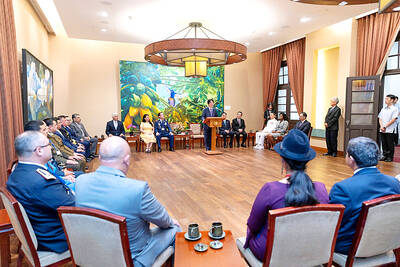
Costa Rica sent a group of intelligence officials to Taiwan for a short-term training program, the first time the Central American country has done so since the countries ended official diplomatic relations in 2007, a Costa Rican media outlet reported last week. Five officials from the Costa Rican Directorate of Intelligence and Security last month spent 23 days in Taipei undergoing a series of training sessions focused on national security, La Nacion reported on Friday, quoting unnamed sources. The Costa Rican government has not confirmed the report. The Chinese embassy in Costa Rica protested the news, saying in a statement issued the same

Taiwan’s Liu Ming-i, right, who also goes by the name Ray Liu, poses with a Chinese Taipei flag after winning the gold medal in the men’s physique 170cm competition at the International Fitness and Bodybuilding Federation Asian Championship in Ajman, United Arab Emirates, yesterday.
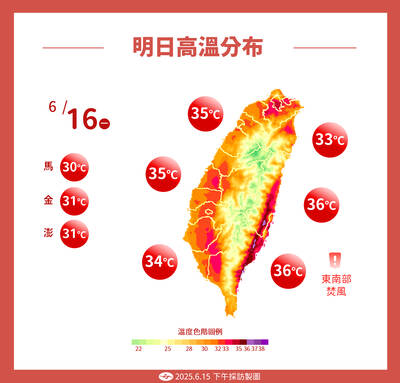
Temperatures in New Taipei City’s Sindian District (新店) climbed past 37°C yesterday, as the Central Weather Administration (CWA) issued heat alerts for 16 municipalities, warning the public of intense heat expected across Taiwan. The hottest location in Taiwan was in Sindian, where the mercury reached 37.5°C at about 2pm, according to CWA data. Taipei’s Shilin District (士林) recorded a temperature of 37.4°C at noon, Taitung County’s Jinfeng Township (金峰) at 12:50 pm logged a temperature of 37.4°C and Miaoli County’s Toufen Township (頭份) reached 36.7°C at 11:40am, the CWA said. The weather agency yesterday issued a yellow level information notice for Taipei, New
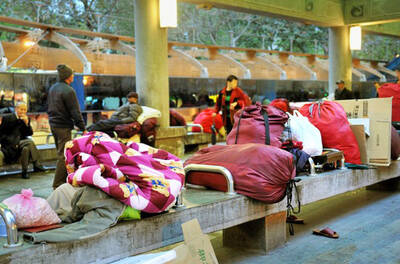
A year-long renovation of Taipei’s Bangka Park (艋舺公園) began yesterday, as city workers fenced off the site and cleared out belongings left by homeless residents who had been living there. Despite protests from displaced residents, a city official defended the government’s relocation efforts, saying transitional housing has been offered. The renovation of the park in Taipei’s Wanhua District (萬華), near Longshan Temple (龍山寺), began at 9am yesterday, as about 20 homeless people packed their belongings and left after being asked to move by city personnel. Among them was a 90-year-old woman surnamed Wang (王), who last week said that she had no plans


 RSS
RSS