


As the nation is confronted by the challenge of containing further outbreaks of severe acute respiratory syndrome, or SARS, legislators with medical backgrounds yesterday offered the advice that frequently washing one's hands is the best protection against the disease.
"Washing hands is the best prevention to avoid contracting the SARS virus. The measure is even more important than wearing gauze masks since medical experts found that SARS was not an airborne epidemic," said Legislator Peter Lin (
Lin, who holds a masters degree in epidemiology, advised that compared to a gauze mask, wearing gloves would better protect a healthy body against contracting the disease indirectly.
"Indirect transmission usually affects healthy people when they touch the virus in SARS patients' bodily fluids left in public places. Therefore, wearing gloves should be the best protection when it comes to cutting the risk of contracting SARS," he explained.
Lin, in addition, called on the government to see that the all-out prevention measures against the mysterious epidemic as a chance to enhance the nation's public hygiene education.
"The numerous SARS reports by local media endeavored to update the latest developments of the infection. Few of them have done a good job of teaching the public on how to protect themselves from being infected, as well as giving instructions on the fundamental measures for halting the disease's spread," he argued.
PFP Legislator Kao Ming-chien (
Instead of wearing the gauze masks, Kao said, intensified washing of hands, feet and the mouth should be emphasized.
The washing will protect frail eyes and the nasal cavity in case a healthy person touched the SARS virus left by infected persons on handrails or chairs at public places, he explained.
Wearing a gauze mask is advised for an all-out prevention effort when healthy citizens approach areas where cases of infection have been confirmed, he added.
Kao advised citizens to avoid unneeded visits to public places, especially those with poor ventilation, while suspected cases of the disease continues to rise.
"Crowded public places without good ventilation could be danger areas for spreading SARS. In this case, it is advisable to avoid these places when the nation is facing the threat of further outbreaks," Kao said.
The former medical director said that the chances of catching the disease at the Legislative Yuan would likely be much lower than the chances in an air-conditioned compound or business building.
DPP Legislator Chen Chi-mai (
"Prevention measures need to achieve a balance between warning against spreading of the disease and engendering emotional fears.
"The mass infection at Hoping Hospital revealed that the administration had not successfully contained the epidemic situation.
"The protest staged by the hospital staff exposed the problem that the legal regulation relating to epidemic prevention must be reinforced for the sake of attaining control," Chen said.

UPGRADE: The Kang Ding-class frigate is replacing its Chaparall missiles with Tien Chien II and Hua Yang VLS, which would provide it with long-range, 360° air defense Taiwan plans to produce 1,200 to 1,376 Hai Chien II missiles (海劍二, Sea Sword II) — also known as TC-2N — to serve as the standard air defense system of the navy’s surface combatant fleet, a source said yesterday. Last week, the Hai Chien II, the naval version of the Tien Kung II missile (天劍二, Sky Sword II), completed a live-fire test in waters off the National Chungshan Institute of Science and Technology’s Jiupeng facility (九鵬) in Pingtung County’s Manjhou Township (滿州). The MIM72 Chaparral and other dated air defense missiles that currently arm Taiwanese ships have inadequate range to combat Chinese

REASONS FOR TRAVEL: An assistant professor said that proposed amendments to penalize drivers if they used drugs overseas would not deter people from traveling People who operate a motor vehicle under the influence of marijuana would have their driver’s license revoked, even if they used the substance while overseas, the Ministry of Transportation and Communications said yesterday, citing proposed amendments to the Road Traffic Management and Penalty Act (道路交通管理處罰條例). The amendments would also authorize the government to revoke the licenses of people determined to have used Category 1 or Category 2 narcotics, even if they were not operating a vehicle while under the influence of drugs, as well as ban them from taking the license test for three years, the ministry said. People aged 18 or

HEAVY WEATHER: Typhoon Jangmi is due to crash straight into the Ryukyus as airlines look to shift flights to larger aircraft or cancel flights to Okinawa entirely Taiwan’s international air carriers announced flight adjustments over the weekend as Typhoon Jangmi is forecast to hit the Ryukyu Islands today and tomorrow. The Central Weather Administration (CWA) upgraded Jangmi from a tropical storm to a typhoon at 8am yesterday, with the eye located 580km south of Naha city. It was moving north at 19kph. Today, China Airlines’ CI-120, CI-121, CI-122 and CI-123 flights between Taoyuan and Naha, Okinawa, have been canceled as well as CI-132 and CI-133 between Kaohsiung and Naha. EVA Air’s BR-112, BR-113, BR-186 and BR-185 flights between Taoyuan and Naha are also canceled. Low-cost carrier Tigerair Taiwan canceled IT-230,
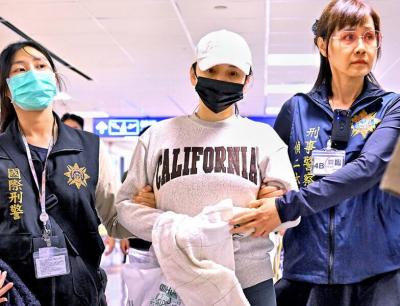
Johanne Liou (劉喬安), a Taiwanese woman who shot to unwanted fame during the Sunflower movement protests in 2014, returned to Taiwan last night after being deported from the US. She is to stand trial in Taiwan for charges involving embezzlement, fraud and drug crimes. The Criminal Investigation Bureau (CIB) said it took her into custody at Taiwan Taoyuan International Airport and would first question her before transferring her to the New Taipei District Prosecutors’ Office. She was arrested upon disembarking a flight from San Francisco that landed shortly before 7pm. Liou absconded to the US in 2019 after jumping bail


 RSS
RSS