


As the last defense minister before the largest military restructuring in decades, Wu Shih-wen (
Because of his reticent and conservative character, Wu is likely to fade from public memory.
Wu once described himself as a man "who has never vied for higher positions or greater fame in the military."
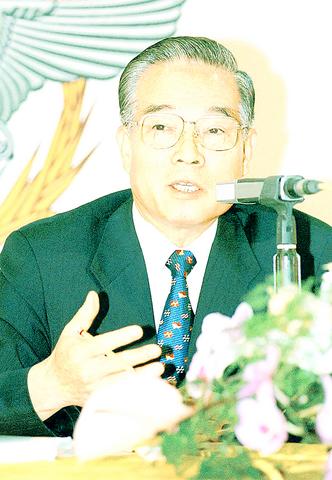
TAIPEI TIMES FILE PHOTO
He made the statement at a dinner with the press before stepping down as defense minister early last year.
Wu seemed to be differentiating himself from a military leader who accompanied him to the dinner with the media. The leader, a three-star army general, was troubled by a report by the United Daily News alleging that he had been sending specially prepared food to the Presidential Office to win favors with certain government leaders.
No one could deny Wu's claim of refusing to seek the spotlight as he has maintained his image throughout his 44 years of service in the military.
Wu, born in 1934, spent most of his service days in the navy. He graduated from the navy academy in 1955. Over the next 44 years, he spent most of his time in the navy with a few years at the Ministry of National Defense (MND).
Wu had been the commander of the 146th fleet and amphibious command before directing the armaments department and then the personnel department.
He later worked with the navy in Kaohsiung, which has the largest naval base in the Tsoying district.
While in the south, Wu served first as the head of the navy's fleet training command and then as the commandant of the navy academy.
In January 1993, Wu was promoted to become one of the two vice commanders in chief of the navy -- the most significant appointment in his career.
The appointment was questioned by many naval officials, especially older ones at the rank of vice admiral, since the promotion violated a long-held navy tradition, said a naval official who had worked under Wu.
Under navy tradition, candidates for the position of vice commander in chief should have served as a commander of fleet command or logistics command -- the two most important positions for vice admirals under the rank of vice commander in chief.
Despite the skepticism, Wu got the promotion, which was vital for his later advancement in the military.
According to Wu, he did not ask for the job, but got it because a retired naval leader wanted to cultivate him as a future leader, sources said.
Wu's later advancement was rather smooth. After a short term as the navy's vice commander in chief, Wu climbed the ranks, becoming one of the three deputy chiefs of the general staff, navy commander in chief, and deputy defense minister.
In June 2000, after the first-ever change of power in Taiwan, Wu became the minister of defense under the recommendation of his predecessor, Tang Fei (唐飛).
Over the next 20 months, Wu contributed to the greatest restructuring of the military in decades. He stepped down in February last year, replaced by chief of the general staff Tang Yao-ming (湯曜明).
During his term, Wu helped the power structure of the military change from one dominated by the chief of the general staff to one controlled by the defense minister.
Wu's efforts seemed like self-castration but he had never been heard voicing any complaints about it.
In March 2000, one month after Tang replaced Wu, two defense-related laws were formally put into practice, providing the legal basis for the change of the military power structure. The two laws were the National Defense Law (國防法) and the amended Organizational Law of the MND (國防部組織法).
Other military changes or innovations that could be attributed to Wu include expanding military exchanges with foreign countries, especially the US, and enabling the longest journey of the navy's friendly flotilla.
The military exchanges with foreign countries were highlighted by those with the US. During Wu's term, senior defense officials began to fly to the US to attend advanced courses.
Wu made several trips to other countries including the US, diplomatic allies in Latin America and Singapore.
He was the first minister of defense to visit the US since the severing of diplomatic relations between the two countries in 1979, but the trip was categorized as a private one and its significance was overshadowed by a trip to the US by his successor, Tang Yao-ming.
As a man who shuns the grandiose, Wu accomplished a lot during his term as minister, with few even noticing.

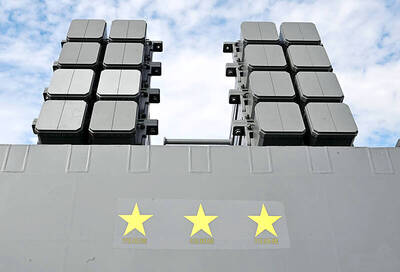
UPGRADE: The Kang Ding-class frigate is replacing its Chaparall missiles with Tien Chien II and Hua Yang VLS, which would provide it with long-range, 360° air defense Taiwan plans to produce 1,200 to 1,376 Hai Chien II missiles (海劍二, Sea Sword II) — also known as TC-2N — to serve as the standard air defense system of the navy’s surface combatant fleet, a source said yesterday. Last week, the Hai Chien II, the naval version of the Tien Kung II missile (天劍二, Sky Sword II), completed a live-fire test in waters off the National Chungshan Institute of Science and Technology’s Jiupeng facility (九鵬) in Pingtung County’s Manjhou Township (滿州). The MIM72 Chaparral and other dated air defense missiles that currently arm Taiwanese ships have inadequate range to combat Chinese

REASONS FOR TRAVEL: An assistant professor said that proposed amendments to penalize drivers if they used drugs overseas would not deter people from traveling People who operate a motor vehicle under the influence of marijuana would have their driver’s license revoked, even if they used the substance while overseas, the Ministry of Transportation and Communications said yesterday, citing proposed amendments to the Road Traffic Management and Penalty Act (道路交通管理處罰條例). The amendments would also authorize the government to revoke the licenses of people determined to have used Category 1 or Category 2 narcotics, even if they were not operating a vehicle while under the influence of drugs, as well as ban them from taking the license test for three years, the ministry said. People aged 18 or
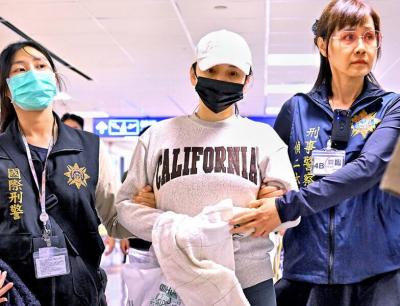
Johanne Liou (劉喬安), a Taiwanese woman who shot to unwanted fame during the Sunflower movement protests in 2014, returned to Taiwan last night after being deported from the US. She is to stand trial in Taiwan for charges involving embezzlement, fraud and drug crimes. The Criminal Investigation Bureau (CIB) said it took her into custody at Taiwan Taoyuan International Airport and would first question her before transferring her to the New Taipei District Prosecutors’ Office. She was arrested upon disembarking a flight from San Francisco that landed shortly before 7pm. Liou absconded to the US in 2019 after jumping bail
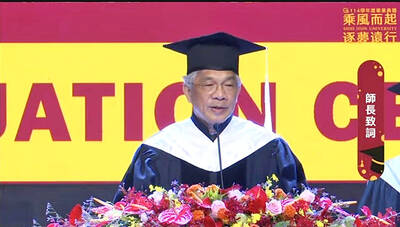
Shih Hsin University President Chen Ching-he (陳清河) yesterday issued a public apology for comments made in his commencement speech last week, stating that he has asked the school to suspend his duties and halt his wages for two months as a show of contrition. At the commencement ceremony on May 30, Chen said, “If you don’t manage your time well, or your own emotions, or your health, then I am telling every one of you — put a quick end to ‘you,’ because the world has no need for ‘you.’” The comments have sparked significant controversy online, and Chen through an open


 RSS
RSS