


At 64, Kang Ning-hsiang (
Doyen of the opposition movement in the 1970s and early 1980s, Kang now finds himself back on the political frontline after two decades in which he was shunned by mainstream members of the DPP as the party grew and prospered.
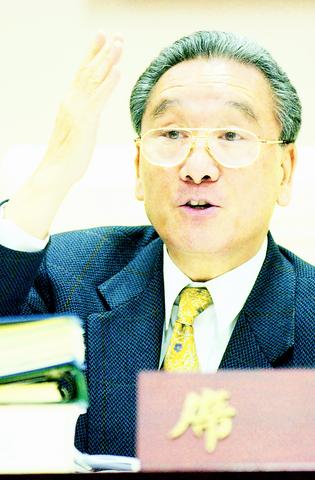
TAIPEI TIMES FILE PHOTO
Unknown to most of the younger generation, Old Kang (
In 1975, Time magazine named Kang as Asia's rising political star. He helped to nurture the careers of many current DPP politicians and served as an inspiration to many others.
Initially planning to stay on as a member of the Control Yuan until retirement, Kang was persuaded to serve as vice minister of national defense in June last year.
After only half a year at the ministry, Kang had to be moved -- not because he was unfit for the job, but because he was outshining his boss, Minister of National Defense Tang Yao-ming (
Under the policy of civilian control, Tang had attempted to resign twice because he seemed uneasy with Kang's company.
Kang is the fourth secretary-general of the NSC since President Chen Shui-bian (
Chiou's predecessors were the former director of the National Security Bureau, Ting Yu-chou (
Ups and downs
The changing fortunes of Kang's career reflect the dramatic changes in Taiwan's political development, from the exciting and precarious opposition movement to the process of democratic consolidation.
Kang earned a bachelor's degree in public administration from National Chunghsiung University in 1957. Growing up in Wanhua (
A charismatic figure and passionate orator with a distinctly husky voice, Kang was a popular politician from the beginning. Many people were moved by his speeches and inspired by his strong sense of Taiwanese awareness to join the opposition movement.
Hard-working and someone who lives modestly, Kang was the first tang wai (黨外), outside the party, politician to foster close ties with liberal mainland intellectuals and KMT dissident faction leaders. He also had close contact with Japanese-educated Taiwanese intellectuals.
Partly through his experience in the legislature and partly through the influence of liberal scholars and senior politicians, Kang developed his well-known philosophy that, to gain power, "one should demonstrate one's wisdom in the legislative chamber, rather than showing one's strength on the street."
When Taiwan was under martial law, this strategy was unpopular among his more radical young comrades.
Kang was the first tang wai leader to focus on national budgets, government organization, national defense, cross-strait issues and international affairs.
Push for democratization
He was also the first to develop coordinated action between overseas Taiwanese and activists within Taiwan to push for the nation's democratization. That made him a leader of opposition movement.
In 1982, he led You Ching (
He advocated a moderate pace of reform from within the system, and sought to extend his influence by launching a series of opposition magazines.
Taiwan Tribune (台灣政論) was founded in 1975 with the help of late DPP chairman Huang Hsin-Chieh (黃信介). But the monthly was banned after only four issues.
The Eighties (
When James Soong (宋楚瑜), now PFP chairman, was in charge of the censorship of publications as the director of the Government Information Office and the head of the KMT's propaganda department, the magazines were banned, confiscated or suspended more than several dozen times. But the publications came back again and again under different titles over the course of eight years.
Practicing what he preached, Kang did not take part in street demonstrations in the 1970s or 1980s. He was the only opposition activist who was not arrested after the Kaohsiung Incident in 1979, and for that reason, he was seen as too timid to be a revolutionary leader.
In 1983, unhappy with his Kang's moderate stance, a younger, more radical generation of tang wai followers led by Chiou I-jen launched a series of attacks against Kang, whom they considered an appeaser. Swamped by a wave of criticism from both the elite and the rank and file of the opposition movement, he lost his legislative seat at the end of that year.
After the defeat, he went to Columbia University as a visiting scholar, researching national defense policy, and made friends with specialists in China studies in the US and with many congressmen. Those old connections appear valuable for his job today.
It was perhaps not surprising then that, returning to the legislature in 1986, he enjoyed better relations with many KMT figures than with most of his DPP comrades. It was perhaps also not surprising that, before long, he lost his passion for politics and started to shift his focus to the press after media restrictions were lifted in 1988.
With support from his old colleague, Antonio Chiang, Kang founded The Capital Morning Post (
The closing of the newspaper dealt a blow to Kang's career. He also faced a crisis in his personal life when he was involved with a scandal. It was the darkest period of his life.
It was not until in 1993, when then-president Lee Teng-hui (
In the latest turn of the political wheel of fortune, Kang is to succeed Chiou, his one-time nemesis, as head of the NSC, where he will work with Chiang for a third time.
While his career has had its highs and lows, he has demonstrated in his personality the constancy, discipline and endurance of a political distance runner.
Kang has kept himself in shape by maintaining a regular exercise regimen over the past 30 years. He continues to pursue his interests in national defense and international affairs and still lives in his modest apartment in Wanhua.
The more other politicians change, the more he remains the same. That's the Old Kang.

UPGRADE: The Kang Ding-class frigate is replacing its Chaparall missiles with Tien Chien II and Hua Yang VLS, which would provide it with long-range, 360° air defense Taiwan plans to produce 1,200 to 1,376 Hai Chien II missiles (海劍二, Sea Sword II) — also known as TC-2N — to serve as the standard air defense system of the navy’s surface combatant fleet, a source said yesterday. Last week, the Hai Chien II, the naval version of the Tien Kung II missile (天劍二, Sky Sword II), completed a live-fire test in waters off the National Chungshan Institute of Science and Technology’s Jiupeng facility (九鵬) in Pingtung County’s Manjhou Township (滿州). The MIM72 Chaparral and other dated air defense missiles that currently arm Taiwanese ships have inadequate range to combat Chinese

REASONS FOR TRAVEL: An assistant professor said that proposed amendments to penalize drivers if they used drugs overseas would not deter people from traveling People who operate a motor vehicle under the influence of marijuana would have their driver’s license revoked, even if they used the substance while overseas, the Ministry of Transportation and Communications said yesterday, citing proposed amendments to the Road Traffic Management and Penalty Act (道路交通管理處罰條例). The amendments would also authorize the government to revoke the licenses of people determined to have used Category 1 or Category 2 narcotics, even if they were not operating a vehicle while under the influence of drugs, as well as ban them from taking the license test for three years, the ministry said. People aged 18 or

HEAVY WEATHER: Typhoon Jangmi is due to crash straight into the Ryukyus as airlines look to shift flights to larger aircraft or cancel flights to Okinawa entirely Taiwan’s international air carriers announced flight adjustments over the weekend as Typhoon Jangmi is forecast to hit the Ryukyu Islands today and tomorrow. The Central Weather Administration (CWA) upgraded Jangmi from a tropical storm to a typhoon at 8am yesterday, with the eye located 580km south of Naha city. It was moving north at 19kph. Today, China Airlines’ CI-120, CI-121, CI-122 and CI-123 flights between Taoyuan and Naha, Okinawa, have been canceled as well as CI-132 and CI-133 between Kaohsiung and Naha. EVA Air’s BR-112, BR-113, BR-186 and BR-185 flights between Taoyuan and Naha are also canceled. Low-cost carrier Tigerair Taiwan canceled IT-230,
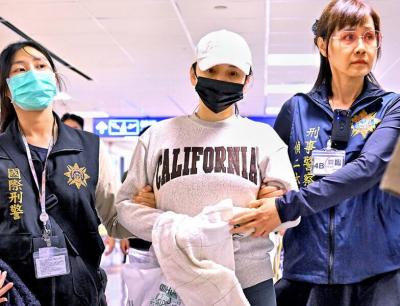
Johanne Liou (劉喬安), a Taiwanese woman who shot to unwanted fame during the Sunflower movement protests in 2014, returned to Taiwan last night after being deported from the US. She is to stand trial in Taiwan for charges involving embezzlement, fraud and drug crimes. The Criminal Investigation Bureau (CIB) said it took her into custody at Taiwan Taoyuan International Airport and would first question her before transferring her to the New Taipei District Prosecutors’ Office. She was arrested upon disembarking a flight from San Francisco that landed shortly before 7pm. Liou absconded to the US in 2019 after jumping bail


 RSS
RSS