


Late Captain Yin Ching-feng (
The impact of Yin's death is reflected most strongly in the navy's lack of courage and determination to push for any new shipbuilding in the years following the murder.
Yin's death is still a mystery. No conclusion can be made as to who killed him or why he was murdered.
The slaying in late 1993 happened at a time when the navy was planning a series of arms-acquisition projects.
A retired navy commander, who had worked at the navy's bureau of planning, said Yin played a key role in these projects.
Yin was the director of the navy's procurement office. He had also served as the chief of the navy's research and development department.
"As Yin took charge of the department, he had many well-educated naval officials working under him. Almost all of these officials had master's degrees. Most of them graduated from the Chung Cheng Institute of Technology like Yin. Only a few were graduates from the navy academy," said the retired commander, who wished to give only his surname, Che.
"These talented officials contributed a lot to the navy. Most of the arms-acquisition projects that the navy is pushing now were the brainchildren of these people. They worked out, over 10 years ago, plans for the acquisition of new diesel-powered submarines, second-generation warships, and P-3C anti-submarine aircraft," Che said.
Mini-aegis
"They were also key to plans to build a mini-Aegis ship, known as the Advanced Combat System (ACS) project. This project was the navy's most ambitious effort to build an advanced fighting ship," he said.
"All these plans were either delayed or shelved following Yin's murder. The navy did not revive the plans for the acquisition of submarines and P-3C aircraft until two years ago. The ACS plan is still on hold," he said.
"Yin's death has caused the navy to be become timid. Navy leaders over the past nine years would rather do nothing and make no mistake than do something that might incur trouble for them," he said.
"Many of Yin's subordinates at the research and development department chose to retire from the navy after the death of their boss because they were no longer needed."
Retired Vice Admiral Lan Ling-li (
"Many arms-acquisition projects were canceled or put off because of Yin's death. Many talented officials left the navy as a result," Lan said.
"Former defense minister Wu Shih-wen (
The three years Wu referred to were the years that PFP lawmaker Ku Chung-lien (
Shelved project
"It was Ku who decided to shelve the ACS project. Ku said at the time that any arms-acquisition project was not worth trying as long as it had a 1 percent chance of risk," Lan said.
Ex-China Shipbuilding Corp (CSBC) engineer Chen Hsiao-ming (
"The navy initially did not want to build the Chenkung-class frigates, either. They agreed to try because of strong pressure by CSBC," Chen said.
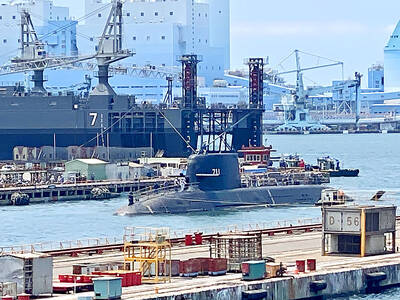
AGING: While Japan has 22 submarines, Taiwan only operates four, two of which were commissioned by the US in 1945 and 1946, and transferred to Taiwan in 1973 Taiwan would need at least 12 submarines to reach modern fleet capabilities, CSBC Corp, Taiwan chairman Chen Cheng-hung (陳政宏) said in an interview broadcast on Friday, citing a US assessment. CSBC is testing the nation’s first indigenous defense submarine, the Hai Kun (海鯤, Narwhal), which is scheduled to be delivered to the navy next month or in July. The Hai Kun has completed torpedo-firing tests and is scheduled to undergo overnight sea trials, Chen said on an SET TV military affairs program. Taiwan would require at least 12 submarines to establish a modern submarine force after assessing the nation’s operational environment and defense

A white king snake that frightened passengers and caused a stir on a Taipei MRT train on Friday evening has been claimed by its owner, who would be fined, Taipei Rapid Transit Corp (TRTC) said yesterday. A person on Threads posted that he thought he was lucky to find an empty row of seats on Friday after boarding a train on the Bannan (Blue) Line, only to spot a white snake with black stripes after sitting down. Startled, he jumped up, he wrote, describing the encounter as “terrifying.” “Taipei’s rat control plan: Release snakes on the metro,” one person wrote in reply, referring
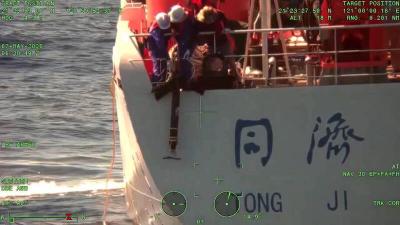
The coast guard today said that it had disrupted "illegal" operations by a Chinese research ship in waters close to the nation and driven it away, part of what Taipei sees a provocative pattern of China's stepped up maritime activities. The coast guard said that it on Thursday last week detected the Chinese ship Tongji (同濟號), which was commissioned only last year, 29 nautical miles (54km) southeast of the southern tip of Taiwan, although just outside restricted waters. The ship was observed lowering ropes into the water, suspected to be the deployment of scientific instruments for "illegal" survey operations, and the coast
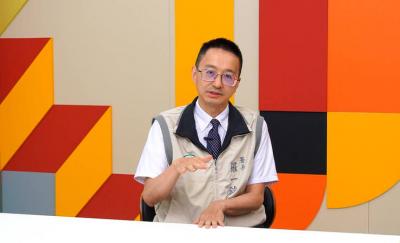
Taiwan’s two cases of hantavirus so far this year are on par with previous years’ case numbers, and the government is coordinating rat extermination work, so there should not be any outbreaks, Centers for Disease Control (CDC) Director-General Philip Lo (羅一鈞) said today in an interview with the Liberty Times (the Taipei Times’ sister newspaper). An increase in rat sightings in Taipei and New Taipei City has raised concerns about the spread of hantavirus, as rats can carry the disease. In January, a man in his 70s who lived in Taipei’s Daan District (大安) tested positive posthumously for hantavirus, Taiwan’s


 RSS
RSS