


During a flurry of high-level exchanges with the US, China has been hinting that US concessions over Taiwan may produce greater Chinese cooperation in the US-led war on terror and Iraq, analysts said yesterday.
While Deputy Secretary of State Richard Armitage was in Beijing this week to rally support for the US stance on Iraq, he also discussed US arms sales to Taiwan with Chinese officials.
"The Taiwan issue is the most important, most sensitive issue facing the entirety of Sino-US relations," the official Xinhua news agency quoted Chinese negotiators as saying.
He urged the US to end weapons sales to Taiwan and "do more things that are beneficial to peaceful reunification" with Taiwan.
James Mulvenon, a China analyst at the influential Rand think tank in Washington, said Beijing was making a mistake if it believed it could wring concessions from Washington using the Taiwan issue.
"China is operating under the mistaken assumption that the war against terrorism and Iraq will get them something in return on Taiwan, that the US will make concessions on Taiwan. This won't happen," he said.
"The US is saying `we want a coalition against Iraq and we want a coalition against North Korea, but we will not budge on Taiwan,'" Mulvenon said.
Su Ge, vice president of the foreign ministry-run China Institute of International Studies, declined to say if Beijing was directly linking cooperation on Iraq with hopes for US concessions on Taiwan.
But he said recent improvements in the relationship made trade-offs a natural expectation.
"What China wants is a more business-like relationship with the United States on all issues, not just Taiwan," he said.
"China-US relations over the last year have reached a turning point, with relations moving toward a warming trend, before this it was very tense, but now the relations have gradually moved toward detente and consultation."
To solidify the gains, more confidence-building measures were needed, including this week's resumption of military-to-military ties agreed to during an October summit between US President George W. Bush and Chinese President Jiang Zemin (江澤民), he said.
Since the Sept. 11 attacks, China has generally supported US efforts to fight terrorism and supported last month's UN resolution on weapons inspections against Iraq.
But Mulvenon warned that the warming trend between Beijing and Washington was like "a series of bubbles of expectations" all of which could easily burst over an unexpected crisis.
He pointed to the collision between a US spy plane and a Chinese fighter jet in April last year, which led to a rapid and dangerous deterioration in relations.
"We still have not seen a strategic shift, but instead a movement for more cooperation driven by a need for a united front against Iraq and North Korea," he said.
"I'm not totally convinced that if another crisis like the EP-3 or a crisis over Taiwan erupts, that this nascent strategic cooperation will continue to pan out."
The US, especially the Pentagon, would continue to view Beijing with suspicion as long as China continued deploying ballistic missiles along its southeastern coast facing Taiwan, he said.
The US has said China has deployed some 400 ballistic missiles within striking distance of Taiwan and is increasing that number by some 50 missiles per year.
Mulvenon said that, for the Bush administration to even consider reducing arm sales to Taiwan, Beijing would have to redeploy its missile force away from the Taiwan Strait.
Su said China was not expecting dramatic gestures from Washington on arms sales.
"We are not asking the US to stop the arms sales to Taiwan right here and now or even tomorrow, but we want to see the US return to its 1982 promise to gradually reduce arms sales to Taiwan," Su said.

NATIONAL SECURITY: Authorities are working to confirm the identities of the military personnel involved and investigating possible illegal conduct and regulatory violations Authorities are probing possible national security implications after Kinmen police and immigration officers on Sunday found a Chinese woman allegedly posing as a tourist while engaging in prostitution involving more than 10 military personnel. The woman, surnamed Chen (陳), has since been deported, authorities said, adding that investigators are still working to confirm the identities of those implicated, as the records only listed code names and aliases. The case stemmed from a report received by the Kinmen District Prosecutors’ Office on Friday last week from the Jinhu Precinct of the Kinmen County Police Bureau. On Sunday, police, along with the National Immigration
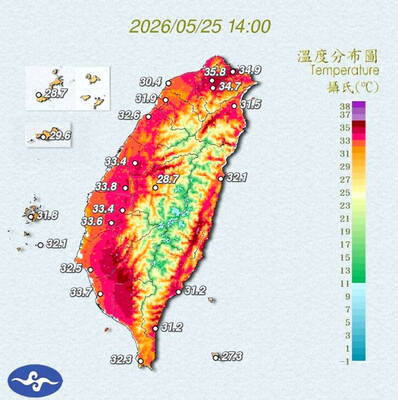
STAY COOL: The HPA recommended that people stay hydrated, use air-conditioning or fans while indoors, wear loose-fitting clothes and walk in the shade while outdoors Employers must implement measures such as installing cooling equipment, and providing drinking water and rest breaks for outdoor workers starting from Monday next week, the Taipei Department of Labor said on Sunday. Employers who fail to comply could face fines of NT$30,000 to NT$300,000 under the Occupational Safety and Health Act (職業安全衛生法), the department said. Businesses in Taipei employing fewer than 100 workers, as well as registered self-employed workers with labor insurance coverage, could receive on-site assessments and guidance from occupational safety consultants to help them apply for central government subsidies to implement or improve heat-protection measures, it said. Under the Ministry of

GLOBALGIVING: ‘ Caving to external pressure is not acceptable for an organization that has cultivated justice reform and human rights for 30 years,’ one NGO said A slew of non-government organizations (NGOs) have withdrawn from the GlobalGiving fundraising platform after it announced it would use “Chinese Taipei” instead of “Taiwan” from next month. The Taiwan Good Rice Association wrote on Facebook on Friday that it was informed on April 28 via a teleconference call of the change, which was made because the platform wanted to operate in China. Taiwan Good Rice is to terminate all cooperative relationships with GlobalGiving in response to the platform’s “unilateral and non-negotiable” decision to remove references to Taiwan, the NGO said. “Taiwan is in the official name of Taiwan Good Rice Association and the

Chinese Nationalist Party (KMT) Chairwoman Cheng Li-wun (鄭麗文) yesterday briefed her party’s Central Standing Committee regarding her scheduled visit to the US between Monday next week and June 16, saying that her purpose would be to persuade the US that the Republic of China (ROC) Constitution was a “one China” constitution that would foster stable and peaceful cross-strait relations. The ROC Constitution is the most important defense for all Taiwanese citizens, as it upholds our democracy and has contributed to our robust economy, which aligns with international and US interests, she said. “We would not be troublemakers and drag the US under,”


 RSS
RSS