


President Chen Shui-bian (陳水扁) yesterday defended the Cabinet's announcement to halt reform of the grassroots cooperatives, saying the decision reflects a timing adjustment.
In the face of public criticism, Chen pledged his resolve to reform and urged the Cabinet to start direct communication with farmers and fishermen to allay opposition fears so that the goal of reform will be ultimately achieved.
"The DPP would not be called the DPP if it feared reform. The course of reform is full of obstacles. To take public opinion into account, we may adjust the pace. But [the adjustment] does not mean [we] flinch from reform, nor does it mean there is reversal of the reform," Chen told the media after the DPP's Central Standing Committee.

TAIPEI TIMES FILE PHOTO
Bowing to pressure from the KMT and leaders in the credit department of the farmers' and fishermen's associations, the Cabinet said Sunday night it would indefinitely suspend a three-tiered risk-control mechanism -- which took effect in August -- over those credit departments with outstanding non-performing loans.
The decision, which meant to be a goodwill gesture to the farmers' and fishermen's associations, appeared to please no one after it was announced.
While the farmers and fishermen's Saturday march will proceed as scheduled, opposition lawmakers have suggested that the policy turnaround is a gambit by the Cabinet to coax farmers, fishermen and DPP lawmakers to doubt the government's resolve on reforms.
The dispute took center stage at the DPP's Central Standing Committee yesterday, where the president was forced to make a public speech to clarify the government's position after the meeting.
Chen said for future generations and for the future of Taiwan, the DPP will not fear reform, nor will the DPP fear losing power due to reforms.
But he said the DPP administration had to suspend the scheme because the public still has reservations about the plan. "As long as there is doubt, it means communication is not sufficient," he said.
Chen stressed that the government needs to take its case to the public and let them know that farmers and fishermen are the beneficiaries, not the victims, of the reform.
The overhaul of credit departments with non-performing loans will help the farmers' and fishermen's associations, Chen said. "The reform will not attempt to wipe out all farmers' and fishermen's associations," he said.
The president said that the DPP gained power from grassroots politics, so it places a high regard on public opinion.
"The party hates to see opposition because farmers and fishermen don't fully understand the policy," Chen said.
He called on the executive departments to communicate directly with farmers and fishermen to provide them with thorough explanations on the government's intention to work together toward the goal.
Former president Lee Teng-hui (李登輝) was said to have played a crucial role in the Cabinet's about-face.
Lee has opposed the reform measures proposed by DPP administration. He said in September that the DPP would risk losing power if it fails to tread carefully when dealing with the credit cooperatives' non-performing loans.


An essay competition jointly organized by a local writing society and a publisher affiliated with the Chinese Communist Party (CCP) might have contravened the Act Governing Relations Between the People of the Taiwan Area and the Mainland Area (臺灣地區與大陸地區人民關係條例), the Mainland Affairs Council (MAC) said on Thursday. “In this case, the partner organization is clearly an agency under the CCP’s Fujian Provincial Committee,” MAC Deputy Minister and spokesperson Liang Wen-chieh (梁文傑) said at a news briefing in Taipei. “It also involves bringing Taiwanese students to China with all-expenses-paid arrangements to attend award ceremonies and camps,” Liang said. Those two “characteristics” are typically sufficient
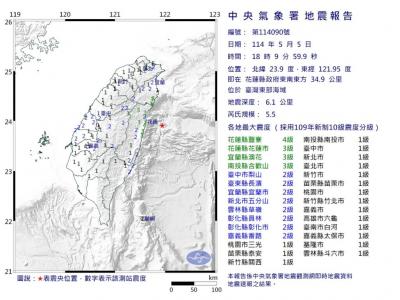
A magnitude 5.9 earthquake that struck about 33km off the coast of Hualien City was the "main shock" in a series of quakes in the area, with aftershocks expected over the next three days, the Central Weather Administration (CWA) said yesterday. Prior to the magnitude 5.9 quake shaking most of Taiwan at 6:53pm yesterday, six other earthquakes stronger than a magnitude of 4, starting with a magnitude 5.5 quake at 6:09pm, occurred in the area. CWA Seismological Center Director Wu Chien-fu (吳健富) confirmed that the quakes were all part of the same series and that the magnitude 5.5 temblor was

The brilliant blue waters, thick foliage and bucolic atmosphere on this seemingly idyllic archipelago deep in the Pacific Ocean belie the key role it now plays in a titanic geopolitical struggle. Palau is again on the front line as China, and the US and its allies prepare their forces in an intensifying contest for control over the Asia-Pacific region. The democratic nation of just 17,000 people hosts US-controlled airstrips and soon-to-be-completed radar installations that the US military describes as “critical” to monitoring vast swathes of water and airspace. It is also a key piece of the second island chain, a string of

The Central Weather Administration has issued a heat alert for southeastern Taiwan, warning of temperatures as high as 36°C today, while alerting some coastal areas of strong winds later in the day. Kaohsiung’s Neimen District (內門) and Pingtung County’s Neipu Township (內埔) are under an orange heat alert, which warns of temperatures as high as 36°C for three consecutive days, the CWA said, citing southwest winds. The heat would also extend to Tainan’s Nansi (楠西) and Yujing (玉井) districts, as well as Pingtung’s Gaoshu (高樹), Yanpu (鹽埔) and Majia (瑪家) townships, it said, forecasting highs of up to 36°C in those areas


 RSS
RSS