


Frank, quick-witted and having a great sense of humor, Wu Shu-chen (
Tseng Wen-hui (
In contrast to her predecessors, Wu behaves much more like a next-door neighbor, especially in the ways she expresses her true feelings.
At home, Wu always amuses the public by her spontaneously witty remarks. Her charm as a public speaker was further revealed during her recent landmark trip to the US.
Wu returned home last Sunday from her 11-day visit to New York, Washington and Los Angeles. She was the first president's wife from Taiwan in 50 years to attend a reception on Capitol Hill.
During her journey, the first lady appealed to US' political circles and the overseas Taiwanese community with her genuineness as well as her sharp responses in the face of the media's questioning.
"If Taiwan is not a country, how could you call me first lady?" Wu said, responding to a question by a CBS reporter, who asked her if Taiwan is a country.
"[The fact that Taiwan is a country is clear,] it is just like it is needless to stress my being a woman," Wu said.
Wu's performance during her historic visit received acclaim from the public, who billed her "a natural-born diplomat" because she knew how to best uphold the country's pride with simple and clear language.
Wu should be praised, but not only for her success in widening Taiwan's diplomatic horizons. What deserves more admiration is her strong will to conquer her physical limitations while trying to take Taiwan to the world.
"Wu's iron-will has posed a striking contrast to her small, feeble body," said a Presidential Office official.
After a traffic accident 17 years ago, which many suspect was actually a politically motivated attempt on her life, Wu has been paralyzed from the chest down and confined to a wheelchair.
"She cannot stand on her own feet, but she used a wheelchair to push Taiwan to the United States, to Washington," her husband, President Chen Shui-bian (陳水扁), told the media the day after her return.
"Given Wu's bold example, there is no reason why other Taiwanese should be either pessimistic or lacking in energy in pursuing Taiwan's diplomatic goals," Chen said.
Despite her physical pain and the inconvenience resulting from her confinement to a wheelchair, Wu appears unusually optimistic.
"I would choose to cry if it would free me from this wheelchair. But the fact is I'll be bound to this wheelchair no matter what. So why not choose to be happier?" Wu once said.
It is due to this mindset that we see the first lady making fun of her own tiny breasts and the fact that she is experiencing menopause -- explaining why she can sometimes be emotionally unstable at home.
She also jokes about her husband's fat stomach and his being an unromantic and sometimes boring man.
"A-bian is just like tap water. It is tasteless, but I can't go on with my life without it," she once said with her trademark amusing style.
The love story between Chen and Wu is one of the most talked-about subjects since Chen was elected as president.
Their romance seems to be made up of the material used in soap operas.
The daughter of a doctor, Wu comes from a well-heeled family, whereas Chen hailed from an impoverished home.
But Wu was touched by the unimpressive, bookish looking man who ultimately won her heart after he waited five hours for her at a train station.
In 1975, Wu upset her family by marrying Chen -- then a young lawyer who had to shoulder the financial responsibility for his family.
Wu had never worked in her entire life, yet they did manage to enjoy the good life for a while after Chen made a small fortune early in his career.
It was Wu's stubbornness, along with her strong sense of justice, that pushed Chen onto the political path.
Wu urged her husband to join the legal team defending the late DPP chairman Huang Hsin-Chieh (黃信介) when he was on trial for his involvement in the 1979 Kaohsiung Incident, a human rights rally
denounced by the KMT regime as a seditious demonstration and put down with force.
Since then, Chen's association with the democracy movement, and then with the DPP, has never been interrupted.
While Chen was behind bars for several months on trumped-up charges in 1986, Wu sought to complete her husband's unfinished mission. She was elected as a legislator that year.
She went on to help her husband become a lawmaker in 1989, Taipei mayor in 1994 and the nation's president two years ago.
Now that the worst moments have passed, Wu appears content with her life, and is especially looking forward to being a grandmother soon. Her daughter, Chen Hsing-yu (
"Wu cannot hide her happiness about being a grandmother. She likes to talk about the grandson because she is so delighted to be able to live to see the day to come," said a Presidential Office official.
Yet underneath her sunny, cheerful appearance, the official said there is a shadow of sadness that outsiders are not aware of.
"Although nobody says it, she has a feeling that she cannot live for long. For her remaining time, she'd like to go through all sorts of life experiences, if she can," the official added.
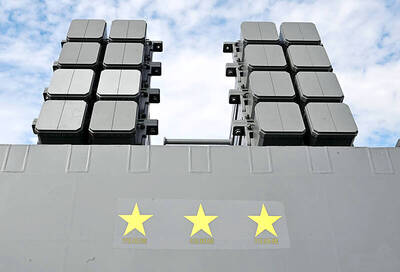
UPGRADE: The Kang Ding-class frigate is replacing its Chaparall missiles with Tien Chien II and Hua Yang VLS, which would provide it with long-range, 360° air defense Taiwan plans to produce 1,200 to 1,376 Hai Chien II missiles (海劍二, Sea Sword II) — also known as TC-2N — to serve as the standard air defense system of the navy’s surface combatant fleet, a source said yesterday. Last week, the Hai Chien II, the naval version of the Tien Kung II missile (天劍二, Sky Sword II), completed a live-fire test in waters off the National Chungshan Institute of Science and Technology’s Jiupeng facility (九鵬) in Pingtung County’s Manjhou Township (滿州). The MIM72 Chaparral and other dated air defense missiles that currently arm Taiwanese ships have inadequate range to combat Chinese

REASONS FOR TRAVEL: An assistant professor said that proposed amendments to penalize drivers if they used drugs overseas would not deter people from traveling People who operate a motor vehicle under the influence of marijuana would have their driver’s license revoked, even if they used the substance while overseas, the Ministry of Transportation and Communications said yesterday, citing proposed amendments to the Road Traffic Management and Penalty Act (道路交通管理處罰條例). The amendments would also authorize the government to revoke the licenses of people determined to have used Category 1 or Category 2 narcotics, even if they were not operating a vehicle while under the influence of drugs, as well as ban them from taking the license test for three years, the ministry said. People aged 18 or

HEAVY WEATHER: Typhoon Jangmi is due to crash straight into the Ryukyus as airlines look to shift flights to larger aircraft or cancel flights to Okinawa entirely Taiwan’s international air carriers announced flight adjustments over the weekend as Typhoon Jangmi is forecast to hit the Ryukyu Islands today and tomorrow. The Central Weather Administration (CWA) upgraded Jangmi from a tropical storm to a typhoon at 8am yesterday, with the eye located 580km south of Naha city. It was moving north at 19kph. Today, China Airlines’ CI-120, CI-121, CI-122 and CI-123 flights between Taoyuan and Naha, Okinawa, have been canceled as well as CI-132 and CI-133 between Kaohsiung and Naha. EVA Air’s BR-112, BR-113, BR-186 and BR-185 flights between Taoyuan and Naha are also canceled. Low-cost carrier Tigerair Taiwan canceled IT-230,
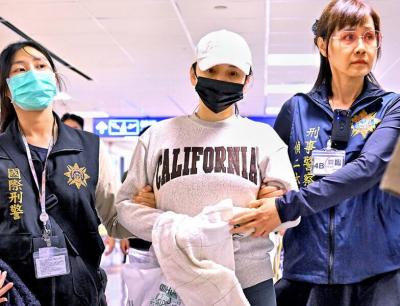
Johanne Liou (劉喬安), a Taiwanese woman who shot to unwanted fame during the Sunflower movement protests in 2014, returned to Taiwan last night after being deported from the US. She is to stand trial in Taiwan for charges involving embezzlement, fraud and drug crimes. The Criminal Investigation Bureau (CIB) said it took her into custody at Taiwan Taoyuan International Airport and would first question her before transferring her to the New Taipei District Prosecutors’ Office. She was arrested upon disembarking a flight from San Francisco that landed shortly before 7pm. Liou absconded to the US in 2019 after jumping bail


 RSS
RSS