


Speaking in Taipei yesterday, two Japanese opposition lawmakers joined in the chorus calling for Taiwan's Legislative Yuan to pass a resolution in support of a bill that would require the Japanese government to apologize to and compensate former "comfort women."
"We believe it would be helpful to our push for such a bill if we could get a resolution in Taiwan's legislature to support our move," said Tomiko Okazaki, a lawmaker and member of Japan's Democratic Party.
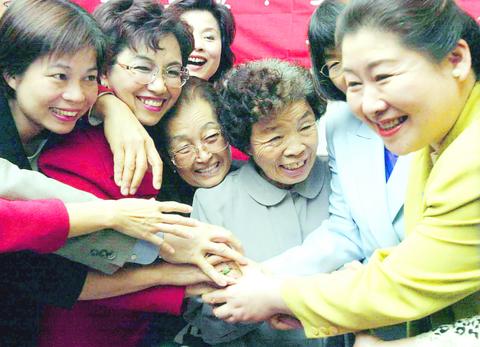
PHOTO: CHIANG YING-YING, TAIPEI TIMES
The term "comfort women" refers to the more than 200,000 women from Taiwan, China, South Korea, North Korea, the Philippines and Indonesia who were forced to serve as sex slaves for the Imperial Japanese Army before and during World War II.
Okazaki made the remarks at a press conference held by KMT Legislator Chiang Yi-wen (
Both these female members of the Diet were present at the press conference at the invitation of Chiang. The decleration of support is intended to influence the Japanese Diet as it gets ready to vote on new bills surrounding the issue of comfort women.
Two former Taiwanese comfort women, in their 70s and 80s, were also present at the press conference.
"We are encouraged by the fact that there are people, both in Taiwan and Japan, who care about us," said Chen Tao (
Okazaki added that she hoped the resolution would be passed by the Legislative Yuan before a special session of the Japanese Diet is called on Oct.18.
According to Chiang, the Japanese government has so far refused to give official compensation to former wartime sex slaves, saying obligations related to wartime atrocities were settled under the 1951 San Francisco Peace Treaty.
But a private Asian Women's Fund was set up in June 1995, funded by private contributions from the Japanese people, to offer each surviving comfort woman ?2 million (about US$17,000) in compensation.
"However, since the fund was liquidated on May 1 this year, the only way to solve the comfort-women issue now is through legislation," said Chiang, adding that most of the surviving women, including those from Taiwan, had turned down the compensation offer because the money came from private donations rather than the Japanese government.
Chiang said that the Tokyo District Court is expected to rule on Oct. 15 on a lawsuit that was filed by nine former comfort women from Taiwan in July, 1999. The suit was filed against the Japanese government and asks for a formal apology and compensation of ?10 million (about US$85,000) each.
"Judging from other cases that had been filed by former comfort women from other countries, we are not optimistic that the court will rule in favor of the comfort women," said Chiang.
Taiwan currently has 37 registered former comfort women.

Considering that most countries issue more than five denominations of banknotes, the central bank has decided to redesign all five denominations, the bank said as it prepares for the first major overhaul of the banknotes in more than 24 years. Central bank Governor Yang Chin-lung (楊金龍) is expected to report to the Legislative Yuan today on the bank’s operations and the redesign’s progress. The bank in a report sent to the legislature ahead of today’s meeting said it had commissioned a survey on the public’s preferences. Survey results showed that NT$100 and NT$1,000 banknotes are the most commonly used, while NT$200 and NT$2,000

The Centers for Disease Control (CDC) yesterday reported the first case of a new COVID-19 subvariant — BA.3.2 — in a 10-year-old Singaporean girl who had a fever upon arrival in Taiwan and tested positive for the disease. The girl left Taiwan on March 20 and the case did not have a direct impact on the local community, it said. The WHO added the BA.3.2 strain to its list of Variants Under Monitoring in December last year, but this was the first imported case of the COVID-19 variant in Taiwan, CDC Deputy Director-General Lin Ming-cheng (林明誠) said. The girl arrived in Taiwan on

South Korea is planning to revise its controversial electronic arrival card, a step Taiwanese officials said prompted them to hold off on planned retaliatory measures, a South Korean media report said yesterday. A Yonhap News Agency report said that the South Korean Ministry of Foreign Affairs is planning to remove the “previous departure place” and “next destination” fields from its e-arrival card system. The plan, reached after interagency consultations, is under review and aims to simplify entry procedures and align the electronic form with the paper version, a South Korean ministry official said. The fields — which appeared only on the electronic form

The Ministry of Foreign Affairs (MOFA) is suspending retaliation measures against South Korea that were set to take effect tomorrow, after Seoul said it is updating its e-arrival system, MOFA said today. The measures were to be a new round of retaliation after Taiwan on March 1 changed South Korea's designation on government-issued alien resident certificates held by South Korean nationals to "South Korea” from the "Republic of Korea," the country’s official name. The move came after months of protests to Seoul over its listing of Taiwan as "China (Taiwan)" in dropdown menus on its new online immigration entry system. MOFA last week


 RSS
RSS