


A local university has completed the installation of a world-class test facility for large-scale models of surface ships and submarines, which the university says could be of much help to the navy.
The test facility, called the Large Cavitation Tunnel (LCT), is the third largest of its kind in the world. Completed earlier this year, it sits in the Keelung-based National Taiwan Ocean University (NTOU). It cost nearly NT$400 million to build and took more than three years to complete.
The university made a detailed introduction to the functions and capabilities of the LCT on Wednesday at the Tenth National Conference on Naval Ship Engineering hosted by the Chung-Cheng Institute of Technology of the military.
Dr. Ke Yung-tse (
"Commercial ship designs do not need to be tested in the LCT. Only military ships will need tests in the LCT, since they must not produce much noise while in operation," Ke said.
The LCT tests are aimed at finding out -- using a one-tenth scale model of a surface ship or submarine design -- the noise level which would be produced by the vessel's propeller or the vortex which would be caused by the hull design of the vessel.
"If the navy is not interested in using the university's LCT for the design of a submarine, it could consider applying it to find out the noise levels or other relevant facts about surface ships already in service," Ke said.
"The domestically-built Cheng Kung-class frigate, for instance, has been short of such data since the design phase. It is really necessary for the navy to start building a data bank for the Cheng Kung-class frigate regarding facts such as the noises that the ship produces during operation," he said.
The university's installation of a world-class LCT marks part of the efforts being made by academic institutions to comply with the government's policy of developing a self-reliant defense industry.
Besides NTOU, the National Taiwan University and National Chen Kung University have also built similar but lower-end test facilities, which the navy could use in its ship-building efforts.
But these efforts might not be appreciated by defense contractors, who prefer to buy mature technologies from abroad rather than domestically-developed ones that need to take time to become reliable.
The state-run China Shipbuilding Corp. (CSBC), which has been bidding to participate in the construction of part of the eight diesel-powered submarines that the US has promised to get for Taiwan, does not think the university's LCT will be of any help to its submarine building project.
A spokesman for the CSBC said the company does not want to start from scratch, since it does not have much time.
"We are now trying to import existing submarine designs from abroad so as to be able to get into the business as early as possible," the company spokesman said.
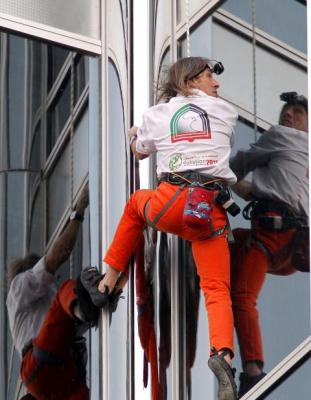
Alain Robert, known as the "French Spider-Man," praised Alex Honnold as exceptionally well-prepared after the US climber completed a free solo ascent of Taipei 101 yesterday. Robert said Honnold's ascent of the 508m-tall skyscraper in just more than one-and-a-half hours without using safety ropes or equipment was a remarkable achievement. "This is my life," he said in an interview conducted in French, adding that he liked the feeling of being "on the edge of danger." The 63-year-old Frenchman climbed Taipei 101 using ropes in December 2004, taking about four hours to reach the top. On a one-to-10 scale of difficulty, Robert said Taipei 101
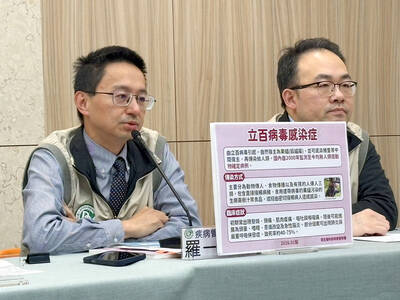
Nipah virus infection is to be officially listed as a category 5 notifiable infectious disease in Taiwan in March, while clinical treatment guidelines are being formulated, the Centers for Disease Control (CDC) said yesterday. With Nipah infections being reported in other countries and considering its relatively high fatality rate, the centers on Jan. 16 announced that it would be listed as a notifiable infectious disease to bolster the nation’s systematic early warning system and increase public awareness, the CDC said. Bangladesh reported four fatal cases last year in separate districts, with three linked to raw date palm sap consumption, CDC Epidemic Intelligence
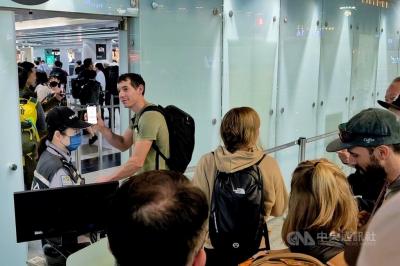
US climber Alex Honnold left Taiwan this morning a day after completing a free-solo ascent of Taipei 101, a feat that drew cheers from onlookers and gained widespread international attention. Honnold yesterday scaled the 101-story skyscraper without a rope or safety harness. The climb — the highest urban free-solo ascent ever attempted — took just more than 90 minutes and was streamed live on Netflix. It was covered by major international news outlets including CNN, the New York Times, the Guardian and the Wall Street Journal. As Honnold prepared to leave Taiwan today, he attracted a crowd when he and his wife, Sanni,
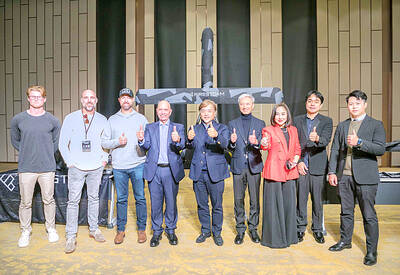
Taiwanese and US defense groups are collaborating to introduce deployable, semi-autonomous manufacturing systems for drones and components in a boost to the nation’s supply chain resilience. Taiwan’s G-Tech Optroelectronics Corp subsidiary GTOC and the US’ Aerkomm Inc on Friday announced an agreement with fellow US-based Firestorm Lab to adopt the latter’s xCell, a technology featuring 3D printers fitted in 6.1m container units. The systems enable aerial platforms and parts to be produced in high volumes from dispersed nodes capable of rapid redeployment, to minimize the risk of enemy strikes and to meet field requirements, they said. Firestorm chief technology officer Ian Muceus said


 RSS
RSS