


Anti-nuclear activists will this weekend launch their first nationwide march since the DPP took power in 2000 to raise environmental awareness and push for the scrapping of the Fourth Nuclear Power Plant.
The action will be the activists' third march since September 1994, when former DPP chairman Lin I-hsiung (
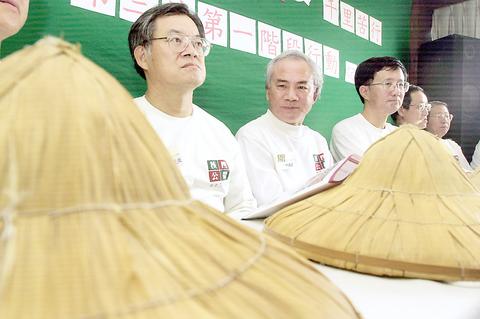
PHOTO: LIAO CHENG-HUEI, TAIPEI TIMES
At a press conference yesterday in Taipei, march organizer Cheng Hsien-yu (
According to Cheng, the 1,000-km march across Taiwan will begin Saturday and will again demand a national referendum on the future of the nuclear plant, now under construction.
"If we have more people raising consciousness with regard to public affairs, we will get the power to scrap the Fourth Nuclear Power Plant," Cheng said.
Plans for the demonstration have participants marching 20km each weekend for at least 50 weeks.
Cheng said he hopes a referendum can be held in time for the presidential election in 2004.
"A referendum is one of basic rights people have to get involved in the decision-making process," Cheng said.
Cheng said that his goal of building a nuclear-free country could be reached soon if the public, in addition to demanding the scrapping of the Fourth Nuclear Power Plant, seeks the decommissioning of Taiwan's three operational nuclear plants.
In addition to activists from groups such as the Taiwan Environmental Protection Union, Taiwan Agenda 21, the Home-makers' Union and Foundation and the Taiwan Peace Foundation, environmentally minded professors will also participate in the march.
Campaign staff with DPP Taipei mayoral candidate Lee Ying-yuan (李應元) have also signed up, Cheng said.
The organizer added that people shouldn't see the march as political because it is merely an action designed to educate the public.
Former DPP chairman Lin also attended the press conference yesterday but refused to comment when asked if the DPP government had expressed concerns about the event.
"I'm just one of the members of the march who wants to raise public awareness on the nuclear power issue," Lin said.
Lin's action was interpreted as criticism of the ruling DPP, which reversed its decision in October 2000 to halt construction of the nuclear plant after giving in to opposition parties in January last year.
DPP Deputy Secretary-General Michael You (
You said that the party's inability to follow through on its promises can be attributed to the short period of time it has wielded real power in the legislature.
You added that the march would not hurt the party.


UPGRADE: The Kang Ding-class frigate is replacing its Chaparall missiles with Tien Chien II and Hua Yang VLS, which would provide it with long-range, 360° air defense Taiwan plans to produce 1,200 to 1,376 Hai Chien II missiles (海劍二, Sea Sword II) — also known as TC-2N — to serve as the standard air defense system of the navy’s surface combatant fleet, a source said yesterday. Last week, the Hai Chien II, the naval version of the Tien Kung II missile (天劍二, Sky Sword II), completed a live-fire test in waters off the National Chungshan Institute of Science and Technology’s Jiupeng facility (九鵬) in Pingtung County’s Manjhou Township (滿州). The MIM72 Chaparral and other dated air defense missiles that currently arm Taiwanese ships have inadequate range to combat Chinese

REASONS FOR TRAVEL: An assistant professor said that proposed amendments to penalize drivers if they used drugs overseas would not deter people from traveling People who operate a motor vehicle under the influence of marijuana would have their driver’s license revoked, even if they used the substance while overseas, the Ministry of Transportation and Communications said yesterday, citing proposed amendments to the Road Traffic Management and Penalty Act (道路交通管理處罰條例). The amendments would also authorize the government to revoke the licenses of people determined to have used Category 1 or Category 2 narcotics, even if they were not operating a vehicle while under the influence of drugs, as well as ban them from taking the license test for three years, the ministry said. People aged 18 or
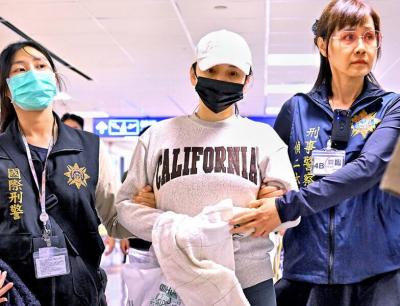
Johanne Liou (劉喬安), a Taiwanese woman who shot to unwanted fame during the Sunflower movement protests in 2014, returned to Taiwan last night after being deported from the US. She is to stand trial in Taiwan for charges involving embezzlement, fraud and drug crimes. The Criminal Investigation Bureau (CIB) said it took her into custody at Taiwan Taoyuan International Airport and would first question her before transferring her to the New Taipei District Prosecutors’ Office. She was arrested upon disembarking a flight from San Francisco that landed shortly before 7pm. Liou absconded to the US in 2019 after jumping bail
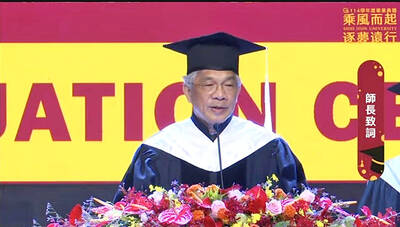
Shih Hsin University President Chen Ching-he (陳清河) yesterday issued a public apology for comments made in his commencement speech last week, stating that he has asked the school to suspend his duties and halt his wages for two months as a show of contrition. At the commencement ceremony on May 30, Chen said, “If you don’t manage your time well, or your own emotions, or your health, then I am telling every one of you — put a quick end to ‘you,’ because the world has no need for ‘you.’” The comments have sparked significant controversy online, and Chen through an open


 RSS
RSS