

While "betel nut beauties" in Taoyuan County continue to protest against a new policy prohibiting the exposure of their breasts, bellies and buttocks, police in Hsinchu City have launched a crackdown on those who attract business by wearing skimpy clothes at their betel-nut stands, local media reported yesterday.
Due to fierce competition, many betel-nut-stand operators have employed young women to sell their products in bikinis or thongs.
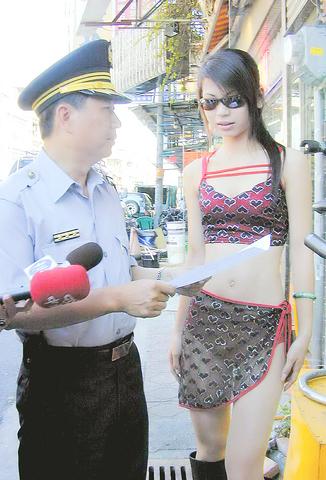
PHOTO: LEE HSIN-HUNG, TAIPEI TIMES
In response, the Taoyuan County Government announced on Monday a "three nos" policy which prohibits the exposure of betel-nut beauties' breasts, bellies and buttocks.
The government's plan, however, triggered a backlash from the betel-nut industry.
One Taoyuan betel-nut beauty, nicknamed Hsiao Ju (
"I have a beautiful body, and I also love to show my pretty clothes to the customers. What's wrong with that?" Hsiao Ju was quoted by a Chinese-language newspaper as saying yesterday.
The Collective of Sex Workers and Supporters protested the regulations in front of the Taoyuan County Hall yesterday morning. Members of the group showed their navels to the cameras, shouting slogans such as "My belly button is guaranteed harmless and it's very cute" and "My body, my job, my own business."
Collective chairwoman Wang Fang-ping (王芳萍) said the government has a double-standard when it comes to betel-nut beauties.
"All the automobile exhibitions or computer shows have hired young women who dress sexy to attract business. No one has any objection to that," Wang said.
"Even popular entertainers such as A-Mei [
However, Deputy County Commissioner Liao Cheng-ching (廖正井) said yesterday that as much as 90 percent of parents in Taoyuan support the "three nos" policy and that the county government will be firm on enforcing the regulations.
Liao also took the murder of a betel-nut-stand operator as an example, saying that the operator was killed by a teenager because he tried to stop the boy from touching a betel-nut beauty's buttocks.
"How can showing butts be OK?" Liao asked.
"[The women] should definitely cover the front of their bodies," Liao said, adding, however, that it's all right for them to show their backs.
In Hsinchu City, police have launched a crackdown on the betel-nut industry in response to the "three nos."
According to the Hsinchu City Police Department, authorities arrested more than 480 betel-nut beauties and their employers between January and last month for violating the Teenagers' Welfare Law (少年福利法), the Social Order Maintenance Law (社會秩序維護法), the Road Traffic Management and Punishment Law (道路交通管理處罰條例), the Business Registration Law (商業登記法) and other regulations.


Two executives of drone supplier Jiin Ming Industry Co (錦明實業) have been detained and held incommunicado over the company's alleged use of prohibited China-made chips and camera lenses in drones supplied under recent military contracts, the Taoyuan District Prosecutors' Office said today. In a statement, prosecutors said they raided the offices of Jiin Ming — headquartered in Taoyuan — as well as those of its subsidiaries and its suppliers on Thursday last week. The raids followed a report that the company had breached its procurement contracts by putting the prohibited components into drones delivered to the military. During the raids, prosecutors summoned
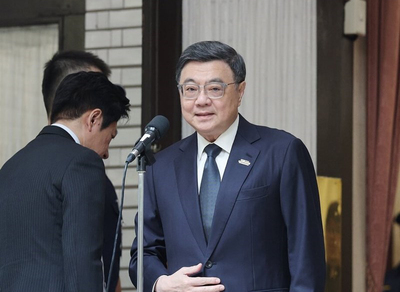
The government would continue monitoring online rumors that a pneumonic plague outbreak has spread from Russia into China and could enhance existing quarantine measures, Premier Cho Jung-tai (卓榮泰) said today. During a legislative meeting, Democratic Progressive Party Legislator Wang Ting-yu (王定宇) said rumors were circulating that the disease had spread across several Chinese provinces. He asked Cho whether the government was prepared to prevent the disease from spreading to Taiwan, given the frequent exchanges between Taiwan and China, and how concerned the government was about the alleged outbreak. The Ministry of Health and Welfare implemented border quarantine measures after briefing the Executive Yuan

South Korean boy band BigBang drew 120,000 fans to three concerts at Taipei Dome from Friday through yesterday, as the band thanked them for their support over their 20-year career. The Taipei Dome concerts were part of BigBang's "2026-2027 World Tour XX: Cosmos." Friday's concert was BigBang's first performance in Taiwan in 11 years. During the encore, group leader G-Dragon (GD) shouted "I love you" in Chinese and said he was especially happy to perform in Taiwan with bandmates Taeyang and Daesung. "Taipei, I'm very grateful to you all," GD said in Chinese, asking fans to wait for the band's return. Daesung thanked
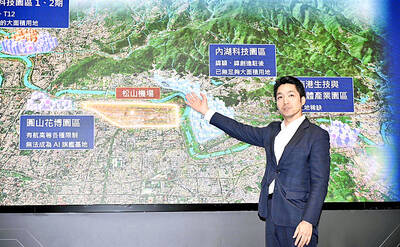
DETAILED PLAN NEEDED: Relocating the airport would affect not just travelers, but also undermine national defense and emergency medical services, a legislator said Taipei Mayor Chiang Wan-an (蔣萬安) yesterday proposed relocating Taipei International Airport (Songshan airport) and turning the site into an artificial intelligence (AI) park, drawing opposition from politicians across party lines. Chiang’s plan would turn the 300 hectares into an AI park featuring tech clusters, residential communities and green space. The industrial cluster would host 200 domestic enterprises, generate NT$12 trillion (US$376.47 billion) in output, and accommodate 65,000 jobs and 35,000 residents, he said. Cabinet spokeswoman Michelle Lee (李慧芝) said the Executive Yuan was surprised by the announcement, as the Taipei City Government did not discuss the proposal with the central government before making


 RSS
RSS