


A controversy over the establishment of the Makao Chinese Cypress National Park (
While more than 600 Atayal Aborigines, led by independent Aboriginal legislator May Chin (
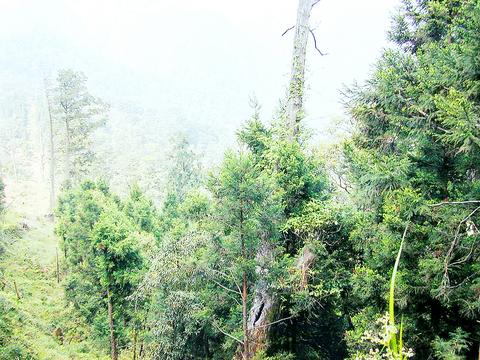
PHOTO: LEE KUEI-CHUNG, TAIPEI TIMES
Not the first controversy
It wasn't the first time there's been controversy concerning the Makao National Park, a proposed park that is to cover 53,000 hectares of sprawling mature forest in northern Taiwan, encompassing four Atayal Aboriginal villages in Wulai township, Taipei County; Fuhsing township in Taoyuan County; Chienshih township in Hsinchu County; and Tatung township in Ilan County.
According to Tien Chiu-chin (田秋菫), secretary-general of the Taiwan Cypress Woods Protection Association, the controversy over the establishment of the park first emerged four years ago when environmentalists grew upset with the government's logging.
Purporting to be clearing unhealthy and dead trees, the Forest Protection Department under the Vocational Assistance Commission for Retired Servicemen (VACRS,
"Noting such, we [conservationists] called for the preservation of trees," Li Ken-cheng (
And it was through a lot of work and effort -- including three large-scale demonstrations and a petition with more than 100,000 signatures -- that the VACRS was finally banned from cutting down the forests on Makao Mountain in 1999, Lee said.
Primary landmark
According to Chen Yueh-fong (陳玉峰), professor of the ecology department at Providence University's Graduate Institution, Makao National Park, with Chilan Mountain (棲蘭山) in Ilan County as its primary landmark, has Asia's only virgin cypress forest and rare natural ecology
"The area has the only extensive and homogenous Taiwanese red cypress (
The government has promised that the Makao National Park will be managed under joint management mechanisms between the government and Aborigines, with the protection of the interests of local Aborigines and conservation of their culture as the principal aim.
Protesters led by Chin, however, questioned whether such mechanisms offered Aborigines a true chance to have a say in the park's management.
Chin also argued that the establishment of the proposed national park would only bring gain to special-interest groups, while the area's Aborigines would remain impoverished.
Autonomous region
Anti-park protesters called for the return of tribal areas to their traditional owners and proposed that the park be turned into an autonomous region for Aborigines instead.
"We don't want a 53,000-hectare national park but an autonomous region of our own," Chin said.
But Chen disagreed with the protesters' claims.
"If we were to speak in terms of the rightful owners of the natural territory, none of us -- nor the Atayal Aborigines -- existed before these red and yellow cypress trees," he said. "We have no right to destroy the environment where they live."
Lee added: "The establishment of the Makao National Park is the outcome we've strived for for all these years. We all should cherish it, for it is a way for us to retain the vitality of the land and to preserve the area's biodiversity after 40 years of logging."
Echoing Chen's remarks, Adong Yupasu, secretary-general of the Association for Continuing Development of the Atayal Tribe, added that establishment of the Makao National Park would not run in conflict with the anti-Makao protesters' call for an autonomous region.
"Their call for an autonomous region has been reduced to a mere slogan, for they are asking for the instant establishment of autonomy, yet in order to have such a goal realized, there are many things that need to be set in place such as the need to amend all laws pertaining to autonomy," Adong Yupasu said.
"In comparison, the establishment of the Makao National Park needs no amendments to regulations and would allow us to take a gradual course that would lead to autonomy in the future," he said, explaining that continued development of the Atayal culture and livelihood would be able to be preserved, as people are trained to manage the park and local Aborigines' economical status greatly improves due to their ownership and management of related national park establishments such as customer service centers, entertainment parks, recreation centers and tourist resting stations.
Gaining recognition
The Aboriginal activist said it is through the demonstration and incorporation of wisdom and experience gained by Aborigines over thousands of years into the management of the park and relevant regulations that Aborigines will be able to gain recognition.
"The establishment of the Makao National Park is different from any previous national park," he added. "Before, there was no way for Aboriginal people to voice our opinion on national parks but the government now is more inclined to respect Aboriginal rights and thus provide channels to communicate with us and take into account our considerations."
Chen Yueh-fong said: "To protect these rare cypress is the best gift we could leave for our future generations. For where will there be Aboriginal culture if there is no more primitive forest about?"

Considering that most countries issue more than five denominations of banknotes, the central bank has decided to redesign all five denominations, the bank said as it prepares for the first major overhaul of the banknotes in more than 24 years. Central bank Governor Yang Chin-lung (楊金龍) is expected to report to the Legislative Yuan today on the bank’s operations and the redesign’s progress. The bank in a report sent to the legislature ahead of today’s meeting said it had commissioned a survey on the public’s preferences. Survey results showed that NT$100 and NT$1,000 banknotes are the most commonly used, while NT$200 and NT$2,000

The Centers for Disease Control (CDC) yesterday reported the first case of a new COVID-19 subvariant — BA.3.2 — in a 10-year-old Singaporean girl who had a fever upon arrival in Taiwan and tested positive for the disease. The girl left Taiwan on March 20 and the case did not have a direct impact on the local community, it said. The WHO added the BA.3.2 strain to its list of Variants Under Monitoring in December last year, but this was the first imported case of the COVID-19 variant in Taiwan, CDC Deputy Director-General Lin Ming-cheng (林明誠) said. The girl arrived in Taiwan on

South Korea is planning to revise its controversial electronic arrival card, a step Taiwanese officials said prompted them to hold off on planned retaliatory measures, a South Korean media report said yesterday. A Yonhap News Agency report said that the South Korean Ministry of Foreign Affairs is planning to remove the “previous departure place” and “next destination” fields from its e-arrival card system. The plan, reached after interagency consultations, is under review and aims to simplify entry procedures and align the electronic form with the paper version, a South Korean ministry official said. The fields — which appeared only on the electronic form

The Ministry of Foreign Affairs (MOFA) is suspending retaliation measures against South Korea that were set to take effect tomorrow, after Seoul said it is updating its e-arrival system, MOFA said today. The measures were to be a new round of retaliation after Taiwan on March 1 changed South Korea's designation on government-issued alien resident certificates held by South Korean nationals to "South Korea” from the "Republic of Korea," the country’s official name. The move came after months of protests to Seoul over its listing of Taiwan as "China (Taiwan)" in dropdown menus on its new online immigration entry system. MOFA last week


 RSS
RSS