


The dispute over whether to print "Taiwan" in Roman script on the cover of ROC passports sparked a row in the legislature yesterday, with Taipei's unofficial ambassador to the US saying there's no harm in calling the country "Taiwan" in "informal documents."
Chen Chien-jen (
During the interpolation session, legislators bombarded the seasoned diplomat with various questions ranging from the prospects for President Chen Shui-bian's (
But even before the interpellation began, the committee meeting saw a chaotic dispute over the passage last week of a non-binding resolution recommending that "Taiwan" in Roman script be printed above "Passport" on the cover of the nation's passport.
The foreign ministry announced in January that "Issued in Taiwan" would be placed at the bottom of the nation's passport covers starting later this year.
KMT Legislator Sun Kuo-hwa (
He also warned the foreign ministry not to take the recommendations seriously, triggering protests from lawmakers that supported the resolution.
Opposition lawmakers such as Sisy Chen (
"I am glad that I am not the incumbent minister of foreign affairs so that I don't have to make the decision [on the issue]," the former foreign minister said.
While declining to directly comment on the issue, Chen added, "The mainland called us Taiwan, and so does the US as well as many other countries. So there is no reason why we shouldn't call ourselves `Taiwan' on informal documents."
On the probability of the president's visit to the US capital, Chen said the issue was complex and sensitive thus requiring wisdom and diplomatic skills to handle it.
"There is a difference between pushing for the issue and having the visit realized," Chen said.
Chen said the consensus reached between him and the US government was not to discuss the issue in public unless President Chen's visit to Washington could be realized.
On the possibility of forging a Taipei-Washington FTA, Chen Chien-jen pinpointed several factors that may impede progress, including Taiwan's ability to be WTO-compliant, lobbies by various interest groups in the US, as well as "the third party" factor, referring to China's obstruction.
As the US is currently negotiating with Singapore and Chile on forging FTAs, the progress in these talks would affect the US' willingness to seek possibilities to forge the agreement with Taiwan, Chen added.
"Singapore has been targeted by the US as the first Asian country with which the US would forge an FTA with. It is possible that the US will not make further contacts with us until its negotiations with Singapore are completed," Chen said.
The US-Singapore FTA talks have almost been completed, but there are still many issues to be overcome, according to Chen.
The US International Trade Commission is scheduled to complete its report on the economic impact on the US economy of signing an FTA with Taiwan to the US Senate Committee on Finance no later than Oct. 17.

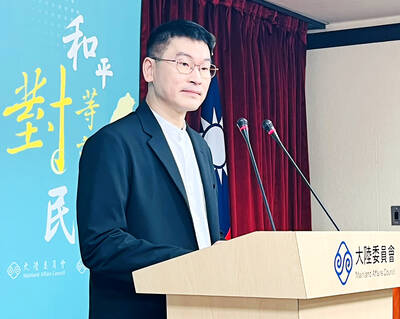
An essay competition jointly organized by a local writing society and a publisher affiliated with the Chinese Communist Party (CCP) might have contravened the Act Governing Relations Between the People of the Taiwan Area and the Mainland Area (臺灣地區與大陸地區人民關係條例), the Mainland Affairs Council (MAC) said on Thursday. “In this case, the partner organization is clearly an agency under the CCP’s Fujian Provincial Committee,” MAC Deputy Minister and spokesperson Liang Wen-chieh (梁文傑) said at a news briefing in Taipei. “It also involves bringing Taiwanese students to China with all-expenses-paid arrangements to attend award ceremonies and camps,” Liang said. Those two “characteristics” are typically sufficient
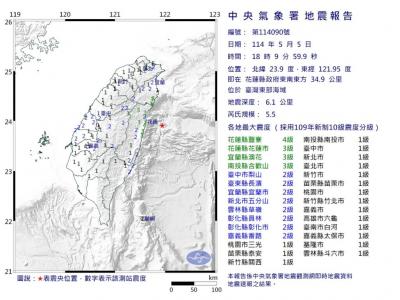
A magnitude 5.9 earthquake that struck about 33km off the coast of Hualien City was the "main shock" in a series of quakes in the area, with aftershocks expected over the next three days, the Central Weather Administration (CWA) said yesterday. Prior to the magnitude 5.9 quake shaking most of Taiwan at 6:53pm yesterday, six other earthquakes stronger than a magnitude of 4, starting with a magnitude 5.5 quake at 6:09pm, occurred in the area. CWA Seismological Center Director Wu Chien-fu (吳健富) confirmed that the quakes were all part of the same series and that the magnitude 5.5 temblor was
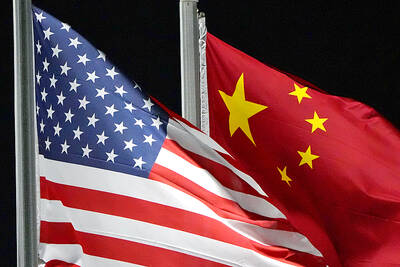
The brilliant blue waters, thick foliage and bucolic atmosphere on this seemingly idyllic archipelago deep in the Pacific Ocean belie the key role it now plays in a titanic geopolitical struggle. Palau is again on the front line as China, and the US and its allies prepare their forces in an intensifying contest for control over the Asia-Pacific region. The democratic nation of just 17,000 people hosts US-controlled airstrips and soon-to-be-completed radar installations that the US military describes as “critical” to monitoring vast swathes of water and airspace. It is also a key piece of the second island chain, a string of
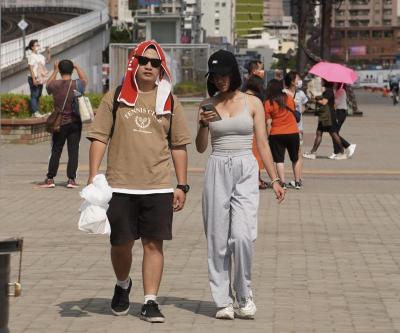
The Central Weather Administration has issued a heat alert for southeastern Taiwan, warning of temperatures as high as 36°C today, while alerting some coastal areas of strong winds later in the day. Kaohsiung’s Neimen District (內門) and Pingtung County’s Neipu Township (內埔) are under an orange heat alert, which warns of temperatures as high as 36°C for three consecutive days, the CWA said, citing southwest winds. The heat would also extend to Tainan’s Nansi (楠西) and Yujing (玉井) districts, as well as Pingtung’s Gaoshu (高樹), Yanpu (鹽埔) and Majia (瑪家) townships, it said, forecasting highs of up to 36°C in those areas


 RSS
RSS