


Although none other than President Chen Shui-bian (
"Just like many parents, I am worried about the TV channels broadcasting so much information about killings, suicides, and arson," the president said in a speech to commemorate the 40th anniversary of Taiwan Television Enterprise last Sunday.
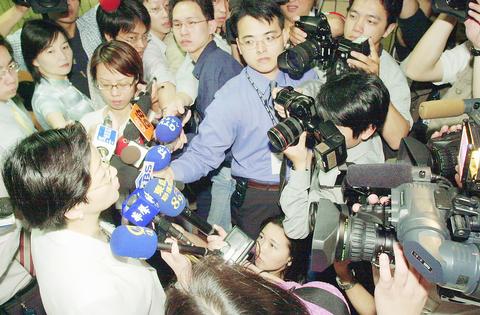
PHOTO: CHIANG YING-YING, TAIPEI TIMES
"We hope that the media can strike a balance in its reporting between positive and negative, speed and depth ? local and international," Chen said.
With cable TV stations operating 24 hours a day, so-called "social news" now dominates the stations' output. Cable news channels broadcast at least 30 minutes of social news every hour, including coverage of road accidents, fires, thefts, even domestic disputes despite criticism from scholars and some media employees.
Lost opportunity
"After the martial law era ended, Taiwan missed the opportunity to create a media environment focused on the analysis and discussion of issues, creating instead a current totally commercialized and sensationalized media," said Ping Lu (
Ping Lu added that since Taiwan's media does not invest in extensive coverage of international news or in-depth coverage of major local stories, it chooses instead to focus on the minutiae of local society, "most of which doesn't even count as news."
Chang Fu-chin (
"Taiwan doesn't generate enough news to fill the space created by its 24-hour cable news channels. With the pressure to fill space, anything new is considered news," Chang said.
"There should be a standard by which to judge whether to broadcast social news. Social news should not just be about the personal issues of a particular family or individual, but should have some significance for society," he said.
Managers of the news channels, however, objected to the assertion that they broadcast too much social news.
"We don't think we broadcast too much social news. The amount of social news is not much more than that of other categories of news in our average of 400 daily news bulletins," said Wang Cheng-chung (
"Social news does not necessarily make society look negative. It really depends on how you look at it. It reflects what's going on in society."
Taiwan has five 24-hour news channels: TVBS, Power TV, Formosa TV, Eastern TV and Sanlih TV. There are also four terrestrial TV stations broadcasting about 4 hours of news per day, while another cable channel, GALA TV, will start broadcasting news next week.
Social news became the staple of Taiwanese news broadcasts in 1997, after the kidnap and murder of Pai Hsiao-yen (
In light of their "success," they continued to try to recreate the format by homing in on private tragedies such as suicides and suicide attempts, unusual romances -- such as one between a 19-year-old man and a 51 year-old woman -- and on members of the public cursing when stopped by police officers.
Five years on, however, opinion polls -- though not TV ratings -- have suggested that viewers are starting to object to this kind of reporting.
TTV and CTS have taken such surveys seriously enough to seek to minimize the broadcasting of trivia and to focus on news coverage accompanied by analysis and discussion. The ratings, however, show audience appetites for trivia to be undiminished.
Attention deficit
"Taiwan's audiences have been trained to be impatient. They like things that stimulate their senses rather than topics for discussion," said Chiu Yueh (
"Broadcasting less social news and emphasizing analysis and discussion has been a difficult choice for us, especially because of commercial concerns," Chiu said.
Cho Mei-ling (
Ping Lu said that Taiwan audiences "have become used to being made to feel slightly disturbed. Social news is very easy to watch. We don't need to think about it, and we don't get too emotional about it."
Scholars concurred that with the channels' neck-and-neck competition in the current sluggish economy, concerns about ratings will continue to prevent them from changing the nature of their output. But they don't expect to see viewers switching off on a grand scale either.
"TV news bulletins have become more like variety shows in Taiwan. Most of the audience doesn't feel particularly excited by variety shows, but they watch them anyway, which is exactly the same attitude that prevents them from quitting watching TV news," Ping Lu said.

Considering that most countries issue more than five denominations of banknotes, the central bank has decided to redesign all five denominations, the bank said as it prepares for the first major overhaul of the banknotes in more than 24 years. Central bank Governor Yang Chin-lung (楊金龍) is expected to report to the Legislative Yuan today on the bank’s operations and the redesign’s progress. The bank in a report sent to the legislature ahead of today’s meeting said it had commissioned a survey on the public’s preferences. Survey results showed that NT$100 and NT$1,000 banknotes are the most commonly used, while NT$200 and NT$2,000

The Centers for Disease Control (CDC) yesterday reported the first case of a new COVID-19 subvariant — BA.3.2 — in a 10-year-old Singaporean girl who had a fever upon arrival in Taiwan and tested positive for the disease. The girl left Taiwan on March 20 and the case did not have a direct impact on the local community, it said. The WHO added the BA.3.2 strain to its list of Variants Under Monitoring in December last year, but this was the first imported case of the COVID-19 variant in Taiwan, CDC Deputy Director-General Lin Ming-cheng (林明誠) said. The girl arrived in Taiwan on

South Korea is planning to revise its controversial electronic arrival card, a step Taiwanese officials said prompted them to hold off on planned retaliatory measures, a South Korean media report said yesterday. A Yonhap News Agency report said that the South Korean Ministry of Foreign Affairs is planning to remove the “previous departure place” and “next destination” fields from its e-arrival card system. The plan, reached after interagency consultations, is under review and aims to simplify entry procedures and align the electronic form with the paper version, a South Korean ministry official said. The fields — which appeared only on the electronic form

The Ministry of Foreign Affairs (MOFA) is suspending retaliation measures against South Korea that were set to take effect tomorrow, after Seoul said it is updating its e-arrival system, MOFA said today. The measures were to be a new round of retaliation after Taiwan on March 1 changed South Korea's designation on government-issued alien resident certificates held by South Korean nationals to "South Korea” from the "Republic of Korea," the country’s official name. The move came after months of protests to Seoul over its listing of Taiwan as "China (Taiwan)" in dropdown menus on its new online immigration entry system. MOFA last week


 RSS
RSS