


The Taiwan High Court Prosecutors' Office (
Hsieh Zhong-liang (謝忠良), a senior reporter from Next magaz-ine, was also charged for the same violation on Thursday. The pros-ecutors' office ordered Hsieh to answer questioning next Thursday about who tipped him off about the NSB's two secret accounts.
The magazine announced that it will appeal the decision on Monday.
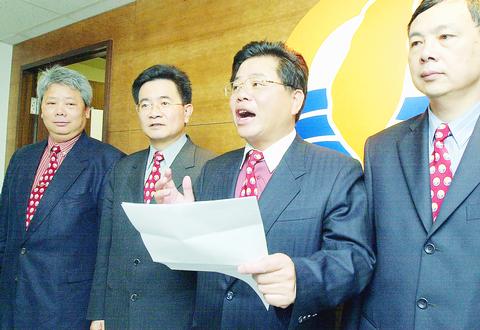
PHOTO: CHIANG YING-YING, TAIPEI TIMES
Pei Wei (裴偉), executive editor of Next, insisted that the magazine's story has nothing to do with national security.
"What we did was to report a scandal, corruption in the NSB which everybody should know about," Pei said.
"Of course, we know the importance of national security and we would not touch that issue either."
Both the magazine and the newspaper printed roughly the same story. The difference was that Next ran the story under Hsieh's name, while the China Times did not print the reporter's byline. As a result, Prosecutor Chen Uen-li (陳文禮) decided to charge the newspaper's editor in chief.
At press time, Huang still had not received any notice of his being charged by the prosecutors and he refused to make any statements.
In the meantime, Minister of Justice Chen Ding-nan (陳定南) yesterday said that the raid on Next magazine's offices was aimed at collecting evidence, not confiscating the magazine itself. He said that prosecutors will also search the NSB for evidence, if necessary.
While attending a regular legislative meeting at the Legislative Yuan yesterday, KMT lawmaker Hung Hsiu-chu (洪秀柱) asked Chen whether it was really necessary for the prosecutors to crack down on the magazine. Hung also asked if prosecutors would dare to search NSB offices. Chen said that prosecutors were just doing their duty -- to investigate any case that could endanger national security -- and they will do the same in the NSB case if necessary.
Hung also asked Chen whether the prosecutors' raid on the magazine might have violated press freedom. Chen replied that the pro-secutors were just trying to collect evidence about the leaking of classified information -- and that it had nothing to do with violating press freedom, according to Chen.
"Press freedom is important," Chen said. "But national security weighs more."
"Well, in fact," he added, "we had searched the NSB office in Yanmingshan for information in the earlier case of former colonel Liu Kuan-chun (
"Therefore I can say there is no question about whether we would `dare' to do it or not. If the NSB violates the Criminal Code, prosecutors will administer the necessary searches, arrests or detentions of their officials, without exception."
Liu was the NSB's former chief cashier and is wanted by authorities for allegedly embezzling NT$192 million.

Considering that most countries issue more than five denominations of banknotes, the central bank has decided to redesign all five denominations, the bank said as it prepares for the first major overhaul of the banknotes in more than 24 years. Central bank Governor Yang Chin-lung (楊金龍) is expected to report to the Legislative Yuan today on the bank’s operations and the redesign’s progress. The bank in a report sent to the legislature ahead of today’s meeting said it had commissioned a survey on the public’s preferences. Survey results showed that NT$100 and NT$1,000 banknotes are the most commonly used, while NT$200 and NT$2,000

The Centers for Disease Control (CDC) yesterday reported the first case of a new COVID-19 subvariant — BA.3.2 — in a 10-year-old Singaporean girl who had a fever upon arrival in Taiwan and tested positive for the disease. The girl left Taiwan on March 20 and the case did not have a direct impact on the local community, it said. The WHO added the BA.3.2 strain to its list of Variants Under Monitoring in December last year, but this was the first imported case of the COVID-19 variant in Taiwan, CDC Deputy Director-General Lin Ming-cheng (林明誠) said. The girl arrived in Taiwan on

South Korea is planning to revise its controversial electronic arrival card, a step Taiwanese officials said prompted them to hold off on planned retaliatory measures, a South Korean media report said yesterday. A Yonhap News Agency report said that the South Korean Ministry of Foreign Affairs is planning to remove the “previous departure place” and “next destination” fields from its e-arrival card system. The plan, reached after interagency consultations, is under review and aims to simplify entry procedures and align the electronic form with the paper version, a South Korean ministry official said. The fields — which appeared only on the electronic form

The Ministry of Foreign Affairs (MOFA) is suspending retaliation measures against South Korea that were set to take effect tomorrow, after Seoul said it is updating its e-arrival system, MOFA said today. The measures were to be a new round of retaliation after Taiwan on March 1 changed South Korea's designation on government-issued alien resident certificates held by South Korean nationals to "South Korea” from the "Republic of Korea," the country’s official name. The move came after months of protests to Seoul over its listing of Taiwan as "China (Taiwan)" in dropdown menus on its new online immigration entry system. MOFA last week


 RSS
RSS