


In just six years, and with close to 2 million of its products already sold to customers in 10 countries worldwide, the Taipei-based multinational Advanced Digital Broadcast (ADB) is making impressive inroads into markets around the world.
Today, at Taipei's American Club in China, ADB will spotlight its growth. Andrew Rybicki, ADB founder, president and CEO, along with Miguel Caballero, general manager (Hong Kong) of Europe's second largest bank, the Banco Bilbao Vizcaya Argentaria (BBVA), will sign an agreement to grant ADB special banking facilities.
The BBVA, Europe's second largest bank, finances a sizable portion of ADB's business in Europe, notably in Spain, where ADB is already the vendor of choice of Madritel, Spain's largest cable TV operator. During the past year, ADB has shipped more than 90,000 cable television set-top boxes to Madritel.
The ADB-BBVA agreement will also enable expansion elsewhere, notably in Israel, to which ADB has already shipped over 300,000 set-top boxes -- a total which gives the set-top box designer and developer a 65 percent share of the Israeli STB market. Newly won customers, particularly in the US, are pointing the way toward further, significant worldwide expansion.
Earlier this month, ADB signed a multi-million dollar deal to provide 1 million set-top boxes through to 2005 to a US customer, set to deploy the first enhanced digital broadcast platform for US broadcasters and viewers.
Poland-born Andrew Rybicki said, "For ADB, the hallmark of this agreement is its pioneering nature. It makes ADB the first company operating out of Asia-Pacific to enter the US high-definition TV (HDTV) market.
"Congress has mandated that the change from analog to digital high-definition broadcasting must occur within the next five years."
Ordinarily, this would mean broadcasters would face enormous costs in converting to a digital signal, and the huge US TV viewing public would find itself having to make the very expensive change into new HDTV-compatible sets.
ADB has bypassed the need for that by providing a low-cost alternative: a smart digital decoder, that enables conversion to over-the-air HDTV viewing. This will enable them as a broadcaster to enhance their program content, accelerate consumer adoption of HDTV, and also generate revenue.
How this deal will change ADB's position in the worldwide ranking of digital decoder sales remains to be seen. Rybicki said the company is 12th in the world in the number of boxes shipped.
ADB employs about 275 staff in 10 countries. The company, with operations headquarters here in Taipei, also maintains a 5,000m2 Software and Customer Support Engineering facility -- ADB Polska -- in Zielona Gora, western Poland.
Here, more than 180 development engineers, led by some of the most innovative minds in the industry, continue to grow the company's worldwide reputation for expertise in digital decoder software design and customization, and modular design.
Their products have included integrated electronic program guides and impulse pay-per-view systems, universal electronic data, and fully interactive stock quotation and trading systems, and a satellite to cable transcoder for condominium distribution of digital satellite broadcasts.
Tomasz Nowacki, the director of the Warsaw Trade Office in Taipei, highlights an important facet of ADB's engineers by describing them as "showcase representatives in Poland's software development arena."
"Poland is coming up fast as a world leader in software development," Nowacki said.
We have emerged over the past decade as a country that has given its software engineers a very solid grounding in the theoretical side. However, because of lack of funds we could do little more than that.
Now, he explained, "With growing international investment we can match that advantage of strength in theory with the funds for putting theory into practice, and we are continuing to discover a new reputation for ourselves. The people at ADB Polska are at the forefront of that self discovery."

‘NO SECURITY RISK’: The Railway Bureau reassured the public that the technicians’ activities were limited to technical guidance and did not involve sensitive systems The Railway Bureau yesterday said it had invited eight Chinese technicians to assist with an airport MRT construction project. The bureau issued the confirmation after an Internet user said Chinese nationals had entered the construction zone of Taiwan Taoyuan International Airport’s Terminal 3 project. They asked why “individuals from an enemy state” were allowed access to such a major national infrastructure project, which raised serious concerns over Taiwan’s industrial safety, sensitive systems and information security. The bureau’s Northern Region Engineering Branch Office said subcontractor Taiwan Handle Industrial Co (台灣手把工業) of the Taoyuan airport MRT’s “Contract No. CU05 Project A14 Station Civil, MEP &

A US uncrewed surface vessel (USV) encountered multiple Chinese warships during an autonomous transit of the Taiwan Strait, US defense company Seasats said in a statement on Wednesday. Seasats announced that a Lightfish USV had completed the first autonomous transit of the Taiwan Strait. Over five days, the USV traversed the entire length of the Strait while constantly monitoring surface vessel traffic, the company said. The Lightfish encountered multiple Chinese warships, one of which was a Chinese People’s Liberation Army Navy (PLAN) Type 056 corvette, it said. The Chinese vessels were operating “well within Taiwan’s exclusive economic zone without transmitting their identity via the
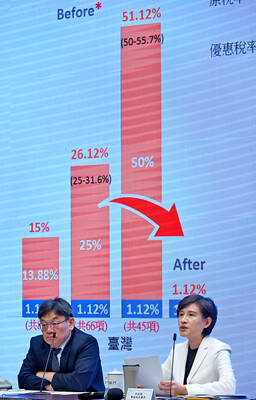
GREATER REACH? Auto parts and wood products would face tariffs of up to 15%, matching those targeting the EU, Japan and South Korea, Vice Premier said The US has announced that preferential tariff treatment for Taiwan’s non-semiconductor Section 232 goods would take effect retroactively from May 1, the Executive Yuan said yesterday. The US government yesterday posted a notice on the Federal Register’s public inspection Web site previewing tariff concessions for Taiwan under a memorandum of understanding (MOU) on Taiwan-US investment after two months of negotiations. The MOU signed on Jan. 15 stipulated three major preferential tariff arrangements: a 15 percent “reciprocal” tariff rate for Taiwan without stacking most-favored nation (MFN) rates; preferential Section 232 treatment for semiconductors and related products; and preferential Section 232 treatment for non-semiconductor

The National Chungshan Institute of Science and Technology yesterday showcased its locally developed variants of the Vision 60 robotic patrol dog, which it plans to deploy on the nation’s outlying territories in the South China Sea. The variants were produced under the Joint Lab project — created by the institute and domestic companies — and assembled with domestically produced motors, lenses and artificial intelligence (AI) systems alongside licensed tech from the US, Missile and Rocket Systems Research Division deputy director Jen Kuo-kang (任國光) told the media event at a military base in Taipei’s Dazhi (大直) area. Taiwan has built up its strengths


 RSS
RSS