

Prominent Australian rowing figures have criticized the approval of Rockhampton’s crocodile-inhabited Fitzroy River as the venue for the sport at the Brisbane Olympics, arguing the course would require extensive investment and leave little lasting legacy.
Worries about the venue initially focused on the 500 crocodiles that live in and around the river, but there are also concerns about the impact of river current on the fairness of competition and the lack of accommodation in the city of 80,000.
However, Queensland Premier David Crisafulli announced in state parliament on Thursday that an independent technical review had found the course capable of hosting fair rowing and canoeing competitions in 2032.
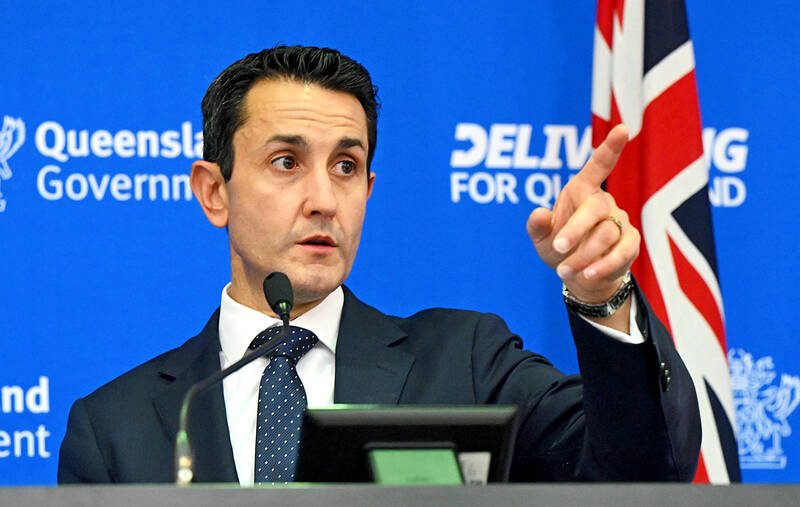
Photo: AP
Experienced coaches and former elite rowers remain unconvinced that a venue about 600km north of the host city is the best option.
“Without a massive infrastructure spend, it’s just going to be like a country regatta with Olympic athletes,” said former world championship medalist Andrew Butler, who has coached rowing for 17 years, including on the Fitzroy River.
“Why are you taking it 700km away from a multi-sport event when it’s obviously not to a better venue?”
Three-times Olympic champion Drew Ginn said he had concerns that water depth, river characteristics and the potential for flooding could all impact the competition.
“I row on a river in Melbourne. I love rowing on it, love training on it, but I’d never want to compete at the Olympic Games on it,” he said.
“If you have flowing and moving water, that is completely unfair,” Ginn said.
“One lane over another lane can be dramatically different. Imagine if [a flood] happens the week of the competition. Races get cancelled or the venue has to be moved,” he said.
“There’s never been a national championships held there, there’s a reason for that. It feels like it’s a gamble that the Queensland government’s taking,” he added.
Ginn also called for the technical review to be made public.
“If there’s good evidence for it and good data for it, then you should be able to make it transparent,” he said.
In a statement issued by Brisbane 2032 organizers on Thursday, World Rowing President Jean-Christophe Rolland was quoted as saying the venue could deliver fair competition, but unusually the body did not issue its own statement nor the report.
There was no immediate response from World Rowing to a request for comment on the technical endorsement.
In a short statement, Rowing Australia “acknowledged” the completion of the technical review while making it clear neither it nor Rowing Queensland had played any part in the process.
John Driessen, an Olympic rowing coach and former elite rower who has coached on the Fitzroy River, echoed Butler and Ginn’s concerns over the legacy of the venue.
“I’ve coached at Fitzroy and it worked really well. But turning it into an Olympic-class course, I would have thought would be quite expensive and difficult,” he said.
“There’d be a lot of money going into a spot where there’s no real guarantee that it would benefit the state of Queensland in the future.”
However, Driessen said he did not think the Fitzroy River course would necessarily lead to unfair competition.
“It’s quite a shallow course,” he said. “If they’re going to maintain the basic principles of a rowing course with depth and lack of flow, then I think it would be a challenge to achieve that. I’m not sure that if the course was run at Rockhampton, it would be that unfair in terms of lanes,” he added.
Driessen said hosting the Olympic rowing at Moreton Bay just north of Brisbane, the site favored by Rowing Queensland, was a “no-brainer” and “the simple answer.”
Butler favored the original plan to stage the rowing on flat water at Wyaralong Dam some 86km southwest of Brisbane, describing it as “probably the best course I’ve rowed on in Queensland.”
“Investment there would be an absolute legacy ticket,” said the twice Australian champion.
However, Crisafulli is determined that regional cities around Queensland should be able to share in the Olympic experience and has previously denounced critics as “elitist.”
“I thought the Olympics was a sporting event,” Butler said.

Taiwan’s men’s basketball team yesterday drained 17 three-pointers in a 91-69 rout of Qatar, advancing to the quarter-finals of the Asian Games in Japan. The lopsided victory was largely powered by the team’s precision long-range shooting. Of the 17 three-pointers, seven came in the opening quarter, giving Taiwan an early 26-12 lead. Boosted by 40 percent shooting from long range, Taiwan also held an edge over Qatar in assists (26-13), committed fewer turnovers (6-14) and steals (9-3). Taiwan shooting guard Lin Ting-chien scored a game-high 21 points, including five three-pointers. Naturalized center Brandon Gilbeck added 12 points, nine rebounds and two steals. With a 2-1
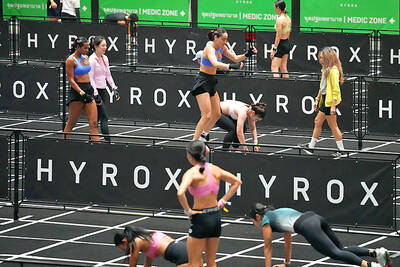
The Hyrox athletics franchise has apologized for allowing an athlete to complete an event in Beijing despite soiling herself midway through, causing an outcry on social media. Posts showed Australian athlete Joanna Wietrzyk with soiled legs and shoes, continuing to use the mats and equipment at the competition held on Saturday in the Chinese capital. She completed the event without the organizing committee intervening, and went on to win the competition, according to the Hyrox Web site. Users pointed out on social media that other participants had to touch the contaminated mats, handles and running tracks after she had used them, raising concerns

Taiwan’s Chen Zhi-ray and Lin Yu-chieh yesterday won the men's doubles final at the Yonex-Sunrise Vietnam Open badminton tournament, quickly dispatching their Singaporean opponents in straight games. Chen and Lin defeated Singapore's Terry Hee and Howin Wong 21-14, 21-12 in 27 minutes at the Badminton World Federation Super 100 event held at the Nguyen Du Club in Ho Chi Minh City. It was the first time the duo had won a BWF Tour event since they paired up in 2024. Previously, 24-year-old Chen and 26-year-old Lin had claimed top spots in three lower-level tourneys, before notching a breakthrough second-place finish at the
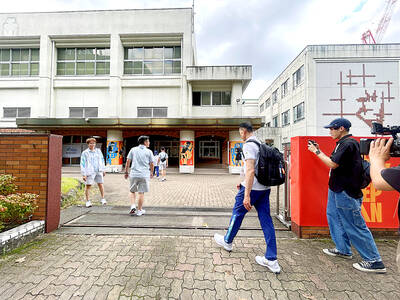
UNDER INVESTIGATION: Taiwan has replaced the damaged banner and more cameras have been installed to protect athletes and staff, the sports ministry said The Ministry of Sports yesterday called for mutual respect after a banner at a training facility used by Taiwanese athletes at the Asian Games was defaced to cover up the Chinese characters for “national” and the English word “Taiwan” in Nagoya, Japan. The banner, displayed at Misono Elementary School in Nagoya, was defaced with ink, the Chunichi Shimbun reported on Wednesday. The orange banner, measuring about 5m long by 1.5m wide, hung near the entrance to the former elementary school. In white lettering it read “National Sports Training Center” (國家運動訓練中心) in Mandarin with the English name “Taiwan Sports Training Center.” The Taiwan delegation


 RSS
RSS