


Curious spectators clutching rule books watch as a batsman smacks a six into the sand and weeds surrounding Japan’s brand-new cricket ground, four months before it hosts matches at the Asian Games.
Japanese fans might be familiar with many of the events at the Olympic-like multisport competition when it is held in Aichi Prefecture and Nagoya from Sept. 19 to Oct. 4, but most are likely to be stumped by cricket.
That would not stop them from taking an interest, and now they have a purpose-built ground to welcome star teams such as India and Pakistan.
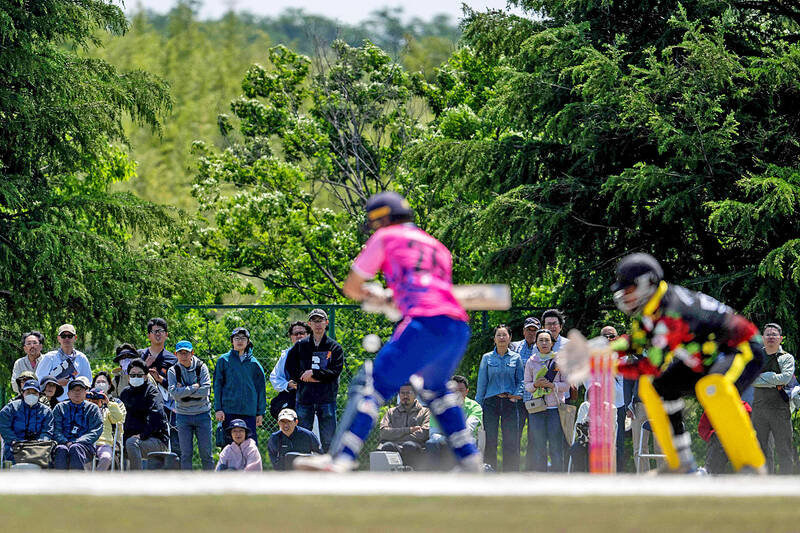
Photo: AFP
Korogi Sports Park, a converted baseball field that still has a pitcher’s mound just beyond the boundary, is about a 40-minute train ride from central Nagoya.
It is warming up for the Asian Games by hosting its first cricket event, the East Asia-Pacific qualifiers for the 2028 Men’s T20 World Cup.
The qualifiers feature Japan and fellow cricket minnows Vanuatu, Fiji, Samoa, Indonesia, the Philippines, Papua New Guinea, the Cook Islands and South Korea.
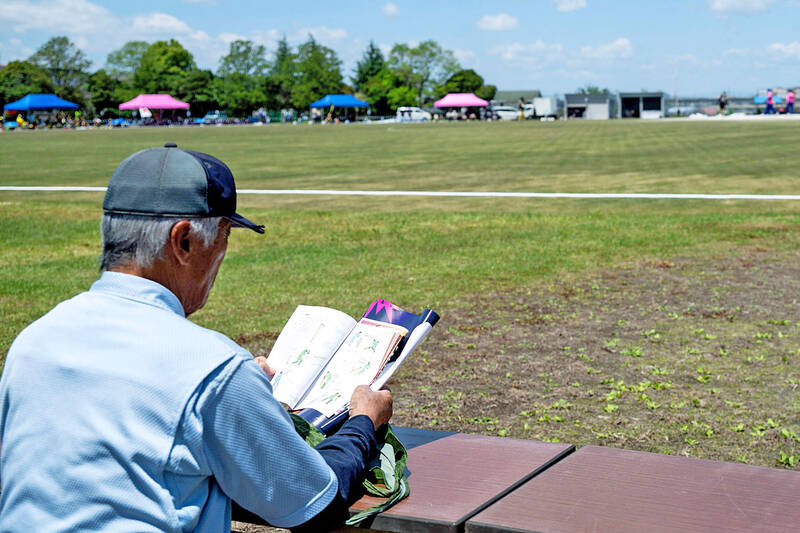
Photo: AFP
Yuya Okimasu, who watched Japan play Vanuatu with his wife and two young children, said that they had only heard of cricket because his daughter watched the Australian cartoon Bluey.
“I’m looking at the rules as I’m watching the game because I don’t understand it, but it looks fun,” said the 34-year-old, who was attending his first cricket match.
About 300 people turned up to watch Japan’s opening game on a windy weekend morning, most sitting on deck chairs within earshot of a commentator guiding them through the basics of the game.
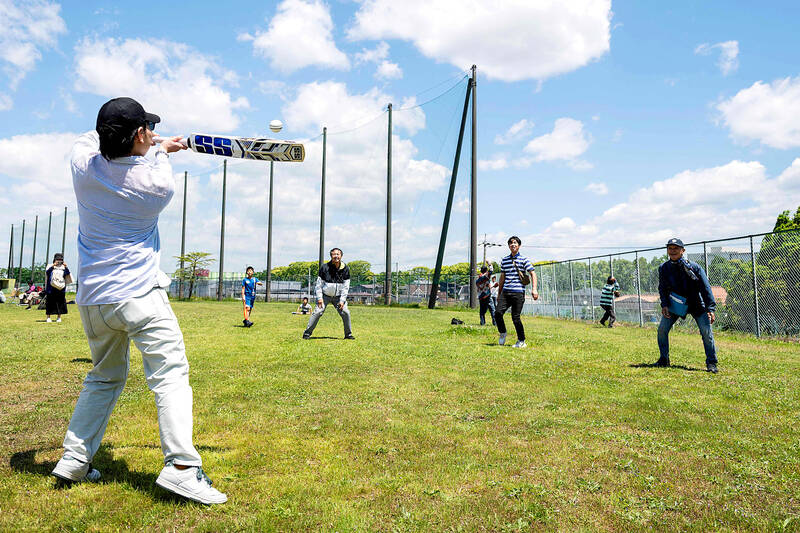
Photo: AFP
Temporary stands would be in place at the Asian Games, taking the capacity up to about 2,000.
While the continent’s star players might be used to grander surroundings, they are unlikely to be disappointed by the quality of the pitch.
That is the responsibility of Asitha Wijayasinghe, who also curates the pitch at the 35,000-capacity Pallekele International Cricket Stadium in Sri Lanka.
Adam Birss, Korogi Sports Park’s Asian Games operations manager, said the pitch is likely to be “bouncy,” even though typhoon season usually arrives in Japan in September.
“I would say that it should act like the pitches in Pakistan, which are bouncy, but also take spin,” he said. “It’s got a grippy surface, so if you put spin on the ball, it will spin off.”
Korogi Sports Park is part of an ambitious strategy to popularize cricket in baseball-mad Japan, which the International Cricket Council sees as one of its “priority countries.”
Playing numbers are on the rise, and the Japan Cricket Association (JCA) has had some success in carving out a tentative foothold for the sport in the Tokyo area.
Cricket’s inclusion in the Asian Games was only confirmed in April last year, and the JCA argued unsuccessfully that it should be played in Sano, a hotbed for the sport about 100km outside the capital.
JCA chief executive officer Naoki Alex Miyaji said Nagoya is “a huge vacuum area for cricket,” adding that he worries there might not be enough time to drum up interest there.
“Creating something here with the Asian Games is an ideal situation, but not when you’re talking with 15 months’ preparation,” he said.
Miyaji is also concerned about the long-term future of Korogi Sports Park, which would be shared with baseball teams when the Asian Games are over.
The question of who maintains the pitch is another unresolved issue, but Miyaji hopes the venue can be “one of the key ingredients of the growth of cricket in Japan.”
The local mayor has been an enthusiastic supporter, and there was certainly interest among those who venture along to watch Japan’s game against Vanuatu.
The Japanese players do their bit, beating their opponents by 30 runs.
With only four months to go until the Asian Games begin, Japan’s players are hoping the buzz continues.
“The ground looks in incredible condition given that they only started building it a few months ago,” Japan captain Kendel Kadowaki-Fleming said. “Excitement is the overwhelming emotion that we’re feeling about it.”

For some, Cristiano Ronaldo remains the essential spearhead for Portugal’s FIFA World Cup bid, while others believe his presence would prevent Roberto Martinez’s strong side from flourishing. The debate around the five-time Ballon d’Or winner rages on, as it did at UEFA Euro 2024 and four years ago in Qatar — yet Ronaldo endures, ready to play in a record sixth World Cup. The 41-year-old remains a global superstar despite swapping the European elite for Saudi Arabia’s Al-Nassr, and is the leading men’s international goalscorer with 143 strikes. With 25 of those coming in 30 games under Martinez, the coach
Taiwanese tennis star Hsieh Su-wei on Wednesday advanced to the second round of the mixed doubles at the French Open, after she and German partner Mark Wallner defeated Slovenian Andreja Klepac and Briton Lloyd Glasspool in straight sets, despite temperatures exceeding 32°C in Paris, while Taiwan’s top men’s doubles player Ray Ho also reached the second round. Hsieh, who made it to the semi-finals in the mixed doubles at Roland Garros in 2024, and Wallner defeated Klepac and Glasspool 6-3, 7-5 in just more than an hour, converting three of five break points, while holding their opponents to just one conversion

FAST AND LOOSE: Despite command struggles, Ohtani has pitched his way out of trouble after falling behind in counts, which manager Roberts credited to his velocity Shohei Ohtani on Wednesday night tossed six innings of no-hit ball, gave himself an early lead with a home run and still was not satisfied with his performance. The Los Angeles Dodgers’ two-way superstar dropped some expletives that were picked up by the on-field mic as he struggled with his command in a 4-1 win over the Colorado Rockies. He struck out seven, walked four and gave up an earned run in the fourth inning while visibly fuming on the mound. Ohtani (5-2) earned his third consecutive victory. “Just command was off, and I just felt like I was battling the lack of
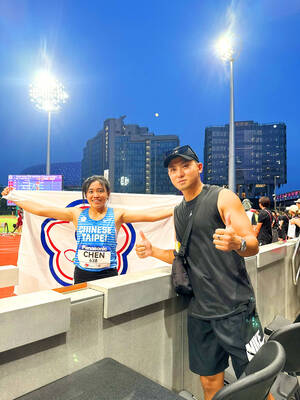
Taiwanese sprinter Chen Yi-cen on Friday won the silver medal in the women’s 400m final at the Asian U20 Athletics Championships in Hong Kong, with a time of 53.16 seconds. Chen, 15, was the youngest among the eight finalists, and her performance also met the qualifying standard of 53.50 seconds for the Nagoya Asian Games in Japan in September and October. Chen first made her mark at the National Games in Tainan in 2023, at the age of 13, winning the women’s 400m final in 55.55 seconds to become the youngest gold medalist in the history of the event. Meanwhile,


 RSS
RSS