


The players struck their crutches against each other as they chased a soccer ball, as well as a larger dream of competing at the global level. Children shrieked in joy as they watched a goalie dive to block an attempt with her remaining hand.
Amputee soccer, a seven-a-side version of the game in which players roam the field on crutches and goalkeepers have one arm, has grown steadily in Rwanda over the past decade. Players say they have found a community on the field after embracing a sport some never imagined they could play. For many, it offers not only physical rehabilitation, but also a sense of belonging.
In the capital, Kigali, amputees play to foster healing and social cohesion after traumas that include the country’s darkest period: the 1994 genocide, in which about 800,000 Tutsis and moderate Hutus were massacred by the majority Hutu population over a 100-day period.
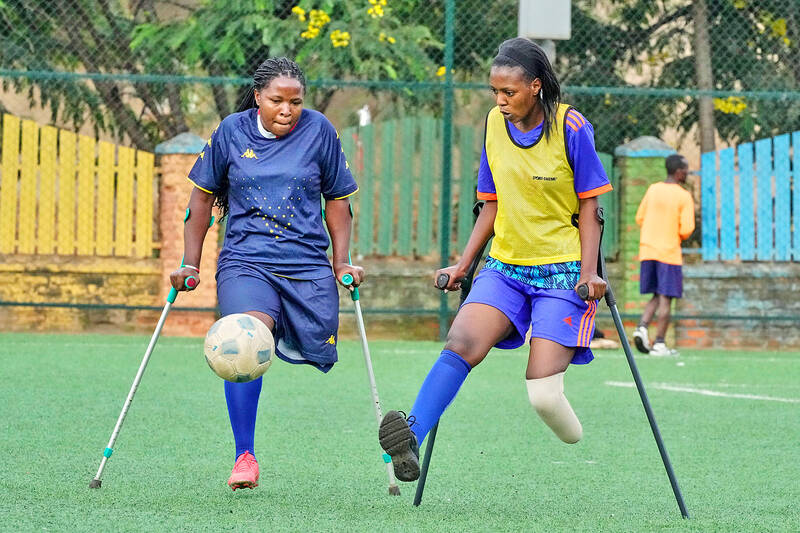
Photo: AP
Nyiraneza Solange was born two years after the genocide, and lost her leg at the age of 5 after falling and developing an infection. She said the resilience shown by people who lost limbs during the genocide attracted her to amputee soccer.
She was encouraged by the former coach of the country’s first amputee soccer team, who told her she could use her crutches to play. She quickly left any fear behind.
“I don’t even think about I don’t have a leg,” Solange said, adding that she feels free while playing and has overcome the stigma that accompanies being an amputee.
Rwanda is estimated to have more than 3,000 lower-limb amputees. Some are victims of the genocide. Others are survivors of road accidents or illness.
Rwanda Amputee Football Association vice president Louise Kwizera said the sport enables players to learn to trust again, building unity in a society that “was once divided.”
“In communities affected by conflict or trauma, the playing field becomes a place of peace. People who may have different pasts come together as teammates,” Kwizera said.
Rwanda hopes to take part next year in the second women’s amputee soccer World Cup, an invitational event expected to be held in Poland or Brazil. Rwanda was represented by only a single player at the first edition of the competition in 2024.
The sport, governed by the World Amputee Football Federation, is played in more than 50 countries. Rwanda has five women’s professional teams and 10 for men.
Haitian women’s amputee soccer team manager Fred Sorrels, who visited Rwanda to help develop the local program, said he was rooting for the East African country to host a World Cup. However, the Rwandan Ministry of Sports said it has yet to make a formal bid.
Sorrels said he has seen the benefits of the sport.
“It’s a win psychologically and mentally for these ladies to have an opportunity to experience wholeness and wellness again,” he said.
Gilbert Muvunyi Manier, the ministry’s director general of sports development, called the sport a “powerful tool” for healing, reconciliation and social cohesion.
Players acknowledged limitations in strategy.
“It’s hard to save the ball when it goes to the side with the receding hand,” goalkeeper Nikuze Angelique said.
Like Solange, she described a sense of community found on the field.
As players took selfies after a game, Angelique said she is hopeful they would reach the World Cup.
“It will be a dream come true,” she said.

For some, Cristiano Ronaldo remains the essential spearhead for Portugal’s FIFA World Cup bid, while others believe his presence would prevent Roberto Martinez’s strong side from flourishing. The debate around the five-time Ballon d’Or winner rages on, as it did at UEFA Euro 2024 and four years ago in Qatar — yet Ronaldo endures, ready to play in a record sixth World Cup. The 41-year-old remains a global superstar despite swapping the European elite for Saudi Arabia’s Al-Nassr, and is the leading men’s international goalscorer with 143 strikes. With 25 of those coming in 30 games under Martinez, the coach

Taiwanese tennis star Hsieh Su-wei on Wednesday advanced to the second round of the mixed doubles at the French Open, after she and German partner Mark Wallner defeated Slovenian Andreja Klepac and Briton Lloyd Glasspool in straight sets, despite temperatures exceeding 32°C in Paris, while Taiwan’s top men’s doubles player Ray Ho also reached the second round. Hsieh, who made it to the semi-finals in the mixed doubles at Roland Garros in 2024, and Wallner defeated Klepac and Glasspool 6-3, 7-5 in just more than an hour, converting three of five break points, while holding their opponents to just one conversion

FAST AND LOOSE: Despite command struggles, Ohtani has pitched his way out of trouble after falling behind in counts, which manager Roberts credited to his velocity Shohei Ohtani on Wednesday night tossed six innings of no-hit ball, gave himself an early lead with a home run and still was not satisfied with his performance. The Los Angeles Dodgers’ two-way superstar dropped some expletives that were picked up by the on-field mic as he struggled with his command in a 4-1 win over the Colorado Rockies. He struck out seven, walked four and gave up an earned run in the fourth inning while visibly fuming on the mound. Ohtani (5-2) earned his third consecutive victory. “Just command was off, and I just felt like I was battling the lack of
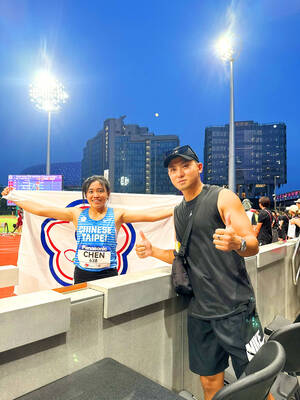
Taiwanese sprinter Chen Yi-cen on Friday won the silver medal in the women’s 400m final at the Asian U20 Athletics Championships in Hong Kong, with a time of 53.16 seconds. Chen, 15, was the youngest among the eight finalists, and her performance also met the qualifying standard of 53.50 seconds for the Nagoya Asian Games in Japan in September and October. Chen first made her mark at the National Games in Tainan in 2023, at the age of 13, winning the women’s 400m final in 55.55 seconds to become the youngest gold medalist in the history of the event. Meanwhile,


 RSS
RSS