


Italian soccer is at its lowest ebb in nearly 40 years after a wholesale European exodus at club level followed the nation’s failure for the third successive time to qualify for the FIFA World Cup, and compounded a leadership and structural crisis.
The exits suffered by Bologna and ACF Fiorentina on Thursday in the UEFA Europa League and UEFA Conference League respectively meant no Italian teams are left in European competition this season.
Italy’s last remaining UEFA Champions League contenders, Atalanta BC, went out in the round of 16 last month.
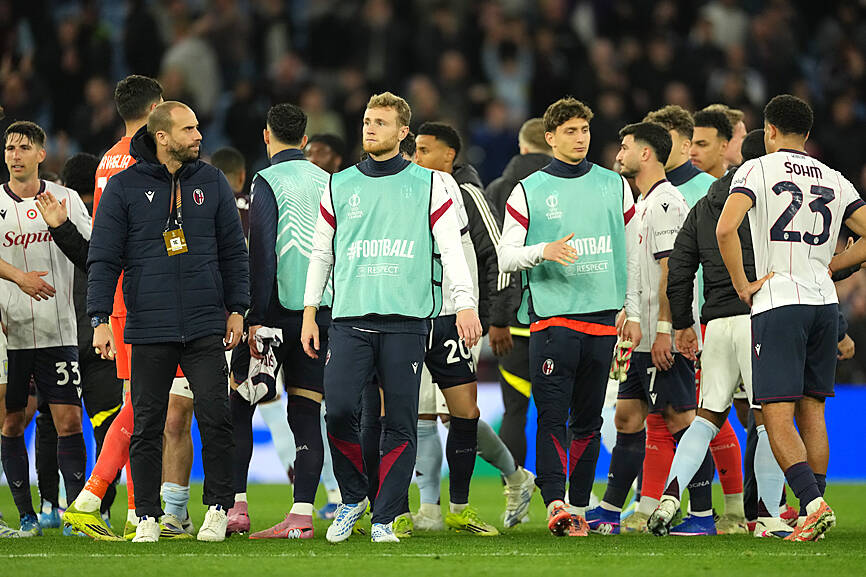
Photo: AP
It is the first time since the 1986-1987 campaign that Italian clubs have been shut out of the European semi-finals across the board in a season with three major continental competitions.
The club-level wipeout has compounded a mounting emergency in a country where soccer is a national passion.
Inter made the Champions League final last year, but they were thrashed by Paris Saint-Germain, and Atalanta won the Europa League in 2024, but Italy have stalled on several fronts.
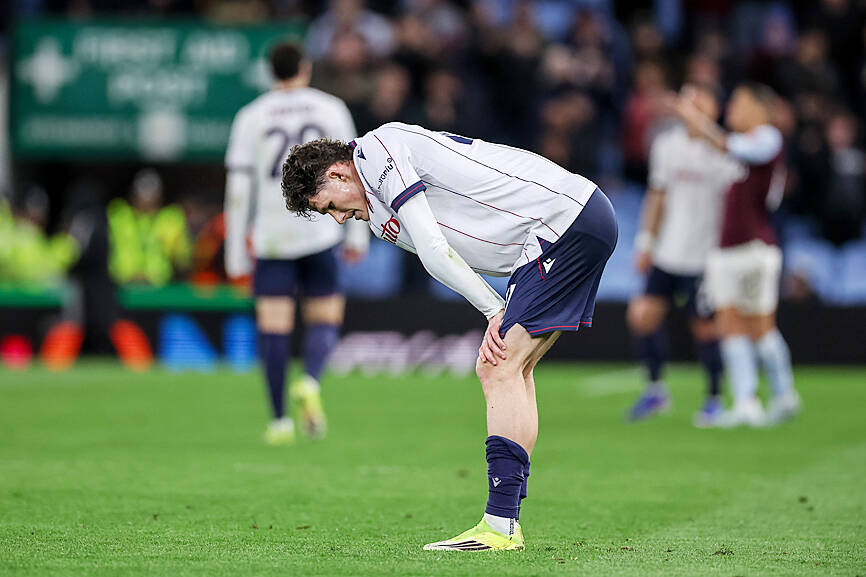
Photo: EPA
Coupled with the national team’s continued World Cup exile, Italian soccer has been plunged into an identity crisis as the country wraps up its annus horribilis season.
Italy suffered a collective shock in March after a 4-1 penalty shoot-out defeat by Bosnia and Herzegovina in their World Cup qualifying playoff final following a 1-1 draw after extra-time led to the departure of coach Gennaro Gattuso.
The resignation of Italian Football Federation president Gabriele Gravina followed in the fallout and he said that the foundations of the domestic game had crumbled.
“The crisis is deep, Italian football needs to be redesigned,” Gravina said, a warning being amplified by several Italian coaches.
Fabio Capello this week said that “it is practically impossible to get worse than this; we have hit rock bottom.”
Carlo Ancelotti, who is in charge of five-time world champions Brazil, told Italian media on Friday that the nation has lost its way on the pitch and financially.
“We already lack talent in other areas of the pitch, but the excessive focus on tactics has distorted our characteristics, the ones on which we have always built our history,” Ancelotti said.
The financial chasm between Serie A and its rivals has stripped the league of its former allure, he said.
“The great foreign players no longer come to Italy. Abroad, with substantial TV rights and powerful investors, a more attractive market is formed,” he added.
The crisis seems to pervade every level of the game, with crumbling infrastructure dominating the headlines as Italy prepares to cohost the 2032 UEFA European Championships alongside Turkey.
Italian media have warned that stadium projects are significantly behind schedule, with construction yet to begin on several key venues.
“I hope the infrastructure will be ready,” UEFA president Aleksander Ceferin said earlier this month. “Otherwise, the tournament will not be played in Italy.”
With the season wrapping up, Italy face a period of restructuring. A new coach and federation president are yet to be announced following the resignations of Gattuso and Gravina.
Media reports suggest that SSC Napoli manager Antonio Conte and AC Milan boss Max Allegri are the frontrunners to succeed Gattuso.
A decision on the next coach is unlikely before the federation elections on June 22. Until then, Italian soccer is in a state of suspended animation, waiting to see if the new leadership will opt for a total reset or more pragmatic rebuilding phase.
In the wake of a season of systemic failure, the pressure for structural reform suggests that the “status quo” is no longer an option for the Italian game that once dominated the sport.
BIG NAMES GONE: Zverev is the clear favorite for a maiden Grand Slam title, reaching semi-finals for the fifth time in six years and finishing second on three occasions Alexander Zverev on Tuesday breezed past Rafael Jodar to stay on course for an elusive Grand Slam title at the French Open, while Jakub Mensik halted Joao Fonseca’s scintillating run in the quarter-finals. Zverev, the highest-ranked player left in the men’s draw, put an end to Spanish teenager Jodar’s impressive Roland Garros debut, easing into the semi-finals with a 7-6, (7/3), 6-1, 6-3 win. The 29-year-old Zverev is the clear favorite for a maiden Grand Slam title. He has finished runner-up on three occasions, including at the 2024 French Open. “I want to win the matches that are ahead of
For some, Cristiano Ronaldo remains the essential spearhead for Portugal’s FIFA World Cup bid, while others believe his presence would prevent Roberto Martinez’s strong side from flourishing. The debate around the five-time Ballon d’Or winner rages on, as it did at UEFA Euro 2024 and four years ago in Qatar — yet Ronaldo endures, ready to play in a record sixth World Cup. The 41-year-old remains a global superstar despite swapping the European elite for Saudi Arabia’s Al-Nassr, and is the leading men’s international goalscorer with 143 strikes. With 25 of those coming in 30 games under Martinez, the coach

Taiwanese sprinter Chen Yi-cen on Friday won the silver medal in the women’s 400m final at the Asian U20 Athletics Championships in Hong Kong, with a time of 53.16 seconds. Chen, 15, was the youngest among the eight finalists, and her performance also met the qualifying standard of 53.50 seconds for the Nagoya Asian Games in Japan in September and October. Chen first made her mark at the National Games in Tainan in 2023, at the age of 13, winning the women’s 400m final in 55.55 seconds to become the youngest gold medalist in the history of the event. Meanwhile,
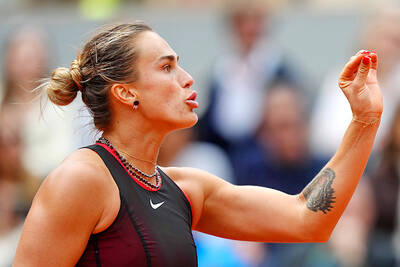
After letting another big lead slip with an error-strewn performance at the French Open on Wednesday, top-ranked Aryna Sabalenka felt like getting as far away from the courts as possible. “Just want to quit tennis right now,” Sabalenka said after wasting a lead of a set and two breaks in a 3-6, 7-5, 6-0 loss to Diana Shnaider in the women’s singles quarter-finals. “We’ll see in few days. Hopefully I’ll get back on track mentally.” Sabalenka’s wait for a first French Open title continues despite the four-time major winner leading 4-1 in the second set and being two points from victory while


 RSS
RSS