


A classified Pentagon-produced, multiyear assessment — the Overmatch brief — highlighted unreported Chinese capabilities to destroy US military assets and identified US supply chain choke points, painting a disturbing picture of waning US military might, a New York Times editorial published on Monday said.
US Secretary of Defense Pete Hegseth’s comments in November last year that “we lose every time” in Pentagon-conducted war games pitting the US against China further highlighted the uncertainty about the US’ capability to intervene in the event of a Chinese invasion of Taiwan.
“It shows the Pentagon’s overreliance on expensive, vulnerable weapons as adversaries field cheap, technologically advanced ones. And it traces a decades-long decline in America’s ability to win a long war with a major power,” the New York Times editorial said.
Photo: Reuters
The editorial said that US dominance in the Pacific two decades ago ensured its capability to defend Taiwan, as China had a small missile arsenal in 2005, which limited its threat to US forces.
Twenty years later, China boasts of missile capabilities that have the potential to destroy advanced US weapons before they come near Taiwan, the editorial said.
Newer forms of technology, doctrines and strategies show that they have become more effective against large conventional forces, with the editorial citing the Ukraine war, where Ukraine has used uncrewed surface vehicles (USVs) to neutralize the Russian Black Sea Fleet, as well as the Ukrainian drone strikes damaging and destroying many of Russia’s heavy bomber fleet.
The editorial contrasted the costs of drone manufacturing in eastern Ukraine, “typically cost a few hundred dollars to make,” to the price to build the latest Gerald R. Ford-class aircraft carrier at US$13 billion, and said that while aircraft carriers are superb against relatively weak countries such as Venezuela, they are vulnerable to other forms of attacks, such as hypersonic missiles.
Sweden’s Gotland-class diesel-powered submarine, in a 2005 war game, had landed multiple torpedo strikes against a US Nimitz-class carrier, which would have hypothetically sunk the carrier, the editorial said.
The editorial asked why successive US administrations adhered to the doctrine of relying on its fleet of super carriers and attendant carrier strike groups (CSGs), when drones, threats to undersea cables and Chinese malware seemed to define new ways of war.
Weapons procurement was limited to five major companies, the entrenched mindset of military commanders prevented innovation, and the prevailing view was that “bespoke, complex and wildly expensive” platforms were always superior, the editorial said.
Such a mentality meant the military was unable to obtain rapidly produced equipment in bulk, it said.
The US defense industry’s capability to produce artillery shells, ships, and aircraft at scale and speed has been lost, putting the US in danger of running out of essential munitions in a war against China, it added.
US defense spending should not focus on enormous new budgets, but instead should be more judicious in its investments, it said, warning that “traditional symbols of might risks shortchanging the true sources of American strength: relentless innovation, rapid adaptability and a willingness to discard old assumptions.”
The report was prepared by the Pentagon’s Office of Net Assessment and was delivered to top White House officials in the past year.
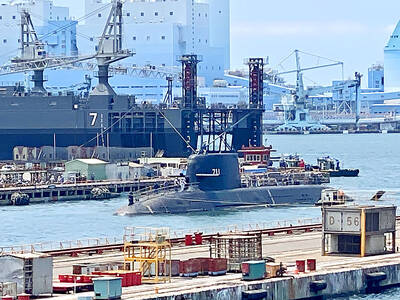
AGING: While Japan has 22 submarines, Taiwan only operates four, two of which were commissioned by the US in 1945 and 1946, and transferred to Taiwan in 1973 Taiwan would need at least 12 submarines to reach modern fleet capabilities, CSBC Corp, Taiwan chairman Chen Cheng-hung (陳政宏) said in an interview broadcast on Friday, citing a US assessment. CSBC is testing the nation’s first indigenous defense submarine, the Hai Kun (海鯤, Narwhal), which is scheduled to be delivered to the navy next month or in July. The Hai Kun has completed torpedo-firing tests and is scheduled to undergo overnight sea trials, Chen said on an SET TV military affairs program. Taiwan would require at least 12 submarines to establish a modern submarine force after assessing the nation’s operational environment and defense

A white king snake that frightened passengers and caused a stir on a Taipei MRT train on Friday evening has been claimed by its owner, who would be fined, Taipei Rapid Transit Corp (TRTC) said yesterday. A person on Threads posted that he thought he was lucky to find an empty row of seats on Friday after boarding a train on the Bannan (Blue) Line, only to spot a white snake with black stripes after sitting down. Startled, he jumped up, he wrote, describing the encounter as “terrifying.” “Taipei’s rat control plan: Release snakes on the metro,” one person wrote in reply, referring
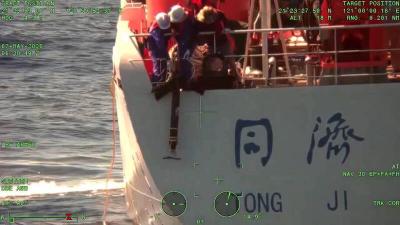
The coast guard today said that it had disrupted "illegal" operations by a Chinese research ship in waters close to the nation and driven it away, part of what Taipei sees a provocative pattern of China's stepped up maritime activities. The coast guard said that it on Thursday last week detected the Chinese ship Tongji (同濟號), which was commissioned only last year, 29 nautical miles (54km) southeast of the southern tip of Taiwan, although just outside restricted waters. The ship was observed lowering ropes into the water, suspected to be the deployment of scientific instruments for "illegal" survey operations, and the coast
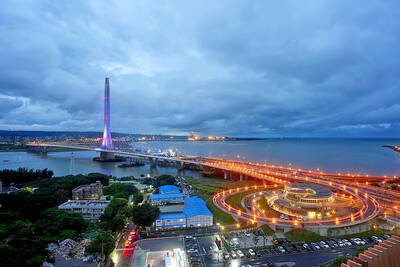
An inauguration ceremony was held yesterday for the Danjiang Bridge, the world’s longest single-mast asymmetric cable-stayed bridge, ahead of its official opening to traffic on Tuesday, marking a major milestone after nearly three decades of planning and construction. At the ceremony in New Taipei City attended by President William Lai (賴清德), Premier Cho Jung-tai (卓榮泰), Minister of Transportation and Communications Chen Shih-kai (陳世凱) and New Taipei City Mayor Hou Yu-ih (侯友宜), the bridge was hailed as both an engineering landmark and a long-awaited regional transport link connecting Tamsui (淡水) and Bali (八里)


 RSS
RSS