


Like most girls her age, Bosnian teenager Mirnesa Junuzovic splits her days into free time and time reserved for school and house chores. However, how she spends the former makes her quite unique.
The 15-year-old takes daily, hours-long walks with her bull, Cobra, and trains him for traditional bullfights that have been organized in the country for more than two centuries.
“We walk for three or more hours every day; I talk to him and call him by different nicknames that I have for him,” Junuzovic said.

Photo: AP
“I can always anticipate when he is going to rush or scrape at the ground,” she added.
She and Cobra share a special bond, and while they train and walk through the fields and forest around her rural home on the outskirts of Kakanj, the bull sometimes uses its horns to move tree branches and shrubs out of her way, she said.
When somebody else approaches him, “his whole demeanor changes” and he starts snorting, Junuzovic said.
“But he never acts like that with me,” she rushed to add. “He knows that I take care of him. He is just like a human, except that he cannot talk.”
Bullfights in Bosnia are relatively mellow and bloodless affairs resembling a natural clash for dominance between male bulls in the wild. Almost every weekend during the summer months, rodeo-like corrals are set up in forest clearings or meadows around the country.
Thousands of people gather around the enclosures in village fair-like settings to watch bull-on-bull fights in which animals push each other and clash horns until one of them admits defeat by turning their tail and fleeing. The clash often lasts just a few minutes.
Before bulls enter the arena, inspectors check their horns and even cut off the tips if they are too sharp. They also check the animals’ anti-doping test results and make sure the bulls clash heads only if they want to.
Among the village folk in Bosnia, the love of bulls and bullfighting is installed in children at an early age. Attending the fights is often embraced as a family activity.
“This is a part of our tradition. We love it,” said Muriz Spahic, who drove for more than 70km to watch bulls fighting outside the village of Bijelo Polje in central Bosnia on Sunday.
“My grandpa loves it. He is here with us today. I love it; my child loves it,” he said. “We go to the fights together.”
In between the fights, the spectators fire up grills, roast meat, drink and dance to blaring folk music.
Fighting bulls of Bosnia have traditionally been trained by men, but women started joining the fray several years ago. Still, women in the field are rare and Junuzovic, who started training bulls at the age of 12, remains the youngest of the trainers.
Some of her school friends look down at her hobby and say that it is “stinky,” she said, but those who she really cares about are “very supportive. They call to congratulate me every time we win.”
Bulls fight in different weight classes and Cobra, who weighs 620kg, is among the “lightweights.”
Cobra’s winning streak, which began eight fights ago, continued in Bijelo Polje, where he scored his ninth victory of this year’s season.
The other bull “quit,” because he “was unprepared,” Junuzovic said.
About half of the scheduled battles overall end with one of the animals leaving the ring without even trying.
“Still, we won and every victory counts,” she said with a big smile.
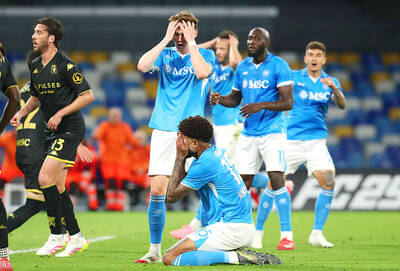
SSC Napoli’s Italian Serie A title hopes suffered a late setback on Sunday when they were held to a 2-2 draw at home against Genoa, setting up a thrilling season finale with closest rivals Inter just one point behind. The hosts remain top with 78 points, holding a slim lead over Inter, who won 2-0 at Torino earlier on Sunday, with two rounds remaining. To make matters worse for Napoli, midfielder Stanislav Lobotka, struggling with an ankle injury, was forced off just minutes after the match began. Scott McTominay delivered a perfect pass into the box where Romelu Lukaku got
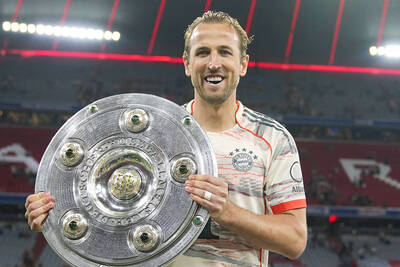
Harry Kane opened the scoring ahead of lifting his first career silverware as Bayern Munich beat Borussia Moenchengladbach 2-0, with veteran Thomas Mueller playing his last home game for the club. Bayern officially won the title on May 4 when defending champions Bayer Leverkusen were held to a 2-2 draw at Freiburg, but were presented with the Bundesliga shield in front of their home fans at full-time. Dripping wet after being showered with beer by teammates, Kane said the title win was “an incredible feeling,” and hoped it would be “the first of many.” “It’s been lot of hard work, a lot of
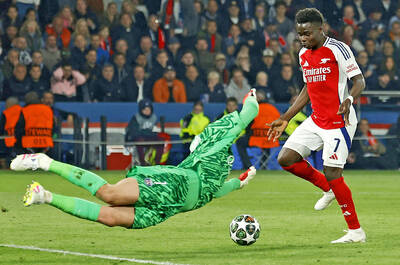
INTER AWAIT: Superb saves by PSG ’keeper Gianluigi Donnarumma inspired the victory, as Arsenal were punished for misses, including one by Bukayo Saka Arsenal on Wednesday fell short on the big stage again as their painful UEFA Champions League semi-final exit against Paris Saint-Germain left Mikel Arteta to rue his club’s failure to provide him with enough attacking options. Arteta’s side were unable to reach the Champions League final for the first time in 19 years as PSG clinched a tense 2-1 win at Parc des Princes. Trailing 1-0 from last week’s first leg in London, the Gunners made a blistering start to the second leg, but could not convert their chances as Gianluigi Donnarumma’s superb saves inspired PSG’s 3-1 aggregate victory. Arsenal were punished for

Taiwanese e-sports veteran Lin “ET” Chia-hung yesterday successfully defended his King of Fighters XV title at this year’s Evolution Championship Series: Japan (EVO Japan), securing his second consecutive championship. Lin claimed victory with a 3-1 win over Japanese pro gamer “mok” in the grand final, repeating his earlier 3-1 win against the same opponent in the winners’ final. The 40-year-old earned a ¥1 million (US$6,897) cash prize at the two-day tournament, which drew 294 competitors. Mok, Lin’s toughest rival in the bracket, took home ¥400,000 as runner-up. Lin remains undefeated in match sets against mok in King of Fighters XV, holding a 10-0 record,


 RSS
RSS