


Amid the somewhat murky details emerging from US President Donald Trump’s and Russian President Vladimir Putin’s call on Tuesday — the two leaders discussed a halt on attacking energy infrastructure, then Russia immediately bombed Ukraine’s energy infrastructure — one deal at least was clear: The US and Russia would resume playing ice hockey.
Although benign enough on the face of it, the idea of organized games in the US and Russia, between players of both countries, was yet another concession to Putin from Trump. Unlike the US president’s previous gifts — pre-emptively allowing Russia to keep the territory it has illegally invaded, refusing to give any security guarantees to Ukraine and strongly hinting US sanctions would soon be lifted — this was soft power, wrapped in a pair of skate laces.
Putin loves hockey. He plays it himself. (His clearly terrified opponents let him score at will.)

Photo: David Gonzales-Imagn Images / USA Today
Russia is a global powerhouse of the sport, but the best Russian players eventually leave Russia, to go play in the National Hockey League (NHL) in the US. The money is better, and the fame greater. Russian hockey has always been geopolitical. The Soviet teams of the 20th century were explicitly military proxies.
The players were soldiers in the Red Army. Their coach was a colonel. They bunked in barracks for 11 months of the year. When they began playing — and beating — North American teams for the first time, the matches were clashes of ideology. The communists, raised since kids to play together in a collective system on the ice, versus the individualist American and Canadian professionals trying to score goals on their own (and when that did not work, trying to bash the Russians in the head). In the 1960s and 1970s, the Soviet Union won five of six Olympic golds.
There were two big exceptions, both at the height of the cold war: the 1972 Summit Series, when a team of Canadian bruisers barely squeaked out a victory in eight games against the silky Red Army, and the 1980 Lake Placid Olympics when a plucky US team of minor-leaguers and misfits (of course) defeated the heavily favored Soviets for gold on home turf in what became known as the “Miracle on Ice.” In case you missed the significance, it inspired a Hollywood film starring Kurt Russell.
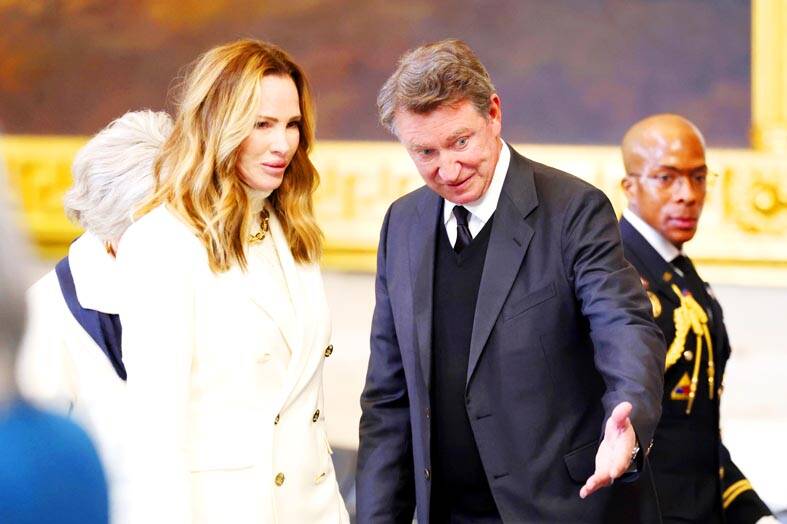
Photo: AP
To fully appreciate the geopolitical significance of these hockey proxies, look no further than the recent Four Nations competition, where Canada and the US worked out their animosity over Trump’s threats to make Canada the 51st state by beginning their first game with three separate fistfights in nine seconds.
Canada won the trophy and the nation practically imploded with emotion. The other two nations? Sweden and Finland. If you think Russia did not feel left out, let Putin bringing this up in the context of a summit with the US president about the biggest war in Europe since 1945 be a clue.
Just as Saudi Arabia knows the soft power of sport, getting back on their blades on the global ice rink would be a huge triumph for Putin’s Russia. Even better that it comes just as Alexander Ovechkin, the best Russian player of all time and the literal founder of a Putin fan club, is about to eclipse Wayne Gretzky’s NHL goal record — and to do so while playing for the Washington Capitals no less. (Gretzky is Canadian, so it is not an American loss — although he has recently attracted Canadian ire by having dinner at Mar-a-Lago and not wearing enough patriotic red.)
As for Trump, who appears to see Putin not as a foe but as an equal — great men leading great powers and carving up the world between them —the idea of a Four Nations competition was silly anyway.
For him, it has only ever been the Two Nations, and you can imagine him and Putin watching it together from the Kremlin press box at Moscow’s CSKA arena, not discussing Ukraine at all.

Greek swimmer Kristian Gkolomeev was the only athlete to “beat” a world record on Sunday at the Enhanced Games, winning the men’s 50m freestyle at the divisive competition where athletes were free to take performance-enhancing substances. His time of 20.81 seconds — which is not considered official — came in the final event of the night in Las Vegas, sparing the blushes of organizers who made claims that multiple world records would be surpassed due to a sophisticated doping regime. Gkolomeev, who was wearing a synthetic “supersuit” long banned at events such as the Olympics, outpaced Australia’s Cameron McEvoy’s 20.88 set in
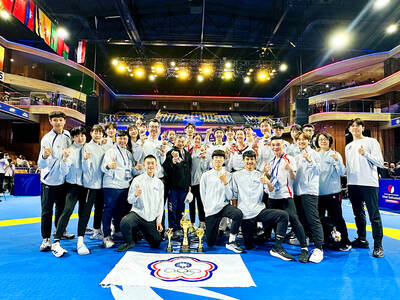
VICTORY ABROAD: The team took home a fistful of medals and secured spots for the autumn’s Asian Games, scheduled for September in Nagoya Taiwan’s women’s team captured the overall title at the Asian Taekwondo Championships in Mongolia on Sunday, finishing with two golds, one silver and one bronze medal. The strong showing, led by gold medalists Wang Chieh-ling and Chang Jui-en secured the full quota of available spots for Taiwan at the Asian Games in Nagoya, Japan, in September. Wang opened Taiwan’s medal run by winning gold in the women’s under-46kg class on Thursday, the first day of competition. Liu Yu-yun later earned a silver in the under-49kg class. On the final day on Sunday, Chang won Taiwan’s second gold medal in the under-62kg event, and

The manager of the Yomiuri Giants, one of Japan’s most popular baseball teams, resigned yesterday after he was arrested for allegedly physically attacking his teenage daughter. Shinnosuke Abe allegedly grabbed the 18-year-old and forced her to the floor at their home in central Tokyo on Monday evening, reported national broadcaster NHK and Kyodo News, citing unnamed police sources. “Leaving like this really means I’m causing you a lot of trouble, and I feel truly sorry about that,” Abe told a hastily arranged news conference, his eyes red with tears. The former star catcher, who is among baseball-obsessed Japan’s most recognized sports figures,
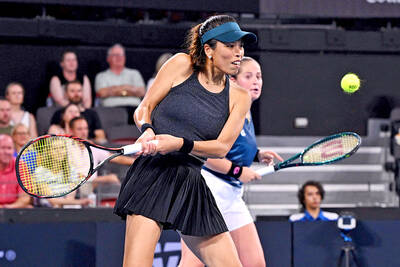
Taiwanese tennis star Hsieh Su-wei on Wednesday advanced to the second round of the mixed doubles at the French Open, after she and German partner Mark Wallner defeated Slovenian Andreja Klepac and Briton Lloyd Glasspool in straight sets, despite temperatures exceeding 32°C in Paris, while Taiwan’s top men’s doubles player Ray Ho also reached the second round. Hsieh, who made it to the semi-finals in the mixed doubles at Roland Garros in 2024, and Wallner defeated Klepac and Glasspool 6-3, 7-5 in just more than an hour, converting three of five break points, while holding their opponents to just one conversion


 RSS
RSS