


The ancient game of kho kho is enjoying a resurgence in India, with organizers of the first international tournament hoping their efforts would secure the sport’s place in the Olympics.
Kho kho, a catch-me-if-you-can tag sport, has been played for more than 2,000 years across southern Asia, but its rules were not formalized until the early 20th century.
It was played as a demonstration sport at the 1936 Olympics in Berlin, but did not gather enough support to be included in the Summer Games and since then has been largely eclipsed by India’s ferocious love of cricket.

Photo: AFP
Nearly a century later, enthusiasts have sought to raise its profile with the inaugural Kho Kho World Cup featuring teams from 23 nations competing in India’s capital, New Delhi.
The tournament’s opening ceremony featured a gala of song, dance and an Olympic-style team parade, reflecting the aspirations of organizers and athletes to take the sport global.
“My elder sister played the sport, but was not able to pursue her dreams,” Indian women’s team player Nasreen Shaikh, 26, said. “We have crossed the first barrier of playing in a World Cup. The next big step would be an entry in the Olympics.”
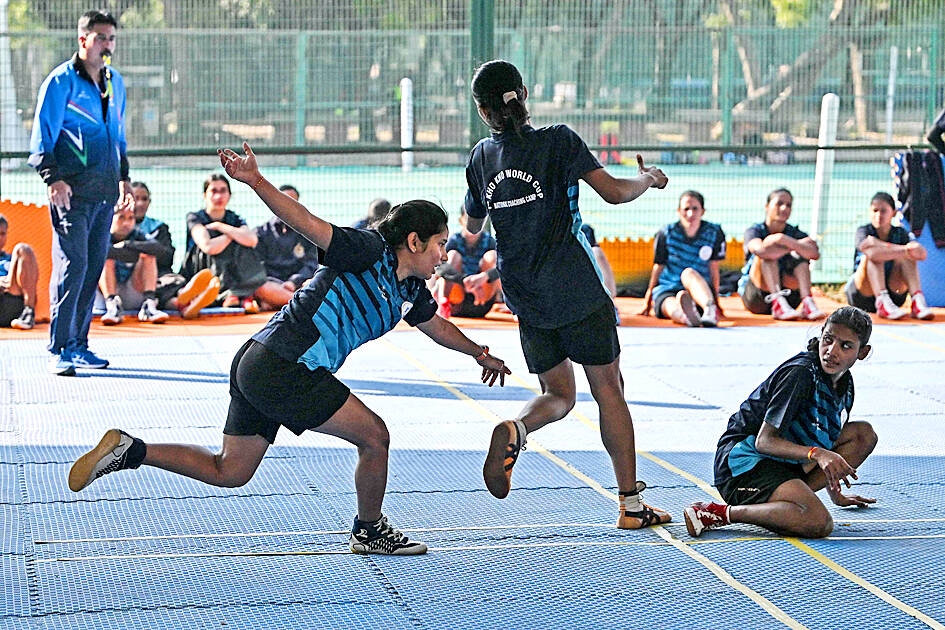
Photo: AFP
Kho kho is traditionally played outside on a rectangular court, divided in two by a line that connects two poles at either end of the field.
Teams switch between attack and defense, with the former chasing and tagging defending players around the field.
Only one player can give chase at a time and attacking players can only move in one direction around the court, forcing them to tag in teammates crouched on the center line to take over pursuit.
The match is won by whichever team can gain the most points, primarily by tagging defenders faster than the opposing team.
The franchise-based Ultimate Kho Kho League, founded in 2022, brought the sport off grassy fields and onto indoor mats, also boosting its profile with a television audience.
Since then the league has become the third most-watched non-cricket sports tournament in the world’s most populous country after the Pro Kabaddi League — another ancient Indian tag sport — and the Indian Super League soccer competition.
“The turning point was when it transitioned from mud to mat. It made it into a global game,” Kho Kho Federation of India president Sudhanshu Mittal said. “Today we are in 55 countries... Native players in countries like Germany, Brazil and Kenya are embracing the game because of its speed, agility and minimal equipment required.”
Mittal said he expected the sport to gain a foothold in dozens more countries by the end of the year, giving it a strong claim to be featured in the Olympics in the coming decade. That would coincide with India’s audacious bid to host the 2036 Games in Ahmedabad, 100 years after kho kho last appeared at the Olympics.
The US, England and Australia were among the nations competing in the World Cup, with expatriate Indians heavily represented after taking the game to foreign shores.
The men’s and women’s Indian and Nepalese teams were last night after press time to face off in their respective finals.
Pakistan was a glaring omission from the competition despite the sport being popular there — a reflection of the deep animosity between the nuclear-armed archrivals.
World Cup organizers have refused to comment on the absence, which failed to dim the sense of optimism at the competition that the sport is destined to thrive.
“There has been a sea change in the sport,” Indian men’s team captain Pratik Waikar, 32, said.
“Cricket has a rich history and they developed it well by going live on TV, and now our sport has also gone live,” he said. “In the next five years it will be on another level.”
Additional reporting by staff writer

When Paddy Dwyer arrived in China in 1976, crowds jostled to catch a glimpse of him and his companions — the first Western soccer team to play in the country. China was emerging from the chaos of the Cultural Revolution, and on the brink of market reforms that would take the country from economic stagnation to explosive growth. “All we could see was lines of people running beside our bus, trying to look in the windows, to see their first visual of a white person,” he said. “It was all bicycles,” he said. “There were very few cars to be seen.” Dwyer,

Jannik Sinner continued his quest to become the first man in history to win five Masters 1000 tournaments in a row with a 6-2, 6-3 victory over Danish qualifier Elmer Moller at the Madrid Open on Sunday. The world leader extended his winning streak to 19 matches, a run that began early March in Indian Wells, and he has captured 24 consecutive victories at the Masters 1000 level, dating back to the Paris Masters last October. Searching for a maiden title at this level on clay, Sinner advanced to the round of 16 at the Caja Magica with a 77-minute performance against

Some of Clearlake Capital Group’s largest investors are growing increasingly concerned about how much time the company’s co-founders are spending on sports investments as they have struggled to complete the fundraising for the private equity firm’s latest flagship fund. One of Clearlake’s co-founders, Behdad Eghbali, has been spending what some investors described as a disproportionate amount of time on the firm’s investment in Chelsea Football Club in recent months. Now, co-founder Jose E. Feliciano and his wife, Kwanza Jones, are nearing a record US$3.9 billion deal to acquire the San Diego Padres. That personal investment by Feliciano has set off the latest
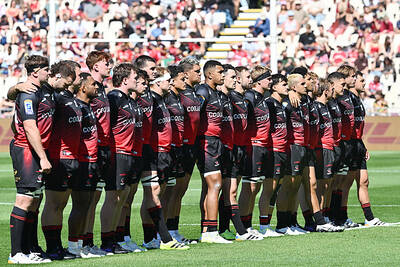
A new NZ$683 million (US$404 million) stadium that was a symbol of Christchurch’s struggle to rebuild after a deadly earthquake struck the New Zealand city is to host its first match tomorrow in front of a sellout crowd. A magnitude 6.2 earthquake killed 185 people in February 2011 and toppled or damaged buildings, including the city’s old Lancaster Park. The stadium, which hosted international rugby and cricket, and was home to the Canterbury Crusaders, was badly damaged and never reopened. It was bulldozed in 2019 and turned into sports fields, leaving the Crusaders without a permanent home. Government funding for a new stadium was


 RSS
RSS