


A debate over the soul of soccer is raging in FIFA World Cup holders Argentina, pitting defenders of the social role of the beautiful game against the government of libertarian Argentine President Javier Milei, who wants to turn clubs into for-profit companies.
Argentina, which gave the world Diego Maradona and Lionel Messi, is home to some of the world’s most devoted soccer fans — a fact attributed by supporters like Gabriel Nicosia to the clubs’ community outreach.
Nicosia is a lifelong supporter of San Lorenzo, a more than 100-year-old first division club based in the working-class Buenos Aires neighborhood of Boedo where he grew up.
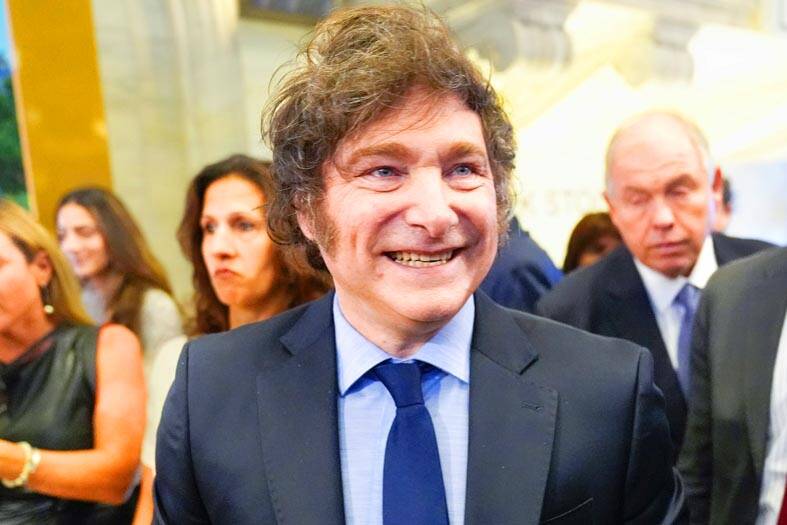
Photo: AP
Several times a week he crosses town to have a coffee or work out in the club of which Argentina-born Pope Francis is a fan.
“When I come here I meet my childhood friends. It’s a fundamental pillar of everyday life,” said the 50-year-old accountant, one of 80,000 members of a club whose stadium can only seat 48,000.
Membership can be acquired for a modest 22,000 pesos (US$22) a month and comes with a vote on the club’s management and tickets to local games.
The club’s role as the glue that binds the community is underscored by the 300 scholarships it awards each year to young people from a nearby shantytown.
The recipients get to indulge their own dreams of fame and fortune by hanging out close to the training grounds of millionaire players. Advocates of the not-for-profit model fear that this outreach could become a thing of the past if Milei manages to impose his free-marketeer vision on the clubs.
The president, an ardent defender of deregulation in all spheres of society, wants to change the statutes of the country’s several thousand soccer clubs to allow them to become privately owned for-profit companies.
During campaigning for president last year, Milei cited Buenos Aires’ famous Boca Juniors, of which he is a fan, saying: “No one cares who the owner is if you beat [arch-rivals] River Plate 5-0 and you win the [FIFA] Club World Cup.”
The alternative was to “live with the misery that is Argentine football, which is deteriorating by the day,” he said.
However, many Argentine clubs are firmly opposed to any change of ownership.
“Our club belongs to its people, its members and its partners who make it greater each day,” Boca Juniors said.
Argentine Football Association (AFA) president Claudio Tapia, who has one FIFA World Cup (2022) and two Copa America (2021, 2024) titles under his belt, has also made no secret of his opposition to the reforms.
It’s “not our football model,” Tapia, whose re-election to another four-year term last month was seen as a rebuke to Milei’s reform, told an AFA assembly in August.
The president, a self-described “anarcho-capitalist,” has forged ahead regardless.
In August, his government ordered the AFA to amend its statutes to allow for-profit clubs to join.
The decree was suspended by a court in September pending the outcome of a legal challenge by the AFA.
In Latin America, the pressure on clubs to open up to private investors is not unique to Argentina.
In 2021, Brazil changed its laws to allow for-profit clubs and Argentina’s neighbor Uruguay has also adopted the model.
Some clubs see outside investment as a way to grow, attract new talent and ensure their long-term viability.
Membership fees “are not enough” to cover a club’s costs, San Lorenzo director Martin Cigna said, adding that without TV rights and transfer fees, his club would be running “a million-dollar deficit.”
Former Argentina international Juan Sebastian Veron, who is president of another venerable club, Estudiantes, said they were preparing for a change to a “hybrid” model that would combine a “social” role with private funding.
The ball is still up in the air but tensions are rising between the AFA and Milei.
The president has vowed to investigate “irregularities” at the AFA, whose leadership he has compared to that of authoritarian Venezuelan President Nicolas Maduro.
However, for the moment, soccer fans are on the AFA’s side.
A poll carried out by sports think tank Tactica showed that 60.2 percent of Argentines interested in the sport opposed a change in the clubs’ ownership.

Home runs are greeted with a celebratory shot of espresso and the donning of an Armani jacket. Victories are marked with bottles of red wine while the soaring voice of opera singer Andrea Bocelli echoes through the locker room. Welcome to baseball, Italian-style. Written off as 80-1 underdogs before the World Baseball Classic started, Italy’s fairytale tournament has carried them all the way to today’s (Taipei time) semi-finals in Miami against Venezuela. On Saturday, Italy — who scored a stunning upset of a star-studded US lineup during the pool phase — kept their unbeaten campaign alive with a nail-biting 8-6

Jannik Sinner on Sunday beat Daniil Medvedev in the Indian Wells final 7-6 (6), 7-6 (4), winning seven straight points to rally from a 4-0 deficit in the second-set tiebreak and claim the title without dropping a single set. The No. 2-ranked Italian beat Medvedev for the ninth time in their last 10 matches to claim his first title at the California desert tournament. Medvedev handed top-seeded Carlos Alcaraz his first loss of the year in the semi-finals of the BNP Paribas Open. Sinner congratulated fellow Italian Kimi Antonelli, who won Formula One’s Chinese Grand Prix earlier on Sunday. “It
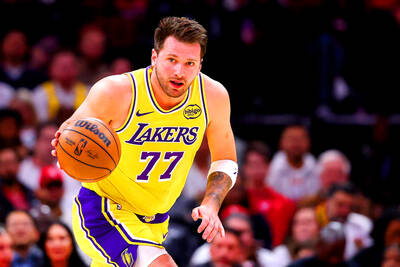
Luka Doncic on Monday scored 36 points as the in-form Los Angeles Lakers powered to their sixth straight victory with a 100-92 defeat of the Houston Rockets. A crucial showdown between the third and fourth-ranked NBA Western Conference teams ended with the Lakers pulling away in the final minute of the fourth quarter to claim an impressive win on the road. The victory gives the Lakers (43-25) a valuable cushion over the Rockets (41-26) as they jostle for post-season positions in the West. Doncic was once again instrumental in dragging the Lakers over the line while a hard-nosed defensive effort
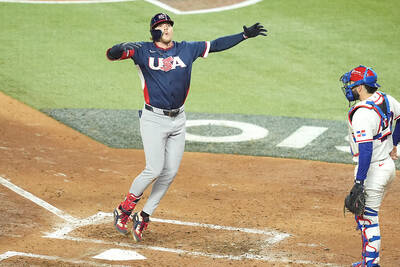
THRILLING GAME: The loaded US roster featuring Paul Skenes, Bryce Harper and Aaron Judge reached their third straight WBC final game, after 2017 and 2023 Gunnar Henderson and Roman Anthony on Sunday homered, and the US limited the Dominican Republic’s electric offense to win a thrilling semi-final 2-1 and move one win from capturing their second World Baseball Classic (WBC) championship. The loaded US roster led by NL Cy Young Award winner Paul Skenes and featuring stars Bryce Harper and Aaron Judge reached their third straight WBC title game after winning in 2017 and falling to Shohei Ohtani and Japan in 2023. The US are to face the winner of this morning’s (Taiwan time) semi-final between Italy and Venezuela a day later. The Dominicans reached


 RSS
RSS